
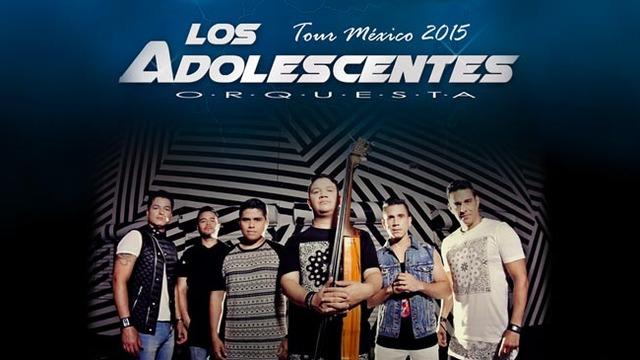
On tour
Every date the ticketer lists, worldwide · venue time
Listen
SoundCloud
The profile · researched 27 October 2026
Thirty-three years on from a demo tape, Adolescent's Orquesta is still a five-singer front line and a trombone wall
The Caracas salsa orchestra that put every track of a 1996 album at number one in Venezuela now tours with a fifth generation of vocalists drawn from five countries, playing US clubs and Mexican dinner shows while a rival outfit led by its founder plays the same songbook.
A demo tape handed to the right man
Víctor Porfirio Baloa Díaz — Porfi Baloa — was born in Caracas on 19 September 1970 and trained as a pianist and arranger at the city's conservatory. He had already lost one band before he built this one. In the early 1990s he put together Salserín with the producer Manuel Guerra, intending it as his own answer to Dimensión Latina; Guerra took the project to Puerto Rico and left Baloa out of it entirely, with no legal recourse.
The second attempt went differently because of a chance handover. In 1991, while working as a pianist in Celia Cruz's band, Baloa passed a demo tape to Luis Francisco Mendoza, known as El Negro, a businessman who heard something in it and put his money and his Korta Records operation behind the idea. The orchestra that resulted was founded in Caracas in 1993 and named for the ages of the people in it — most of the first intake were teenagers or barely out of them.
On 15 December 1993 the song that made the case, "Anhelo", went to radio with Wilmer Lozano singing lead. It crossed the continent quickly and took particularly hard in Miami, which set the pattern for everything that followed: a Venezuelan orchestra whose largest audiences have usually been somewhere other than Venezuela.
The records, and the chart ceiling they found
The debut album, Reclamando Nuestro Espacio, arrived in 1994 carrying "Anhelo", "Hoy Aprendí" and "No Puedo Ser Tu Amigo", and sent its singles to the top of Venezuelan radio repeatedly. The sound was fixed early and has not really moved: romantic salsa built on a brass front line of three trombones and a baritone saxophone, with several young voices trading leads rather than one star out front.
Persona Ideal followed in September 1996 and did something the Venezuelan industry had not seen before — every song on the record reached number one on the national charts. La Misma Pluma came in 1998 and was successful enough to spawn a television series off the back of it. Millenium Hits followed in 1999, Ahora Más Que Nunca in 2001 with "Virgen" and "Recuerdos" on it, then Búscame in 2005 and Indestructible in 2015.
The trophy cabinet is mostly regional rather than Anglophone: Mara de Oro, Meridiano de Oro, the Estrella de Oro in New York, an A.C.E. award from the New York critics' association and a Globo de Oro in the tropical category. Against that sit four Billboard Latin Music Award nominations, three Lo Nuestro nominations and a running total of some sixty number ones on Venezuelan charts. Streaming services still put "Virgen", "Persona Ideal (Me Tengo Que Ir)", "Anhelo" and "Aquel Lugar" at the top of the catalogue, which is a reasonable guide to what a crowd turns up expecting.
Two orchestras playing the same arrangements
The band's history is a sequence of walkouts, and the first was the worst. In 1997, with the orchestra at its commercial peak, negotiations between Mendoza and Baloa failed and most of the original line-up left in a block to form Pasión Juvenil. Mendoza rebuilt around César Monges, a trombonist who had come out of Grupo Niche, and brought in the vocalists Sócrates Cariaco, Juan Carlos Lobo and Jesús Alberto Ochoa. Cariaco later left to start Proyecto A; Néstor Rivero went around 2005; in 2020 Arnaldo Quintero departed with several vocalists and the bassist to found Los Embajadores de la Salsa.
The deeper fracture was between the two men who built it. Baloa and Mendoza eventually divided the orchestra itself, one faction going with each, and both continued to perform the same songs in the same arrangements — Baloa maintaining that he was the author of the original sound. The practical consequence is that the Spanish-speaking market has for years supported two touring entities with near-identical repertoires: Adolescent's Orquesta, which descends from the Mendoza side and is the act billed under that name, and Porfi Baloa y sus Adolescentes, which the founder leads himself. Listings, ticketing sites and streaming metadata do not always distinguish them cleanly, and buyers routinely have to read the small print to work out which band is on the stage.
The fifth generation
The current line-up has been in place since 2021 and the band calls it the fifth generation. The vocalists are Ángel Mejía, Álex Quintero, Andrés "Andy" Moreno, Rodrigo Silva and Ernesto Cabrera, and the group's own framing of itself has shifted from Venezuelan export to something pan-Latin: it describes the ensemble as drawn from five countries — Chile, Mexico, Venezuela, Colombia and Cuba — rather than from Caracas. Jimmy Rodríguez, the Mexican singer in the intake, left in 2024 to pursue a solo career.
New material has been thin but deliberate. "Mi Confesión" and a salsa remix of "Ella" came in 2023, with a video version of "Mi Confesión" featuring Cáceres in 2024. The most substantial recent release is "Nada Más", issued on 28 February 2025 — a heartbreak song written by the Venezuelan composer Mario Cáceres, whose credits include hits for Karol G. Speaking to Mexican press in April 2025 the band said it was working on further songs with the intention of releasing an EP or album, and Mejía put the ambition plainly: the aim is for the new songs to end up as classics in the repertoire alongside the old ones. No album has followed as of late October 2026, which leaves "Nada Más" as the newest thing in the set.
Mexico has become the group's most dependable market. Silva has said the Mexican audience turns up consistently every time the band visits, and the country now accounts for a disproportionate share of its theatre-scale bookings.
Where they stand now
The touring pattern through 2026 has been two distinct kinds of booking. In the United States the band works mid-size Latin nightclubs, event centres and free outdoor festivals: Mamazzita in Newark, New Jersey on 20 February 2026, Giggles Nightclub in Glendale, California on 21 August 2026, and the free Latino Vibe Festival in Manchester, New Hampshire on 12 September 2026, after a run through venues including Evolution Night Club in Sunnyvale, California on 25 October 2025. In Mexico the format is more formal and more expensive.
The most recent engagement was a dinner show with limited capacity in Cholula, Puebla on 23 October 2026, announced in August and built explicitly around the back catalogue — the band said at the time that its central objective was keeping the historic compositions from Reclamando Nuestro Espacio and La Misma Pluma alive. Next on sale is a date at Salón QD Venue in Westminster, California on 13 November.
That is the honest shape of the thing in 2026: an orchestra whose founder is not in it, whose singers were not born when its biggest record came out, and whose principal commercial asset is a set of songs from the mid-1990s that a Latin American audience spread across three continents still knows by heart. The band has not pretended otherwise, and the Puebla billing — classics first, "Nada Más" second — reflects it.
The show, now
A current show is a hits show, and the band is open about it: the repertoire is anchored on "Anhelo", "Hoy Aprendí", "Persona Ideal", "Aquel Lugar", "Virgen" and "Se Acabó el Amor", with the 2025 single "Nada Más" the only recent addition of any weight. Five vocalists — Ángel Mejía, Álex Quintero, Andrés Moreno, Rodrigo Silva and Ernesto Cabrera — share the leads rather than deferring to a frontman, over the trombone-and-baritone-sax brass wall that has defined the arrangements since 1994; the staging is the band itself, not production. The venue dictates the rest. US dates are club and event-centre bookings — Mamazzita in Newark on 20 February 2026, Giggles Nightclub in Glendale on 21 August 2026, Salón QD Venue in Westminster on 13 November — sold as dancing nights with no named support act on the listings, alongside free outdoor festival slots such as the Latino Vibe Festival in Manchester, New Hampshire on 12 September 2026. Mexican dates are seated and more deliberate: the 23 October 2026 engagement in Cholula, Puebla was staged as a limited-capacity dinner show, pitched on hearing the old songs at close range. No promoter or outlet publishes a running time or a fixed setlist, and the band's stated aim for these shows is simply to keep the material from Reclamando Nuestro Espacio and La Misma Pluma in working order.
Researched from es.wikipedia.org · infobae.com · unotv.com · periodistasunidos.com.mx · endirecto.mx · elespectador.com · songkick.com · ticketon.com