On tour
Every date the ticketer lists, worldwide · venue time
 TicketsMusic · GBMutations Festival 2026 - Saturday Day Ticket - Mike D + MoreVarious Brighton Venues · Brighton
Listen
Top tracks on Spotify · SoundCloud
The profile · researched 20 October 2026
Three days, no overdubs: Any Young Mechanic and the cheapest debut on Warner's books
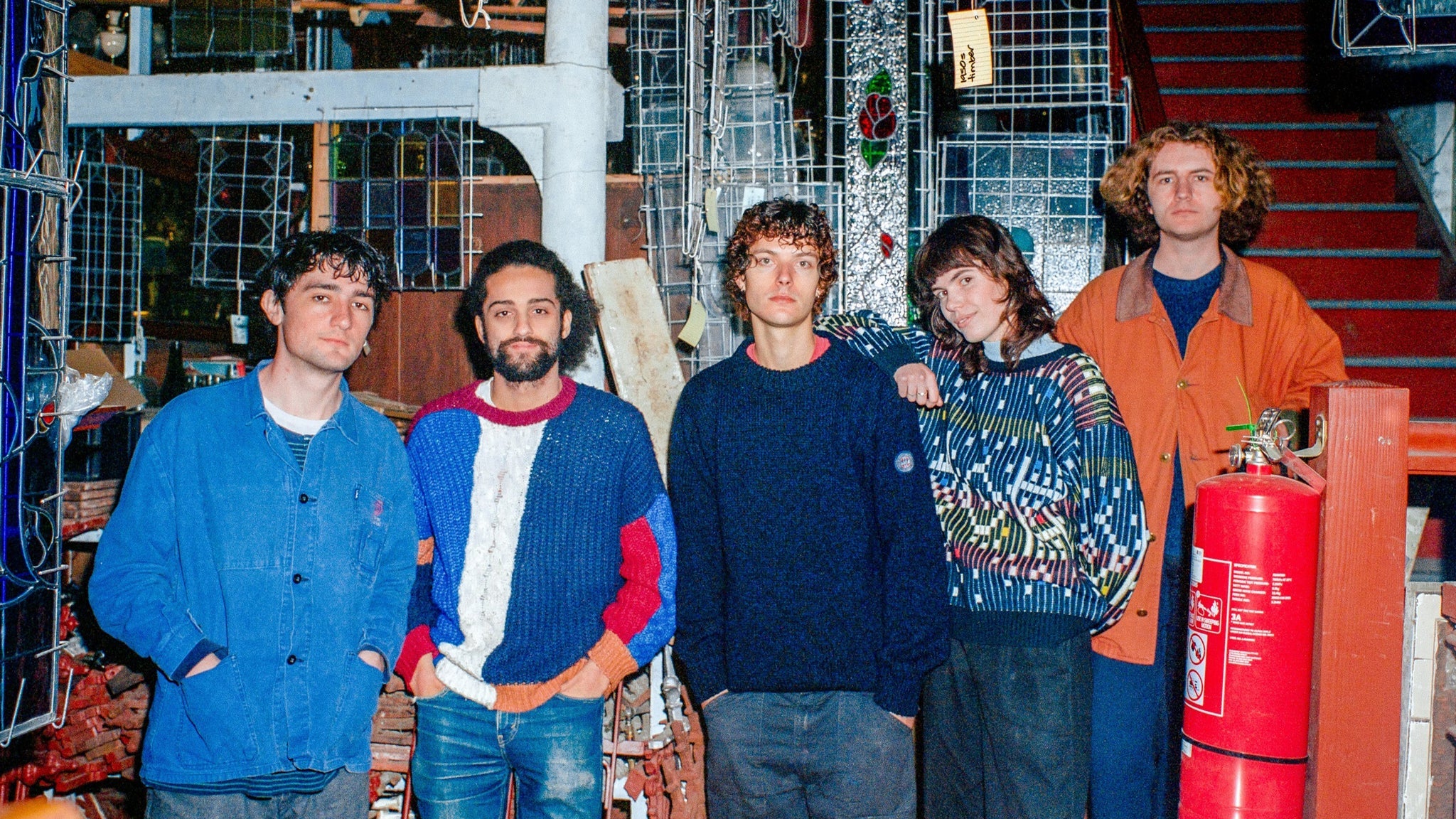
An Adelaide five-piece who recorded their first label album live to tape for about A$3,000 and sat on it for nearly three years. It came out on 5 June 2026, and they are in the middle of the European and British run that followed it.
A popular music module and a creative writing class
The band's two oldest relationships both start at university in Adelaide. Sam Wilson, who writes the songs and sings them, met the drummer Jay Eliot Mee in 2019 in a popular music module; the group's members studied at the University of Adelaide's Elder Conservatorium, which is where the shared appetite for pulling apart conventional arrangements came from. Thea Martin, a violinist with a classical background, came in sideways — Wilson knew her from a creative writing course, brought her in to track session parts over Zoom, and she became a full member in 2022.
The line-up closed in 2023, when Wilson saw the guitarist and banjo player Luka Kilgariff-Johnson and the double bassist Allan McBean playing and recruited both. That is the year the band proper dates from, formed inside Adelaide's DIY scene with British alternative records as much of the reference material as any folk canon. McBean's description of what the five of them produce together is the least mystical version available from the band: what emerges is 'a greater sixth thing which is beyond the five of us'.
They are based in Tarntanya/Adelaide and still describe themselves that way on festival bills, which matters commercially — almost every significant show of the past eighteen months has required a flight of twenty hours or more.
Grant money, Tokyo and a name they gave up
Before any of the current attention, the band ran on arts funding. The Helpmann Academy, a South Australian body that backs emerging artists, has put more than $79,000 behind them: a $3,000 grant in 2023 towards recording, mixing and mastering an album; a $10,000 fellowship the same year that paid for a tour to Tokyo; a $500 emergency grant to Martin in 2024; and, also in 2024, a place on the $45,000 Creative Innovator Program plus $20,000 in seed funding.
That period produced an album, Touch Hands Pack Sting, in 2023, and festival work at home including JaumaFest in South Australia. It also happened under a different name. The group previously operated as Wake in Fright and rebranded to Any Young Mechanic, which is why the back catalogue and the current press file do not line up neatly and why most coverage calls a second album a debut.
Wilson's statement of intent from the Helpmann case study is the clearest thing any of them has said about the music: 'We are trying to make folk music for now. Turning it on its head in a new, sometimes uncanny way, because we don't want to just do the old thing again.'
Three days, no overdubs
The Modern Shoe Is Ruining The Foot was rehearsed in Mee's bedroom over a couple of months and then recorded in a borrowed studio across three days, with Allan McBean joining as those rehearsals started. There are no overdubs and no stitched-together takes. There is also, by design, no amplification anywhere on the record — violin, banjo, double bass and guitar captured as played in a room. The total cost was around A$3,000, covered by grant money.
Wilson's reasoning was blunt: 'I thought we should make a record that is as human as possible.' Kilgariff-Johnson puts the consequence plainly — 'What you hear is what was played, flubs and all.' Wilson has gone further since, telling The Line of Best Fit that where he would once have patched over an audible mistake, 'now I just think: we're going to need more mistakes in music'.
The record was finished nearly three years before it came out. Signing to 23 Recordings, a Warner Records imprint, is what finally moved it, and the lag explains the odd quality of the release — a band whose live show has developed for three years releasing a document of who they were at the start of it.
What the twelve tracks are doing
The album runs to twelve tracks and is held together by discomfort about systems rather than by any folk-revival pose. 'There's A New Place On The Market', the second single, released on 13 February, came out of Adelaide's housing market and the displacement that goes with it, with Pavement audible in the slack of it. Elsewhere there are 'My House Divides', 'Captain And Compass', 'Write You Wrong', 'Bare The Brunt', 'Barn Burning', 'Every Time You Put Me Up, I Get Down Some New Way', 'I Never Met An Engine Don't Need Tanks', 'Pretty Strange World', 'Atlas, Here You Are' and the first single, 'Snug Barber'.
Mee frames the project as confrontational rather than consoling — 'We are always trying to make music that confronts the world' — while Wilson reduces the whole thing to one word: 'We're trying to make something sincere.' Mee's test for whether it has worked is modest. If someone walks away reminded to seek genuine human connection in their own life, that is enough.
Wilson's defence of the genre label is the band's sharpest line on why acoustic instruments and no amplification are not nostalgia: 'It's about folk as a tradition of empathy and community, and that's always radical.'
Standing, October 2026
The Modern Shoe Is Ruining The Foot arrived on 5 June 2026 through 23 Recordings and Warner Records. Music Republic Magazine's Fran Parry gave it four out of five, reading the arrangements as cinematic rather than pastoral and noting how far the band keep from the usual folk aesthetic while using its instruments. Brooks' Rainforest put it at 4.5 out of five among the month's records.
The live push came before the album, not after it. They played The Great Escape in Brighton on 15 May 2026, fitting three separate sets into 36 hours, then London club shows at the Shacklewell Arms on 31 May and the Elephant's Head on 2 June, with The George Tavern added to the London tally. Reading and Leeds and Rock en Seine in France came the year before, and 2026 also brought WOMADelaide and North American dates including Los Angeles and New York.
The gap between press and audience size is still wide. Their monthly Spotify figure sits at roughly 7,600 listeners, and the current headline rooms seat a few hundred at most. Martin's account of why Britain and Europe have become the priority is about reception rather than numbers: 'It feels like we don't have to try and convince people of what we're trying to do. It's just immediately understood.'
The autumn run
The current tour is six dates on sale across the Netherlands and Britain. It opened at Paradiso in Amsterdam on 20 October, takes in Left of the Dial in Rotterdam on 22 October — sold out, and with two sets on the same evening, at Barrio at 19:00 and Salsability at 23:00 — and is listed for Mutations in Brighton over 23 and 24 October. The British leg then runs The Chapel at The Angel in Nottingham on 26 October, the Deaf Institute in Manchester on 27 October, McChuills in Glasgow on 28 October and the Old Blue Last in London on 2 November, the Yorkshire and Lancashire dates presented by Futuresound.
Tickets are priced where a developing act's tickets are priced: £13.75 for Nottingham, £15.19 for the London closer. No support acts are advertised for any of the headline dates, which given the album's method is consistent — the record's whole argument is five people playing at once in one room, and the tour is the cheapest possible way to prove it.
Left of the Dial's billing calls the result irresistible jangly contemporary folk and reaches for Vampire Weekend, Violent Femmes and Of Monsters and Men as reference points, which covers the spread between the spiky end of the material and the wide-screen end.
The show, now
A show on the current run is a five-piece playing acoustic instruments in a small room, which is also exactly how the album was made — three days, no overdubs, no amplification by design. The set is drawn from the twelve tracks of The Modern Shoe Is Ruining The Foot, including 'There's A New Place On The Market', 'My House Divides', 'Captain And Compass' and 'Snug Barber', with Wilson on vocals and guitar, Martin on violin, Kilgariff-Johnson switching between guitar and banjo, McBean on double bass and Mee on drums and backing vocals. Staging is minimal; the selling point is ensemble playing rather than production, and the band's stated preference is to perform together rather than through any technological mediation. Capacity is club-sized — The Chapel at The Angel in Nottingham, the Deaf Institute in Manchester, McChuills in Glasgow, the Old Blue Last in London — with tickets between £13.75 and £15.19 and no support acts advertised on the headline dates. They are capable of a punishing turnaround: three sets inside 36 hours at The Great Escape on 15 May 2026, and two sets in one evening at Left of the Dial in Rotterdam on 22 October, at Barrio at 19:00 and Salsability at 23:00, a date that sold out. Reviews of the record that the set draws on have been strong — four out of five in Music Republic Magazine, 4.5 out of five from Brooks' Rainforest — and the band's own read on British and European audiences, from Thea Martin, is that the approach needs no explaining here: 'It feels like we don't have to try and convince people of what we're trying to do.'
Researched from helpmannacademy.com.au · nme.com · thelineofbestfit.com · atwoodmagazine.com · musicrepublicmagazine.com · musicmusingsandsuch.com · theaureview.com · leftofthedial.nl
Pictures
The ticketer's photographs