
Not on sale
We check the ticketer every hour
Listen
Top tracks on Spotify · SoundCloud
The profile · researched 25 October 2026
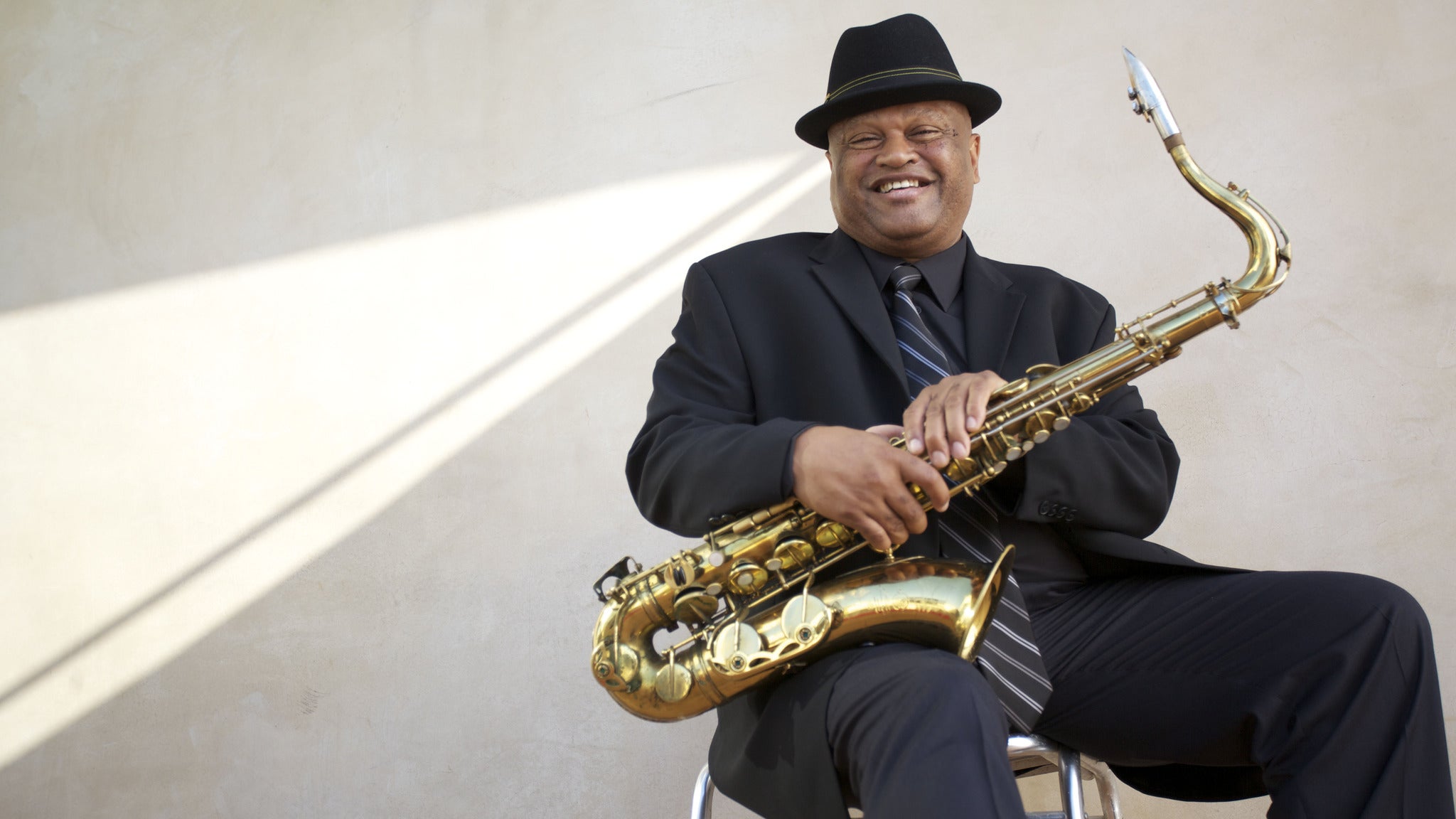
The tenor Miles Davis compared to Coltrane is now the one teaching the lineage
Azar Lawrence spent the 1970s inside McCoy Tyner's band, three Prestige albums of his own and a long stretch of session work before spiritual-jazz reissues pulled him back out front. At 73 he released Turn the Music Up in September 2026 and is touring two different bands either side of the Coltrane centenary.
A violinist from Los Angeles who heard Coltrane
Azar Lawrence was born in Los Angeles on 3 November 1952 and came to the saxophone sideways: he started as a violinist before switching instruments, and the switch stuck. The city he grew up in had its own apprenticeship system, and he went through it — as a teenager he played in Horace Tapscott's Pan Afrikan Peoples Arkestra, the self-organised Los Angeles collective that functioned as a conservatory for players the industry had no interest in developing.
Before he was out of his teens he was also working the other side of Los Angeles music, the paid side: dates with War, the Watts 103rd Street Band and Ike and Tina Turner. That double training — the Arkestra's long-form, spiritually framed music on one hand, functional rhythm-section work on the other — explains a lot about a discography that never settled into one lane.
Elvin Jones made the call, McCoy Tyner took it
In 1972 Lawrence joined drummer Elvin Jones's band, replacing Dave Liebman, and moved to New York. Jones had been Coltrane's drummer; Lawrence was barely twenty and had walked straight into the engine room of that music. Jones then recommended him to McCoy Tyner, Coltrane's pianist, and the sequence of records that followed is the reason Lawrence's name carries weight in this repertoire at all.
Between 1973 and 1974 he recorded Enlightenment, Sama Layuca and Atlantis with Tyner — the tenor chair in the band Tyner built after Coltrane's death. He also turned up on Miles Davis's Dark Magus, cut in 1974 and released in 1977. Davis's assessment of him, which Lawrence has repeated in interviews, was blunt: he had not heard tenor saxophone like that since John Coltrane.
It is a comparison that has followed Lawrence for fifty years and which he has had to work around rather than lean on. JazzTimes has credited him with sculpting that Coltrane-oriented material into the mosaic of his own mature artistry, which is a fairer description of what he actually does than any family-tree diagram.
Three Prestige albums, then two decades in other people's records
Prestige signed him as a leader and he delivered three albums in three years. Bridge Into The New Age (1974) used a large ensemble including Woody Shaw and Billy Hart. Summer Solstice (1975), produced by Orrin Keepnews, brought in Brazilian percussion and the guitarist and composer Amaury Tristão. People Moving (1976) went further towards funk and R&B, with Patrice Rushen and Lee Ritenour on the session.
Then the leader career stopped and the sideman career expanded. Lawrence played on Marvin Gaye's Here, My Dear and Earth, Wind & Fire's Powerlight, and recorded with Freddie Hubbard, Pharoah Sanders, Jaco Pastorius, Roberta Flack, Phyllis Hyman and, later, Busta Rhymes. By the count his own management uses, he has thirteen albums as a leader across the whole span — a small number for fifty years, and a consequence of how those middle decades went.
The reissue economy brought him back
The route back was the one that has reopened a good number of 1970s spiritual-jazz careers: reissues. The Prestige records found an audience that had not been born when they were made, Kendrick Lamar among the listeners who picked them up, and Lawrence restarted as a leader with Legacy & Music of John Coltrane in 2007, carrying on through to New Sky in 2022.
Institutional recognition arrived late and then arrived at once. Since 2024 he has taught in UCLA's Global Jazz Studies programme. He was named a City of Los Angeles Independent Master Artist Project fellow for 2024/25 — a $10,000 grant from the city's Department of Cultural Affairs, with the commissioned work premiered through the Los Angeles Municipal Art Gallery in spring 2025 and Grand Performances in the summer. His COLA award performance went up at Grand Performances on 27 June 2025.
Turn the Music Up, September 2026
The new album came out on 25 September 2026 on Trazar Records, recorded at Earthstar Creation Center in Venice, California and mastered by Bernie Grundman. The premise is a rebuild rather than a new book: Lawrence takes material from Bridge Into The New Age and Summer Solstice and re-records it with his current band. The seven tracks are Highway, Novo Ano, Atlantis, Lost Tribes Of Lemuria, The Creator Has A Master Plan, Fatisha and Summer Solstice — two Amaury Tristão compositions, Tyner's Atlantis, the Pharoah Sanders and Leon Thomas piece, and three of his own.
The band is The Azar Lawrence Experience: Brian Swartz on trumpet, Taka Mori on guitar, Robert Turner on keyboards, Gerald Brown on bass, Yayo Morales on drums and Lynne Fiddmont on vocals, with Quinn Carson, Munyungo Jackson, David Leach and Adam Moseley guesting. Lawrence has described the line-up as the end of a long filtering process — musicians sieved through over the years and brought to a state of refinement.
Reviews have been warm with the same reservation in both. Jim Hynes in Glide Magazine praised the intensity and the Brazilian-tinted opening tracks and singled out the ballad Fatisha, but noted the septet's sheer power leaves the music less room to breathe than the originals had; his advice was to set 1974 aside and take it as contemporary large-ensemble jazz. Andy Hamilton, writing in Jazz Journal on 8 October 2026, found the music delightful while objecting to the scatting and to the fade-out on Atlantis, and landed on "maybe not Azar Lawrence's greatest work, but very worthwhile". A release and listening party followed at Anthony's Place in Long Beach on 12 October 2026.
Two bands, two completely different rooms
Lawrence currently tours in three configurations and they are not interchangeable. The bulk of the calendar goes to The Cookers, the co-operative septet of Eddie Henderson and David Weiss on trumpets, Donald Harrison on alto, George Cables, Cecil McBee and Billy Hart, where Lawrence holds the tenor and soprano chair. That band ran a long North American stretch from 30 January to 7 February 2026 through Detroit, Denver, Minneapolis, Seattle, Oakland and Los Angeles, played Dizzy's Club in New York from 19 to 22 February, Williamstown in September, A Place for Jazz in Schenectady on 16 October and a week at Smoke in New York from 21 to 26 October 2026.
The second configuration is the acoustic quartet, which exists to play Coltrane in the composer's centenary year. It appeared at Jamboree in Barcelona on 22 July 2026 under the title The Azar Lawrence Quartet Salutes John Coltrane: The Impulse Era — a 7pm start, €35, sold out, with Benito Gonzalez on piano, Ray Ferrer on bass and Brandon Lee on drums — then at Jazzaldia in San Sebastián on 24 July, and at Detroit Celebrates Coltrane 100 on 20 September. It returns to Dazzle in Denver on 10 December 2026 as "Culminating Coltrane", with Eric Gunnison, Seth Lewis and Alejandro Castano.
The third is the septet, which is where the new record lives. Ahead: The World Stage in Leimert Park on 4 December 2026, then an Elvin Jones centenary celebration on 6 February 2027, a Jazz at Lincoln Center run from 18 to 21 February 2027, Jazz Nad Odrą in Wrocław in late April and New Orleans Jazz & Heritage from 29 April to 2 May 2027.
The show, now
The septet show built around Turn the Music Up runs as a single long sitting rather than two club sets: the 8 November 2026 date at the Bach Dancing & Dynamite Society in Half Moon Bay is scheduled 4.30pm to 7pm, at $60 advance or $50 on the door, with students 25 and under at $23 and $12. The full Experience line-up travels — Lynne Fiddmont on vocals, Brian Swartz on trumpet, Taka Mori on guitar, Robert Turner on piano, Gerald Brown on bass and Yayo Morales on drums — and the material is the new album's book: the two Amaury Tristão sambas, Tyner's Atlantis, The Creator Has A Master Plan, the ballad Fatisha and Summer Solstice itself. Staging is plain, no support act on the club and society dates; the volume is the point, and both published reviews of the record flag the septet's density as the thing that divides listeners who came for 1974. The quartet shows are the opposite proposition: a straight piano-bass-drums Coltrane programme, 8.30pm at Dazzle in Denver on 10 December 2026, with Eric Gunnison, Seth Lewis and Alejandro Castano, pitched by the venue as exploratory rather than a recreation. The Cookers dates, which take up most of the year, are shared-front-line hard bop with Freddie Hubbard's The Core a recurring set item.
Researched from en.wikipedia.org · azarlawrence.com · thetonearm.com · udiscovermusic.com · glidemagazine.com · jazzjournal.co.uk · jamboreejazz.com · visithalfmoonbay.org
Pictures
Photographs from Wikimedia Commons, credited
 Schorle · CC BY-SA 4.0
