
Not on sale
We check the ticketer every hour
Listen
SoundCloud
The profile · researched 5 October 2026
Fifty years of samba doido, now carried by one man and two hired hands
Azymuth have outlived two thirds of their founding trio and most of the scenes that adopted them. Bassist Alex Malheiros, the last original member, is halfway through a European tour behind Marca Passo, the band's first album since drummer Ivan Conti died in 2023.
Three session players and a borrowed title
The group that became Azymuth started working together in Rio de Janeiro in 1968 under the name Grupo Projeto 3. José Roberto Bertrami played keyboards, Alex Malheiros played bass and guitars, and Ivan Conti played drums and percussion. All three were jobbing studio musicians in a city with a great deal of studio work, and they spent the late sixties and early seventies on other people's records — most consequentially with Marcos Valle, whose own catalogue they helped shape.
The name came from Valle too. Azymuth is one of his compositions, and he gave the trio permission to take it. They formalised themselves as a band in 1973 and put out their first album, Azimuth, on Som Livre in 1975, following it with a second for the same label before 1977 was out. What they were doing had no obvious category: samba rhythm sections running under electric piano and synthesiser, with the harmonic looseness of jazz and the weight of American funk. The shorthand the band and its audience settled on was samba doido — mad samba — and it has stuck for five decades because nothing more precise has turned up.
Jazz Carnival and the Milestone decade
In 1979 Azymuth signed to Milestone, the American jazz label, and released Light as a Feather. The album produced Jazz Carnival, which crossed over in a way almost nothing from the Brazilian instrumental scene managed: it reached number 19 on the UK singles chart in January 1980 and, by the band's own account, sold more than half a million copies internationally. It remains the only Azymuth track most casual listeners can name, and it is still the song that ends their concerts.
The Milestone years ran from 1979 to 1988 and were the most prolific of the band's life, with Outubro arriving in 1980 and a long run of records behind it. The trio never broke up in that period and never substantially changed shape. Bertrami's keyboard voice — Rhodes, Prophet, vocoder — was as much the band's signature as the rhythm section, and the three-way split of writing credits kept the material varied enough that the records do not blur into one another.
London adopts them twice
Azymuth's second life was a British invention. The acid jazz movement in London in the early nineties went looking for exactly the kind of record Milestone had been quietly issuing a decade earlier, and the band found themselves with a new audience several thousand miles from Rio. From the mid-nineties onwards their home has been Far Out Recordings, the London label that has handled their new albums, their reissues and their archive ever since.
The sampling followed. MF DOOM and Flying Lotus both built tracks on Azymuth recordings, which pulled the catalogue into hip-hop and beat-scene listening habits that had nothing to do with jazz radio. The band have worked directly with Madlib and Jazzanova, and their material has been remixed by Theo Parrish and by Daniel Maunick, who has since become their producer.
New studio records came at long intervals. Aurora arrived in 2011, Fênix in 2016, and in 2019 Far Out released Demos 1973–1975, a set of recordings from the band's first two years that had never been issued. The reissue programme has kept the back catalogue in print continuously, which is why a band whose commercial peak was in 1980 can still fill a 900-seat London church.
Two deaths and a trio that kept going
Bertrami died on 8 July 2012, aged 66. Malheiros and Conti carried on, and in 2015 Kiko Continentino took the keyboard chair. That configuration held for eight years and made Fênix.
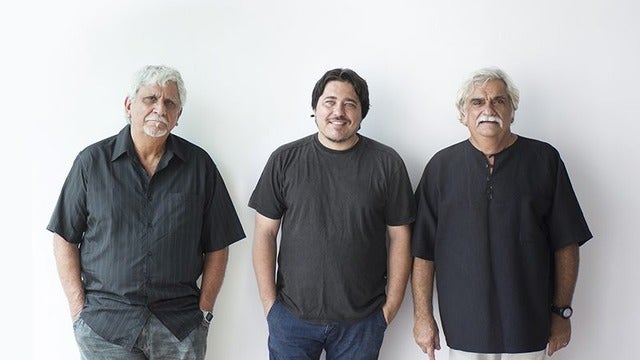
Conti died on 17 April 2023. He had been the band's drummer for half a century and was known universally as Mamão. Roughly two months after his death, Renato Calmon — Massa — took over the drum stool. That left Malheiros as the only founder still playing, and he has been explicit that holding the band together is now the point of it rather than a sentimental extra.
The keyboard position has moved again since. Marca Passo was recorded with Continentino on keyboards, organ, vocoder and voice, but recent concert listings for the current tour name Dudu Viana on keys alongside Malheiros and Calmon. The band has not issued a statement about the change, and both players have credits with the group, so the safest description of Azymuth in late 2026 is a trio led by Malheiros with Calmon on drums and a keyboard chair that is no longer fixed.
Marca Passo, and the year it took to get it on the road
Marca Passo came out on 6 June 2025 on Far Out Recordings, recorded in Rio de Janeiro and produced by Daniel Maunick, who also produced Aurora and Fênix. It was the band's first full-length since Conti's death and arrived fifty years after the 1975 debut, a coincidence the label leaned on in the press material. Ten tracks, two of them explicitly commemorative: Samba Pro Mamão for Conti, and Last Summer in Rio — at eight and a half minutes the longest thing on the record — for Bertrami, with Jean Paul Bluey Maunick of Incognito playing electric guitar on it. Sidinho Moreira and Ian Moreira handle percussion, and José Carlos Bigorna adds soprano saxophone to Samba Pro Mamão.
The touring did not go smoothly. A North American run of nine dates from 20 to 29 June 2025 took in St Paul, Chicago, Toronto and New York. The Australian and Asian dates announced for late October and early November 2025 did not go ahead. Tokyo was rebooked, and the band played WWW X in Shibuya on 28 August 2026 with Malheiros's daughter Sabrina Malheiros singing and DJ Masaki Tamura opening — a billing the promoter described as a parent-and-child collaboration. Seoul, at Musinsa Garage, had come three days earlier on 25 August.
The European leg began in Lisbon at Casa Capitão on 26 September 2026, followed by Casa da Música in Porto on 27 September and La Nau in Barcelona on 29 September. Thirteen more shows run to the end of October across eight countries: Amsterdam, Rotterdam, Berlin, St Leonards, London, Paris, Hamburg, Basel, Gdańsk, Ixelles, Rome and Milan.
Where they stand
Azymuth in October 2026 are a working band with a current record, a full European routing and a steady line of billing from mid-size venues: Melkweg's ROOTS series in Amsterdam, a jazz festival slot in Hamburg, a Monday night at Union Chapel. Ticket prices sit around €25 to €31, which places them somewhere between a club act and a concert-hall act — and the venues reflect that, swinging between the Lido in Berlin and Sala 2 at Casa da Música.
What has changed since 2023 is the band's relationship to its own catalogue. With both of the other founders gone, the Milestone-era material is now performed by one man who wrote part of it and two musicians who learned it. Marca Passo was the test of whether that still produces Azymuth records rather than tribute records, and the set lists suggest the band's own answer: four of the thirteen songs they are playing nightly are from the new album, and Jazz Carnival is still held back until the encore.
The show, now
The current show runs long by jazz-club standards: Casa da Música scheduled Azymuth from 21:20 to 23:30 in Porto on 27 September 2026, with DJ Farofa playing from 20:30 beforehand, and Union Chapel in London on 12 October has doors at 19:00 and a 22:30 curfew. The 2026 set averages thirteen songs — eleven in the main set, two in the encore — and has barely shifted city to city. It opens with Marrocos Club and Villa Mariana (De tarde), moves through May I Have This Dance?, Broken Key, Last Summer in Rio and Águia não come mosca, drops into Partido Alto and a cover of Sabrina Malheiros's Terra de Ninguém, then hands the stage to the percussion piece Tamborim, cuíca, ganzá, berimbau before Dear Limmertz closes the main set. The encore is always the same two: Jazz Carnival, then Voo Sobre o Horizonte. Support is typically a DJ rather than a band — DJ Farofa in Porto, DJ Masaki Tamura in Tokyo — and several rooms on this leg are seated and unreserved, Union Chapel included, which puts the emphasis on the playing rather than on staging; there is no production beyond lights. The Asian dates in August 2026 were the exception, built around a guest spot from Sabrina Malheiros. Fan documentation on setlist.fm runs to 94 logged attendances from 78 users, and the consistency of those logs is itself the most reliable thing about the show: the running order barely moves, and the hit is never played early.
Researched from en.wikipedia.org · azymuth.bandcamp.com · progressiverockcentral.com · setlist.fm · setlist.fm · songkick.com · unionchapel.org.uk · casadamusica.com
Pictures
Photographs from Wikimedia Commons, credited
 Radio Boise KRBX · CC BY 3.0
 deepskyobject from Saint Petersburg, Russia · CC BY 2.0

