
Arts & Theatre · Fine Art · Fine Art
Collezione Gori - Visitare il parco attraverso la poesia
2 dates on sale · on Ticketmaster
On tour
Every date the ticketer lists, worldwide · venue time
The profile · researched 8 September 2026
Walking Celle by ear: the Gori Collection's poetry route through a 45-hectare art park
The Gori Collection at Fattoria di Celle, outside Pistoia, has commissioned site-specific art in its park since 1982. Its poetry visit takes guided groups into the quieter corners of the estate with the recorded voices of the poets who have written there since 2018, two years after founder Giuliano Gori's death and one season after the restored Italian garden reopened.
A textile collector moves his art to a farm
Giuliano Gori was born in Prato in 1930 and made his money in textiles. He and his wife Pina Taddei began buying contemporary art in the years after the war, and by the 1950s and 1960s their holdings were regarded as among the most current in Italy. A 1961 trip to Barcelona's Catalan art museum, where he saw works displayed inside the architecture they were made for, gave him the idea that would define the rest of his life: art that treats its setting as part of the work rather than a container for it.
In spring 1970 the family moved out of a palazzo in central Prato to the Fattoria di Celle at Santomato, a villa and farm on the hills between Pistoia and Prato. The estate came with a Romantic-era park and a formal garden laid out by the Fabroni family in the 17th and 18th centuries. From the early 1970s Gori invited artists to live on the property and make something for a specific spot in it, which he then kept in place for good.
The public first got in on 12 June 1982. Eighteen works were inaugurated that day, ten in the park and eight in the historic buildings, by artists including Alice Aycock, Richard Serra, Robert Morris, Dani Karavan, Fausto Melotti, Giuseppe Penone and Michelangelo Pistoletto. Gori liked to say that collecting meant taking part in a work's birth rather than owning it, and the house rule he borrowed from the writer Carlo Belli was that the rights of art begin where those of nature end.
The works that made the place
Celle is a permanent collection with no rotating exhibitions. Each piece was made for one location and is expected to change with the seasons rather than be moved. Robert Morris built his Labyrinth in the park in 1982 and called it his last minimalist work. Richard Serra made his first sculpture in stone here. Over the following decades the list grew to include Daniel Buren, Alberto Burri, Magdalena Abakanowicz, Dennis Oppenheim, Mauro Staccioli, Sol LeWitt, Jean-Michel Folon, Enrico Castellani, Hidetoshi Nagasawa and Anne and Patrick Poirier. By 2025 the estate held more than eighty site-specific works spread across roughly 45 hectares of woodland, meadow and farm buildings.
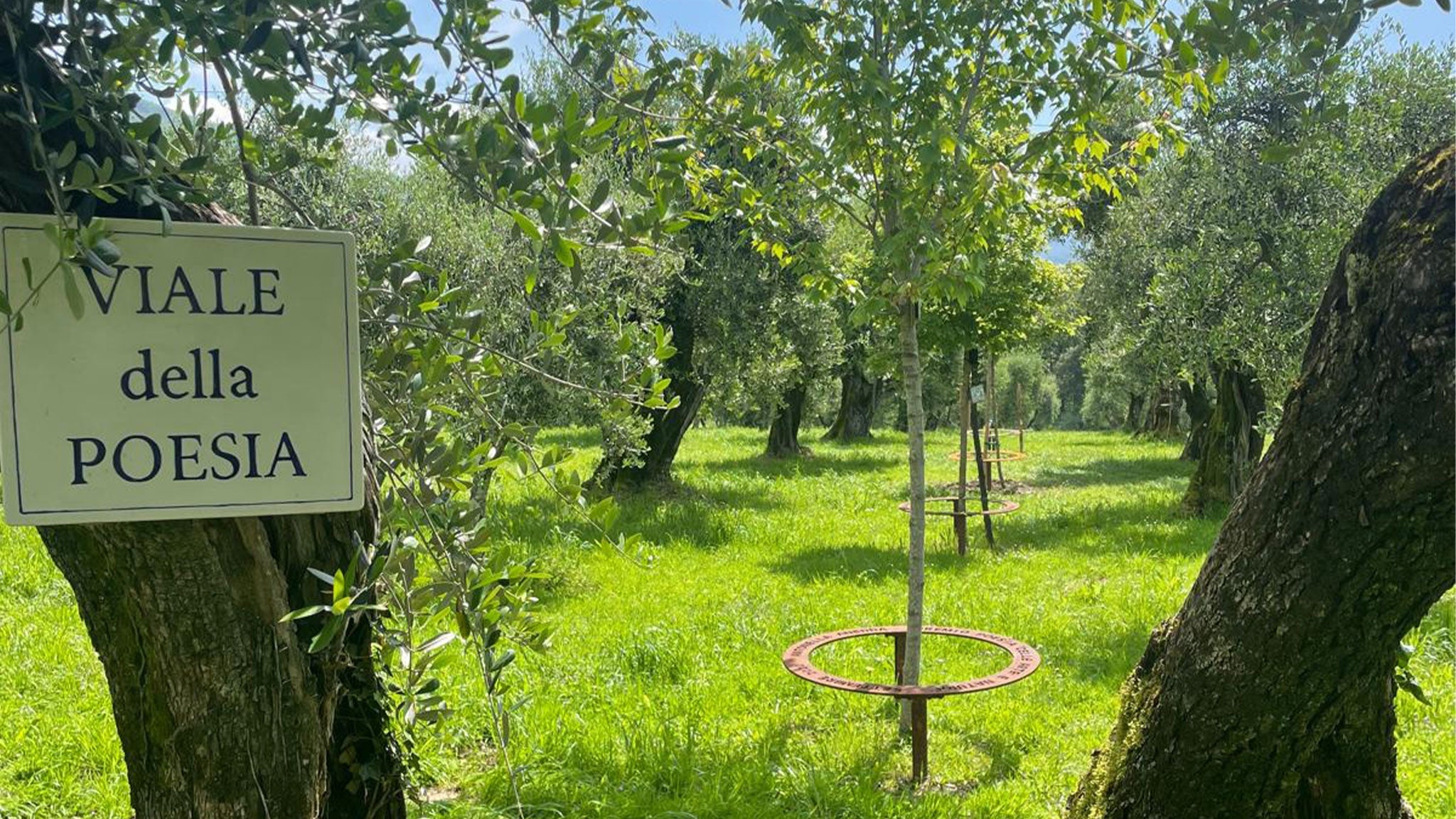
The piece that matters most for the poetry route is the Serra dei Poeti, opened on 24 March 2018 and counted at the time as the collection's eightieth work. It was made by the landscape designer and musician Andrea Mati with the writer and architect Sandro Veronesi. Thirty cypresses run in converging rows towards a steel-and-glass greenhouse, each tree dedicated to a poet from the Italian tradition. Inside, the greenhouse raises seedlings of plants that appear in the poems of Guido Gozzano, Eugenio Montale, Giacomo Leopardi and Giosuè Carducci. Mati described the aim as helping a person crossing the space to search for a place, real or imagined, with the help of the arts.
The collection kept adding through its fifth decade. When the Espoarte magazine marked forty years of public opening in 2022, it noted two new installations that year, Vittorio Corsini's La somma del tutto and Federico Gori's Estinti, and framed the whole enterprise as a kind of environmental poetry set against the monumental land art of the American West.
Poetry becomes the park's second language
Poetry was written into Celle's founding idea, and in 2019 the family gave it a formal structure with the Premio Celle Arte Natura. The prize is biennial and comes with a creative residency on the estate. Verses written during the stay are published by the Pistoia house Gli Ori in a limited art-and-poetry edition, and each winner chooses a plant to be set near the Serra dei Poeti as a permanent marker of their time there.
The first edition went to Antonella Anedda, who worked alongside the artist Christiane Löhr; the resulting book was printed in 99 copies. The second went to Giuseppe Conte, paired with the photographer Luca Gilli. The third was awarded unanimously to the Friulian poet and novelist Gian Mario Villalta by a jury chaired by Paolo Gori and including Sandro Veronesi, Andrea Mati, Antonio Franchini, Silvio Perrella and Antonio Riccardi. Paolo Gori said Villalta was chosen for his sensitivity towards nature, both vegetable and human.
Those residencies produced the sound material for the poetry visit. The estate records the poets reading in Italian, and the route was built so that visitors hear those voices at the points in the park where the writing happened. The collection's own description says the format is meant to reach the least explored areas of the grounds, with the guide telling stories about how individual works came to be and how the artists went about them.
After Giuliano: a garden reopened
Giuliano Gori died in Prato in January 2024, in his nineties, after more than fifty years at Celle. His children now run the collection through the Fondazione Gori Celle, and the stated task is to balance preservation of what he assembled with keeping the place alive as a working site for artists and writers.
The first big project completed under the new stewardship was the restoration of the formal Italian garden in front of the villa. The work took three years and was financed through Italy's PNRR recovery fund under its programme for historic parks and gardens. It repaired hydrogeological damage to the 17th-century layout of boxwood hedges, lemon espaliers, mosaics and wrought-iron gates, drawing on Ignazio Fabroni's sketches from the 1660s, and included a digital census of every plant in the 19th-century park. New routes were laid out with explanatory panels made from recycled wood by Rilegno, and the old pomarium, the estate's fruit orchard, was brought back at the same time.
The garden reopened on 8 June 2025 with a guided walk led by the agronomist Simona Giorgini and a baroque concert by the ensemble I fiori armonici at six in the evening; the regional president Eugenio Giani attended. An area that had never been open to the public became part of the visitor offer, as a two-hour route through the green architecture and the environmental works around it. In October 2025 The Weekend Magazine described the result as restoring harmony and stability to a part of the estate that time had worn down.
What the poetry walk is like now
The 2026 season runs from 1 April to 31 October with a break for the whole of August. Everything is by reservation. The estate offers three formats: the standard tour of the site-specific collection and the Italian garden, which lasts about three hours and is described by the collection itself as a challenging walk; a shorter afternoon walk with a tasting of the farm's wine and olive oil on Saturdays at four; and the poetry visit.
The poetry visit is listed at about three hours and, unlike the standard tour, is explicitly not a demanding walk. It runs on Saturday mornings, shown on the experiences page as the first Saturday of each month at eleven, and is booked through Ticketmaster or by email to the collection. Visitors are told to bring earbuds or headphones for the recordings, with devices available on site for those without. Groups are mixed, so individuals share a slot with other bookers, the whole route must be completed, and anyone more than fifteen minutes late is not admitted. Parties of ten or more are asked to write to the visits office first. In bad weather the visit moves indoors to the works in the buildings.
Independent visitor reviews collected by WhichMuseum in 2026 describe the estate as peaceful and the works as thoughtfully placed, praise the guides for the context they give on each artist, and warn about a lot of walking on uneven terrain and the need for comfortable shoes. The same reviews call the appointment-only system both exclusive and restrictive, and note that the collection will mean less to anyone who has no interest in contemporary art.
The show, now
The poetry visit is a guided walk of about three hours through the less-visited parts of the Celle park, with the guide telling how the works were made while visitors listen on their own earbuds to recordings of the Italian poets who have lived and written on the estate since 2018. The collection lists it on Saturday mornings, on the experiences page as the first Saturday of the month at eleven, bookable through Ticketmaster within a 2026 season that runs from 1 April to 31 October with August closed. It is sold as a gentler route than the standard three-hour tour, groups are mixed and must finish the whole circuit, latecomers beyond fifteen minutes are turned away, and rain moves the visit to the works inside the buildings. Recent visitor reviews praise the guides and the placing of the works but warn about uneven ground and the strictness of appointment-only entry.
Researched from goricoll.it · goricoll.it · goricoll.it · goricoll.it · artribune.com · theweekendmagazine.it · finestresullarte.info · espoarte.net