On tour
Every date the ticketer lists, worldwide · venue time
 TicketsMusic · USFreestyle Free For AllHard Rock Live at Etess Arena · Atlantic City
 Tickets
Listen
SoundCloud
The profile · researched 19 October 2026
Short slots, long memory: Coro and the freestyle package circuit
A New York Latin freestyle singer whose three-year run of dance-chart singles ended in 1993 and whose working life since has been the round stages and multi-act bills of the north-east revival circuit — four of them booked between now and March 2027.
Miami Vice, then Stevie B, then a record
Coro arrived in music sideways. Before any release of his own he turned up in episodes of Miami Vice, the television show that did more than any record label to fix the sound and look of late-1980s Florida in the public mind. The acting did not become the career. Born in New York City to Cuban and Dominican parents, he took a job in 1987 as a backup vocalist and dancer on tour with Stevie B, then one of the larger names in the freestyle boom, and treated it as an apprenticeship. By the end of that run he had moved back to Manhattan to try a solo record.
The timing was close to ideal. Freestyle — Latin and Italian-American New York dance pop built on drum machines, minor-key keyboard hooks and vocals pitched between soul singing and teenage melodrama — was at its commercial peak in the New York and Miami club markets. In 1989 he began working with the producers Zahid Tariq and Todd Terry, the latter already central to the city's house underground. What came out of those sessions was not a crossover attempt. It was a club record aimed at rooms that were already playing the genre.
Four titles that still carry the set
'Where Are You Tonight' went out in 1989 and worked where it was aimed: New York and Miami floors first, then the trade charts, where it reached No. 25 on Billboard's Hot Dance Music/Maxi-Singles Sales listing. 'Can't Let You Go' followed in 1990 and did better, peaking at No. 18 on the same chart.
The self-titled debut album arrived on 5 March 1991 — ten tracks, 43 minutes and 54 seconds, produced by Zahid Tariq and Hector Gonzalez, and split between uptempo material and ballads, of which 'Missing You' is the clearest example of the second mode. It reached No. 10 on Billboard's regional Heatseekers listing for the Northeast, a placing that describes his market precisely. AllMusic rated it three stars out of five.
The third single was the one that got out of the clubs. 'My Fallen Angel', released in 1991, took No. 25 on the dance sales chart and crossed to No. 54 on the Hot 100 — on the available listings, his only entry there. 'Stand by Your Lover' followed in 1993. Those four titles are still the spine of what he performs three decades later.
A career with a thin paper trail
It is worth being plain about how little of the middle period is documented. Wikipedia's article on the singer names Cutting Records as the home of the 1991 album; its separate article on the album names Charisma Records. Both pages carry verification warnings, and neither resolves the other. For an artist whose records sold through 12-inch singles into club and radio channels rather than through album campaigns, that gap is typical rather than suspicious, but it means the standard reference sources cannot be leaned on for anything beyond the chart placings.
Streaming has made the problem worse rather than better. The Apple Music profile filed under Coro mixes his catalogue with Spanish-language urban singles and guest features by at least one unrelated act using the same name, so a release date pulled from a streaming page is not usable evidence about him. The same collision affects Songkick, where his concert listings sit under the entry for the Italian production duo Co.Ro.
What is attributable to recent years comes from his booking profile, which credits a 2023 recording called 'The One Thing' and a collaboration with Julio Mena titled 'I Hope'. Beyond that, the verifiable record of the last two decades is the live work, and there is a lot of it: the same profile puts him past 400 completed events, with roughly 43,100 followers across Facebook, Instagram and SoundCloud.
October 2026: where the work actually is
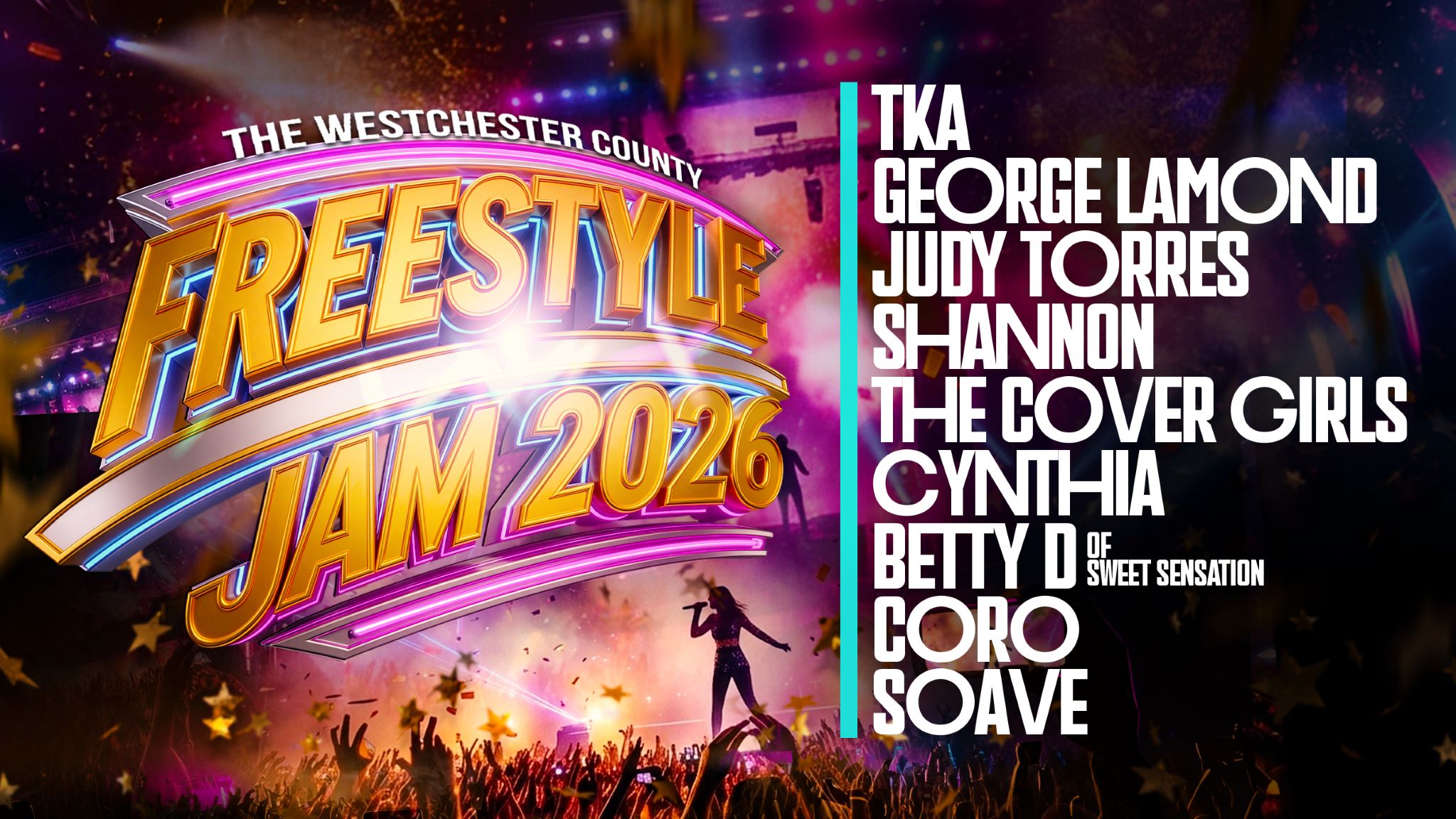
The most recent dated show was on 3 October 2026 at Flagstar at Westbury Music Fair on Long Island, billed as Louder Than Love and sold as a night of classic freestyle. Doors opened at 6.30pm for a 7.30pm start, tickets began at $63, and Coro appeared alongside TKA, George Lamond, Judy Torres, Cynthia, Sweet Sensation featuring Betty Dee, Soave and The Cover Girls. The hall seats between 2,800 and 3,000 in the round and the show ran on its rotating stage with live musicians — unusual on this circuit, where backing tracks are the norm.
That bill is the shape of the whole diary. Next is 24 October 2026 at the Westchester County Center in White Plains, an 8pm start billed as Freestyle Jam 2026. Then 14 November 2026 at Hard Rock Live at the Etess Arena in Atlantic City, promoted as Freestyle Free For All and cross-listed elsewhere under Lisa Lisa's name. Then 28 November 2026 at the Toyota Oakdale Theatre in Wallingford, Connecticut, a rescheduled date advertised as Freestyle 4 EVA with TKA, Judy Torres, Cynthia, Noel and Johnny O.
The furthest booking is 6 March 2027 at the St George Theatre in Staten Island, Freestyle Forever 2027, doors at 6.30pm and show at 7.30pm, tickets $39 to $129. The announced line-up runs to TKA/K7, Lisette Melendez, Reina, C-Bank, Soave, Tony Moran of the Latin Rascals, Pretty Poison and Fascination, hosted by Sal Abbatiello of Fever Records and Joe Causi of WCBS-FM, with DJ WhiteBoy handling music between sets. Roughly 4,588 people are tracking his dates for concert alerts, a figure consistent with an artist who sells through promoters' brands rather than his own.
What the format does to a performer
Nothing on this circuit is a headline tour, and the billing is honest about it. Eight to twelve acts on a single evening at Westbury or Staten Island means each performer gets a compressed slot rather than a set, and the running order is managed by hosts and a DJ who keep the floor moving between changeovers. Abbatiello, whose Fever Records helped build the genre in the Bronx in the 1980s, fronts several of these nights himself; the hosting is part of the product, not an interval.
The constraint is real but it suits the catalogue. An artist with four well-known titles and no need to promote a new album is better served by fifteen or twenty minutes in front of 2,800 people who know every word than by an hour in a 300-capacity room. It also explains why the same twenty or so names recur across every bill on the list above: the promoters are selling the era, and the individual artists are the components.
The risk in this model is that it forecloses new work. Coro has recorded in the past five years, but the circuit that keeps him employed has no slot for a new song, and the reference sources that might log one are too tangled with other acts of the same name to register it. For now the touring is the career, and the 2027 date in Staten Island suggests the promoters expect that to continue.
The show, now
A Coro appearance in 2026 is a slot on a multi-act freestyle package rather than a show of his own, and the published bills make that explicit. At Flagstar at Westbury Music Fair on 3 October 2026 he was one of eight acts — TKA, George Lamond, Judy Torres, Cynthia, Sweet Sensation featuring Betty Dee, Soave and The Cover Girls alongside him — with doors at 6.30pm, the show at 7.30pm, tickets from $63, and the venue's rotating stage and live musicians rather than backing tracks, in a room seating 2,800 to 3,000 in the round. The pattern repeats at the Westchester County Center on 24 October (8pm), Hard Rock Live at the Etess Arena in Atlantic City on 14 November, and the Toyota Oakdale Theatre in Wallingford on 28 November with TKA, Judy Torres, Cynthia, Noel and Johnny O. The St George Theatre date on 6 March 2027 is the clearest template: nine acts, $39 to $129, hosted by Sal Abbatiello of Fever Records and Joe Causi of WCBS-FM with DJ WhiteBoy between sets. The practical effect is a short, high-tempo run through the 1989 to 1993 singles — 'Where Are You Tonight', 'Can't Let You Go', 'My Fallen Angel' — in front of an audience that bought them first time round, with the hosts and the DJ, not the individual performer, carrying the staging and the pacing.
Researched from en.wikipedia.org · en.wikipedia.org · mn2s.com · livenation.com · songkick.com · stgeorgetheatre.com · westburymusicfair.org · music.apple.com
Pictures
The ticketer's photographs