
On tour
Every date the ticketer lists, worldwide · venue time
Listen
SoundCloud
The profile · researched 26 September 2026
Court jester at the end of the empire: Creekbed Carter Hogan's peasant songs
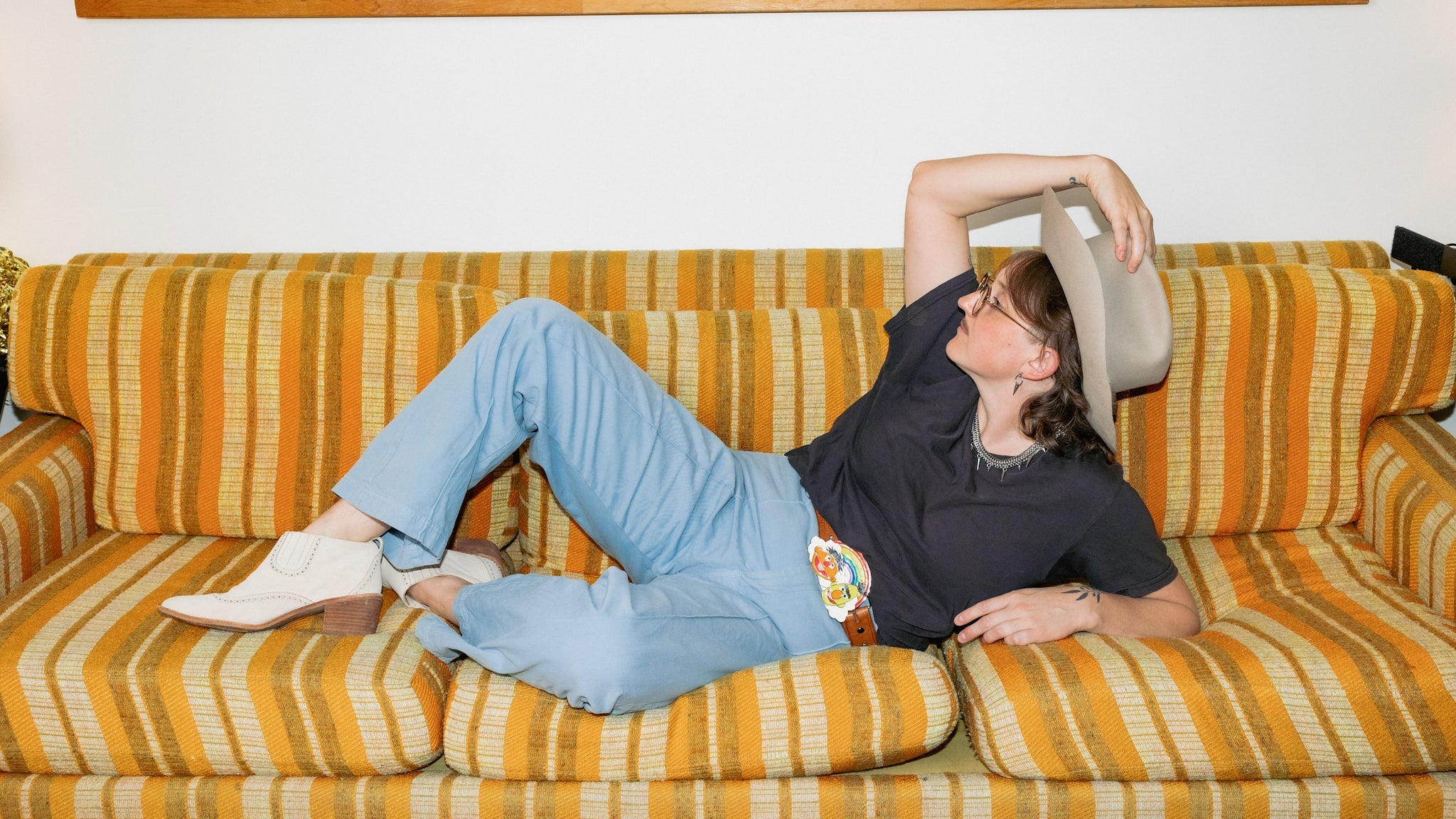
A trans folksinger who built a following on self-taught Appalachian fingerpicking and a homemade suitcase kickdrum, Creekbed Carter Hogan released the ten-track Peasants Revolt on 24 July 2026 — the record that turned a cult Austin act into one of the most argued-over names in American protest folk.
Willamette Valley Catholicism, then an Austin dive bar
Hogan was raised Catholic in Oregon's Willamette Valley and spent most of their adult life in Austin, Texas, where the Creekbed Carter name began as a solo outlet alongside their work as co-frontperson of the band Milktoast Millie & the Scabby Knees. The religious childhood is not background colour: it supplies the canon law jokes, the saints, the relics and the sense that a song can be both a confession and a piece of stagecraft.
The first substantial statement under the name was Good St Riddance in 2021, a concept album built around a patron saint of trans people. American Pancake, reviewing it that June, described a record that opened on water and woodland ambience before the acoustic guitar pushed forward, drawing on 1920s and 1930s hillbilly and bluegrass alongside 1970s folk. It was homemade, and it was a long way from the twelve-piece ensembles Hogan would be conducting five years later.
Hogan is also a fiction writer, publishing under the name Carter Saint Hogan, and an educator. They now live in Saint Paul, Minnesota, having written and moved between the North and the South over the past two years — a displacement that ended up structuring the newest record.
The self-titled record and the Austin cohort
Creekbed Carter arrived on Gar Hole Records on 22 March 2024 and did the work a debut on a small label needs to do: it put a name on a scene. Genevieve Wood, reviewing it in the Austin Chronicle on 28 March 2024, wrote that the album planted a folky freak flag in Austin's new-country community, and singled out the fingerpicked 'Sycamore' as a song about bodily transcendence, 'The Relic Song' for its comic handling of Catholic canon law, and 'Through With Lovin'' for its bittersweet meta-country wordplay.
The credits mapped the local network — the up-and-coming Large Brush Collection, the queergrass act Brand New Key, pedal steel from Zack Wiggs and fiddle from Beth Chrisman, several of whom would still be on the payroll in 2026. Hogan's own press materials name Karen Dalton, John Prine and Elliott Smith as the touchstones, which is a fair account of a voice that shifts between deadpan comedy and something much barer.
Hogan was an official SXSW artist in 2024, and the year after that the festival bookings widened considerably: official-artist slots at Roskilde, Rotterdam Bluegrass, the Kerrville Folk Festival and Blue Skies, all in 2025. Stages shared along the way include Emmylou Harris, Mary Gauthier, Willi Carlisle, Nick Shoulders, Big Richard and Olive Klug.
Peasants Revolt, and the Hot Dog Choir
The new album was announced on 14 May 2026 with the lead single 'Cutbank of Cleves' and a video directed and edited by Lexi Kiecker. Peasants Revolt followed on 24 July 2026, again on Gar Hole Records, co-produced and engineered by Britton Beisenherz, who also plays piano and organ on it. Ten tracks, and a cast of around a dozen musicians credited as the Hot Dog Choir: Beth Chrisman on fiddle, Sarah Schultz on drums, Lindsey Verrill on cello, vibraphone and banjo, Nora Predey on bass and baritone guitar, Zack Wiggs on pedal steel, Hunter Prueger on saxophone, with Jude Brothers, Carolina Chauffe and Gabriela Torres on backing vocals.
The arrangements are correspondingly odd for a folk record — penny whistle over stuttering bass on the opener, a Casio PK-1, saxophone, and a pedal steel that in 'Burn' underpins a lyric written in the knowledge that this is the last petroleum era. Hogan's stated method is to keep the apocalypse in the frame without making it the subject: the songs reach back to medieval uprisings and the Haitian Revolution, take in a Wordsworth sonnet addressed to Toussaint Louverture, and land in twenty-first-century trans activism and a Minneapolis under federal occupation.
Running through all of it is a hot dog. It is the album's recurring joke and its recurring image of American consumption, and it closes the record on 'Hot Dog! Apocalypse'. Hogan has called that track the crown jewel of the album, describing it as disarming humour set against a world that is constantly short-changing people, and framed the whole project as something made to help people sing for their supper and reclaim a better world. Elsewhere the register drops hard: 'Mirrors' is a duet with Jude Brothers about trans identity and pride, and 'Games Of Pretend' is stripped to voice and guitar.
Where the reviews have landed
Corbie Hill, writing in No Depression, cast Hogan as a court jester of the apocalypse and used 'Burn' as the exhibit — a song that begins on a tense Appalachian simmer and breaks into propulsive highway Americana at its midpoint, opening on the line about it being warmer than it ought to be up at the start of the Mississippi.
Thomas Blake at KLOF Mag called the record a detailed American pastoral for the end of the world, and Rachel Cholst at Rainbow Rodeo went further on 4 August 2026, naming it one of the most important albums of the year, praising the folk-rock intricacy of 'Icarus Again' and the vulnerability of 'Mirrors', and describing the title track as the album's pastoral culmination. NPR's Ann Powers summed it up as an album for the people, a line Hogan's own site now leads with.
Not every notice was unqualified. Tim Martin at Americana UK gave it seven out of ten, describing ten vignettes of medieval-Americana reportage and concluding that the songs work best taken as a single narrative arc rather than as individual pieces — which is as much an observation about how the record is built as a complaint about it.
The state of the touring, autumn 2026
Hogan toured more or less continuously from late May to late July 2026 around the album, across Canada, the western United States and the east, with better than seventeen dates on the run: Little Saint in Healdsburg, California on 4 June with The Montvales, Open Space for Arts and Community on Vashon Island on 13 June, the Sunset Tavern in Seattle on 15 June. The venues are small rooms, arts spaces and farms rather than theatres, and the routing reflects a self-booked sensibility even with representation through Row Boat Music.
The autumn leg has stayed at that scale. A Texas run took in the Old Quarter Acoustic Cafe in Galveston on 24 September 2026, Poor David's Pub in Dallas on 26 September and Radio/East in Austin on 27 September. On 7 October Hogan opens for Chris Housman's Hell Out Of Dodge tour at the Turf Club in Saint Paul — a home-town support slot in the city they now live in. The Iowa City Songwriters Festival on 5 November puts them on a bill with Lucinda Williams, Hurray for the Riff Raff and Bill Callahan. After that it is Judson & Moore Distillery in Chicago on 20 November, co-billed with The Montvales, and the Hi-Dive in Denver on 9 December, co-billed with Jude Brothers — the same Jude Brothers who sings the duet on 'Mirrors'.
The co-billing is the pattern worth noting. Hogan tours with collaborators rather than hired openers, which means the people on the record keep turning up on the stage, and the harmony parts are the real ones.
The show, now
A Creekbed Carter Hogan show comes in two configurations and the venue usually tells which. Solo, it is one guitar and a handmade suitcase kickdrum, with long spoken yarns about growing up queer and religious strung between the songs — the format that built the following, and the one that fits rooms like the Old Quarter Acoustic Cafe in Galveston (24 September 2026) or Poor David's Pub in Dallas (26 September). With the Hot Dog Choir, the same songs open out into the record's instrumentation: fiddle, cello, pedal steel, saxophone, vibraphone and three-part backing vocals, which is what makes a track like 'Burn' shift from Appalachian fingerpicking into full-band Americana on stage as it does on tape. The set draws heavily on Peasants Revolt, which its own reviewers say is built as a single arc from 'Cutbank of Cleves' through 'Icarus Again' and 'Mirrors' to the closing 'Hot Dog! Apocalypse', with the quieter 2024 self-titled material — 'Sycamore', 'The Relic Song' — providing the drops in register. Staging is minimal; the venues are small clubs, arts spaces and farms rather than theatres. Support is generally a collaborator rather than a stranger: The Montvales co-bill in Healdsburg (4 June) and Chicago (20 November), Jude Brothers co-bills at the Hi-Dive in Denver (9 December), and on 7 October Hogan opens for Chris Housman at the Turf Club in Saint Paul. The Iowa City Songwriters Festival on 5 November is the largest bill of the year, alongside Lucinda Williams, Hurray for the Riff Raff and Bill Callahan. What recurs in the write-ups is the combination reviewers keep reaching for — comedy delivered straight, then a song with nothing hidden behind it; Danish magazine GAFFA described a performer able to fill a room with warmth, empathy and hope, and the Austin Chronicle put it as open-road mysticism, brokenhearted yearning and laugh-out-loud wit.
Researched from creekbedcarter.com · creekbedcarter.com · nodepression.org · klofmag.com · klofmag.com · americana-uk.com · rainbowrodeomag.com · austinchronicle.com