On tour
Every date the ticketer lists, worldwide · venue time
The profile · researched 7 November 2026
Sweden's borrowed stage: how Dansens Hus got its building back and filled it for 2026
Dansens Hus is Sweden's national guest stage for contemporary dance, founded as a foundation in 1989 and reopened at Norra Bantorget in October 2025 after a two-and-a-half-year renovation. Its autumn 2026 main stage runs from Lia Rodrigues to a Shakespeare danced through artificial intelligence, and it has been named host of the next ICE HOT Nordic platform.
A foundation first, a theatre second
Dansens Hus was an institution before it was an address. Seven existing bodies — the Royal Swedish Opera, Riksteatern, the Gothenburg Opera, Östgötateatern, Danscentrum, the Dance Museum and Skåne Dance Theatre — established it as a foundation in 1989, with Jan Zetterberg as the organising force, on the premise that Sweden had choreographers and companies but nowhere permanent in the capital to show large-scale dance. The stage itself opened in 1991, in Folkets Hus at Norra Bantorget, taking over rooms that Stockholms stadsteater had vacated; the then education minister Bengt Göransson performed the inauguration. The remit has barely shifted since: a national guest stage for contemporary dance and the performance work next door to it, financed mainly from the state cultural budget with a substantial contribution from the City of Stockholm.
That wording — guest stage — is the whole business model, and it separates Dansens Hus from the ballet houses it was partly founded by. There is no resident company and no repertoire of its own. The house books, co-produces and hosts, which means every season is assembled from other people's touring work plus whatever it commissions, and the financial risk sits in the choice of bill rather than in payroll. The main room, Stora scen, seats 782 including eight wheelchair places with eight companion seats. The smaller stage holds 140. Two studios in the Dansklotet annexe are used for rehearsal and training by visiting artists and choreographers.
Leadership has turned over roughly every four to six years. Zetterberg ran the house until 2003, followed by the choreographer Kenneth Kvarnström from 2004 to 2007, Virve Sutinen from 2008 to 2013 and Annelie Gardell from 2014 to 2019. Johannes Öhman became theatre director in 2020 and remains in post, which means the entire renovation and relocation sat inside one directorship.
Three years out of the building
On 30 November 2022 the house announced that the Norra Bantorget premises needed new drainage, better ventilation, rewiring and improved accessibility, along with a modernised foyer, proper sound separation between the spaces and a new studio built off the foyer. Work was to begin at the turn of 2022–23 and finish in autumn 2024. It ran from January 2023 to June 2025 — closer to two and a half years than the eighteen months first set out. Öhman framed the move out as the start of a new chapter rather than a pause, and the programme went with him.
Elverket on Linnégatan 69, a 226-seat space the house had been running with Dramaten since autumn 2021, became the main address. Hallen in Farsta — a former school gymnasium in the old Telestaden — came online from February 2023, with Bonniers Konsthall and Årsta Folkets Hus absorbing further dates. The first displaced spring carried 17 guest performances, 12 of them world premieres, which is a heavier premiere load than a settled season usually takes.
The last season in exile, spring 2025, was nine productions between February and May: Alan Lucien Øyen's Still Life on 5–6 February, Kompani Giraff's A Study of Losses across the new year and again on 13–15 February, Benno Voorham's Beyond Rage from 28 February to 2 March, Philip Berlin's L'exposé on 3–5 April, Sofia Södergård's MASC on 10–12 April, Anna Öberg's Landscapes on 23–25 April, Frédéric Gies's Terpsichore in Scorpio – Deposition on 2–3 May, Norrdans with Crowds & Power on 9–10 May and the international co-production Attitudes on 15–16 May, with three choreographers on technical residencies alongside.
The homecoming and the largest ticket release the house had made
Tickets for the first season back went on sale at midday on 22 May 2025, and for the first time the house put the whole autumn-to-spring programme out in a single release rather than splitting it by term: 33 guest appearances, eight of them on a new studio stage for children and young people that opened in September 2025. The building itself reopened with a Homecoming Party on 2–3 October 2025, just short of three years after the move out. Öhman's line on it was that the reopening was more than a return, it was a new beginning, and that the aim was a living space for contemporary dance at a moment of geopolitical uncertainty.
The names on that season indicate the booking level the house now works at: Wayne McGregor, Anne Teresa De Keersmaeker, Trajal Harrell with Antigone Sr., Florentina Holzinger returning with A Year Without Summer, Virpi Pahkinen and Alexander Ekman. Mette Ingvartsen's Skatepark, which converts the stage into a working ramp, took the main stage on 10–11 April 2026.
Autumn 2026 on Stora scen
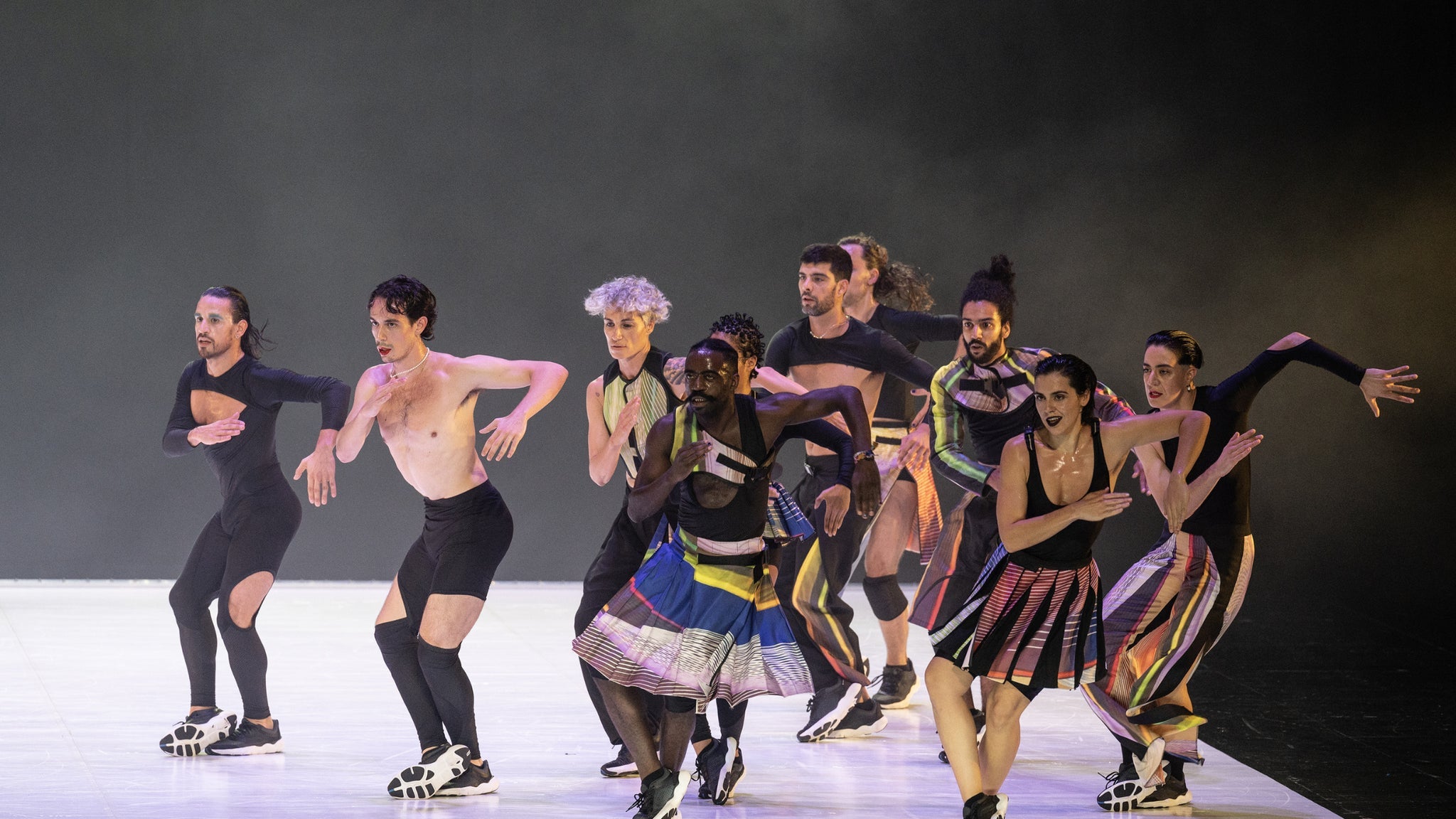
The current autumn opened with Hofesh Shechter's Theatre of Dreams on the main stage from 1 to 4 October 2026. Elina Pirinen's Ghosts of Rosegarden followed on 30–31 October, eight dancers working against a live string quartet, announced by the house on 26 October. Lia Rodrigues's Borda played 6–7 November at 19:00, a 70-minute piece for nine dancers built from fabric, plastic and recycled material carried over from earlier work, made at the Centro de Artes da Maré in Rio de Janeiro and closing the trilogy that began with Fúria in 2018 and continued with Encantado in 2021. Below Zero's circus piece In Praise of Shadows takes 13–14 November, The Dance Fair occupies the studio stage on 17 November, and Israel Galván brings La Edad de Oro to the main stage on 19–20 November.
The commercial anchor arrives on 5 December 2026, when Fredrik Benke Rydman's Romeo & Julia opens on the main stage and runs into January 2027 — a long block in a house that otherwise works in one- and two-night runs. It is billed at 75 minutes and sets Shakespeare in a world where the need for love is fed by artificial intelligence, until the pair encounter something real and painful. It is Rydman's sixth production for the house, after Svansjön in 2011, Stop Play Rewind in 2014, Nötknäpparen in 2016, Snövit in 2019 and Master of Dance in 2023; he said he was returning to work with a new generation of dancers at a theatre he first entered more than 25 years ago. He is house choreographer and director at Kulturhuset Stadsteatern and staged Måns Zelmerlöw's Heroes for Eurovision in 2015.
Further out, Dansens Hus has Crystal Pite and Jonathon Young's Kidd Pivot in Assembly Hall on 26–28 May 2027, which the house flagged in a release on 5 November 2026 — one reason the on-sale list currently stretches well past the spring.
Where the house stands now
The most consequential recent development is not a booking but a hosting. Dansens Hus Stockholm has been named host of the ICE HOT Nordic Dance Platform for 2026, the biennial market and showcase it helped launch in Stockholm in 2010. ICE HOT is run jointly by five organisations — Dansens Hus Stockholm, Dansehallerne in Copenhagen, Performing Arts Center Iceland, Dansens Hus Oslo, and Cirko and Dance Info Finland — and across its editions has brought roughly 2,000 international guests to see 140 productions by 230 companies and choreographers. The Stockholm edition is planned across several venues in the city, with Öhman saying he looked forward to welcoming Nordic and international guests back to the house. For a theatre whose whole output depends on who will tour to it, being the room where European programmers assemble is worth more than any single premiere.
Alongside it sits STHLM DANS, the city-wide contemporary dance festival whose fifth edition ran in May 2026, putting performances into squares, libraries, art spaces and theatres rather than keeping them inside the building. Taken together with the new studio stage for young audiences, it describes where the institution has moved: a renovated 782-seat house at the centre, and a programme that no longer assumes the audience will come to Barnhusgatan to find it.
The show, now
An evening at Dansens Hus is short, single-piece and almost always brief in run. Main stage performances start at 19:00 at Barnhusgatan 12–14, usually for one or two nights only, and the standard length is 70 to 75 minutes straight through with no interval: Lia Rodrigues's Borda ran 70 minutes on 6–7 November 2026, and Fredrik Benke Rydman's Romeo & Julia is billed at 75 when it opens on 5 December. There is no support act in the music sense — the bill is the work, and the house's framing around it comes through its press notes and its own podcast rather than an opener. Casts are small to mid-sized and the staging is whatever the company tours with: nine dancers for Borda, moving through a landscape of fabric, plastic and recycled material reused from earlier pieces in the same trilogy; eight dancers and a live string quartet for Elina Pirinen's Ghosts of Rosegarden on 30–31 October 2026. The room seats 782 including eight wheelchair spaces with companion seats, the smaller stage 140, and a studio stage opened in September 2025 carries the children's and young people's programme, eight titles of it in the first season back. Ticketing runs through Ticketmaster in Sweden. The December-to-January Benke Rydman block is the deliberate exception to the two-night pattern and the one show in the year sold as a season run rather than a visit.
Researched from dansenshus.se · sv.wikipedia.org · press.dansenshus.se · dansenshus.se · dansenshus.se · dansenshus.se · press.dansenshus.se · press.dansenshus.se
Pictures
The ticketer's photographs