
On tour
Every date the ticketer lists, worldwide · venue time
Listen
SoundCloud
The profile · researched 29 November 2026
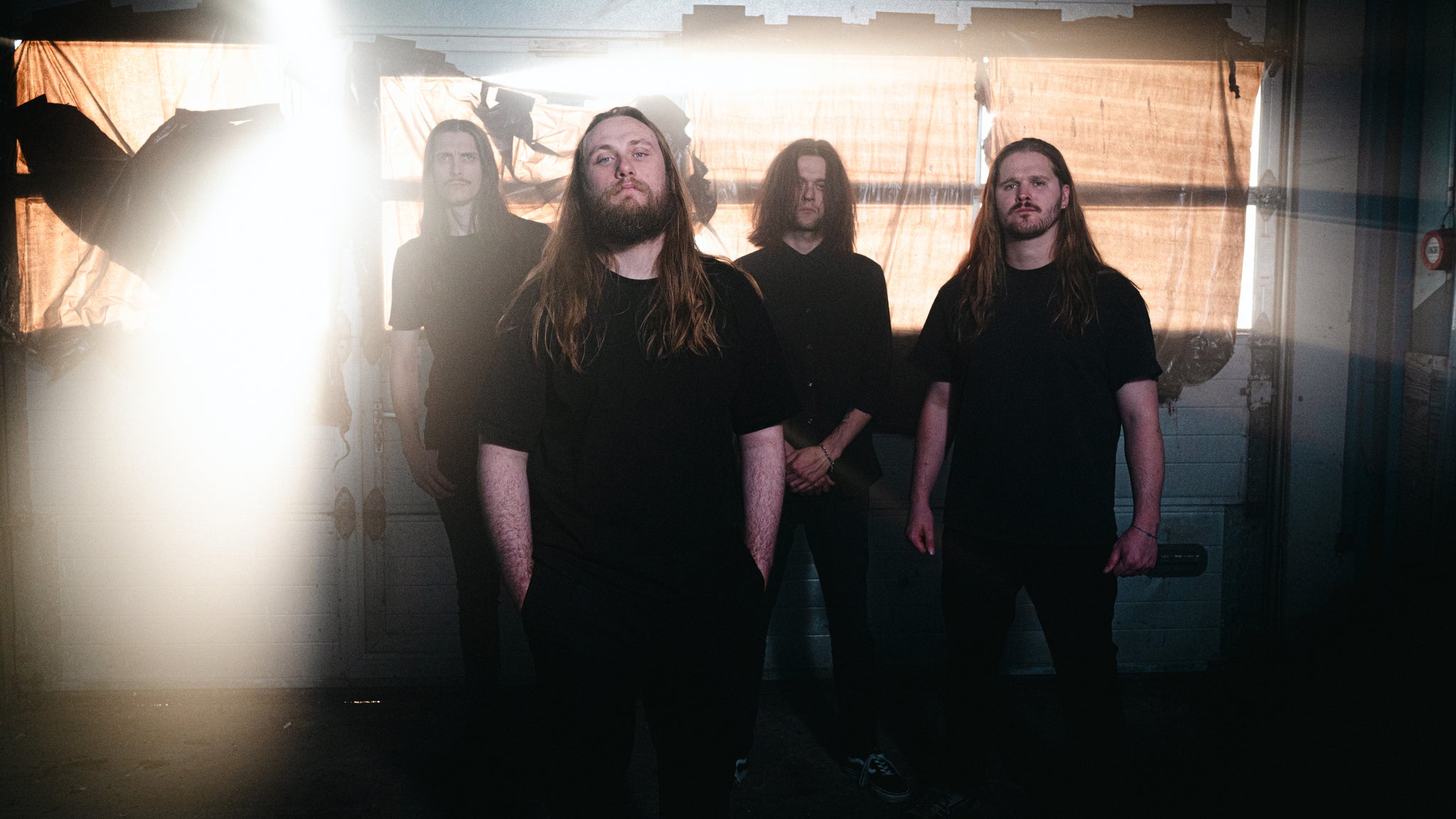
Deadnate, the Fredericia four-piece who stopped editing and started practising
A Danish progressive metal quartet who began as a thrash band, admit openly how much they owe Gojira, and spent 2026 proving on stage what their second album Mosaic argues on record. They closed a 33-date European run with Baest in Odense on 28 November 2026.
Thrash first, then Gojira
Deadnate are a four-piece from Fredericia, the port town on the east coast of Jutland, and their own pages still describe them in those flat terms: progressive metal from Fredericia, Denmark. Baest's tour announcement in June 2026 billed them instead as Aarhus locals, which is worth noting only because the band's own listings have never said so. DPRP places their emergence in the early years of the 2010s and reckons they spent roughly nine years on singles and EPs before the first album arrived. The line-up has never changed: Simon Juul and Kenneth Kejlstrup share lead vocals and guitar, Ole Frank plays drums, Frederik Fammé plays bass.
They started as a thrash band. The turn towards progressive metal came from a single shared discovery, which they described to Prog Rock Journal in an interview published on 19 March 2026: all four found Gojira at the same time, and it 'blew our minds that metal could sound like that'. They are unusually blunt about what followed, conceding that 'obviously that's why our sound is so close to theirs', and saying thrash had come to feel limiting. Asked where they sit among the Danish heavy bands of the moment, they distanced themselves from the scene, claiming kinship instead with a handful of acts that share their attitude.
The debut EP Concrete Flood appeared in November 2018. It did well enough at home to earn support slots with Baest, Møl and Eyehategod. The band say none of those acts changed how they write, but that they set a benchmark for performance — they taught Deadnate 'what level to go for when it comes to playing live'. Rehearsals since have been weekly and multi-tracked, on the stated grounds that their own material is difficult to play.
The North Sea, and a flaw that only showed up on stage
The first album was tracked in 2020, issued in two halves and then as a complete record in March 2022. Frank produced it and Andreas Linnemann engineered. Its subjects faced outward — nature, the environment, humanity's relationship with it — and it drew attention beyond Denmark, which the band say surprised them in a good way without changing how they operate.
It also exposed something that no review could have told them. Much of the record leaned on clean singing, and the band now concede that approach 'sounds cool on a recording, but often has fallen short for us live'. That diagnosis shaped everything after it. Their own account of the turning point is a slot at Copenhagen Metal Fest in 2025: a large stage, a reworked live band, the first airing of new Mosaic material, and an absurd number of hours in the rehearsal room beforehand. Their verdict on it was unambiguous — the single best show they had ever played — and they say they put the same preparation into the release shows, wanting audiences to leave with nothing to criticise.
Mosaic: drier, harder, pointed inward
Mosaic came out on 27 March 2026 through DeadRecords: eight tracks, a little over 41 minutes. Frank produced, mixed and mastered it himself, drums were recorded at Lungaard Studios with Linnemann engineering them, and the artwork is by Andrew Durgin-Barnes. The brief reversed the debut's: more direct, less layered, every instrument tracked to a higher standard, and editing replaced by practice. Rather than repair performances afterwards, they spent the time learning the parts, in places recording a bar at a time. The band wanted punchier and rawer — drums hitting harder, guitars dirtier — along with a curatorial rule against adding material for its own sake.
The writing turned inward: the city, the self, the way people treat each other. The band put that down to being a few years older and to some genuinely rough things having happened in their lives, plus a wish not to repeat the debut. The title arrived early but carries no scheme behind it, functioning as a loose thread rather than a concept.
Guilt & Sorrow is the hardest song on it. Kejlstrup and his wife lost a son, stillborn very late in the pregnancy, and he wrote down what he was thinking; the song was built from those notes. Frank said the guilt running through them had not occurred to him, because it describes a situation nobody can control, and yet the feeling was there anyway. The craft question became how direct or how vague to make each line.
Elsewhere the record works the two extremes of its own press description. Two Tongues, at 7:07, is by the band's own reckoning the most complex thing they have written: a dense intro of odd groupings, immediately answered by a very simple riff in regular time. The title track inverts that, reduced to one note per guitar in quarter notes, made large by an octave effect, a fuzzed tone and bass playing power chords — texture and size rather than notes. He Who Pays, the first single and the opener, was chosen for its hardcore streak and its raw production as a signal that the band had moved.
What the reviews made of it
The critical split came down to one question: how much of Mosaic is Deadnate and how much is Gojira. The Progressive Subway was the least persuaded, scoring it 5.5 out of 10 on 14 April 2026 and arguing that most of the album sounds like an amalgamation of Gojira song pieces, while allowing that the band play the style convincingly and that the sound quality is indistinguishable from a professional production. Its real complaint was sameness — songs converging in a texturally similar, moderately paced fog — though it singled out the duelling tapped and melodic guitar lines early in Morass as sublime.
DPRP's Calum Gibson reached the opposite conclusion from the same evidence on 14 June 2026, writing that Deadnate are not a carbon copy at all and inject their own passion into the sound, while agreeing that even at 41 minutes the record begins to drag and that the chugging needs varying. He ended by saying he would watch their career with interest. Rockfreaks were the most enthusiastic: Petteri Pertola gave it 8 out of 10 on 30 September 2026, writing that the band have massively improved on their sophomore album and now sound ready for international duty, praising a vocal range that moves between monstrously heavy roars and dirty cleans, and calling the result brutal and beautiful at the same time. Morass drew praise from all three.
The Colossal tour
On 17 June 2026 Baest named Deadnate special guests for the European and UK run behind their album Colossal. Baest guitarist Svend Karlsson described the pairing as a night of Danish dynamite and riffs galore, and said that having known them for years it was good to finally bring them over the hills and far away.
The itinerary opened at the M.A.U. Club in Rostock on 19 September 2026 and ran through Berlin, Dresden, Prague, Budapest, Vienna and Aarau before crossing to Britain and Ireland: Southampton on 29 September, then Leeds, Glasgow, Belfast, Dublin, Nottingham, Manchester, Birmingham, Bristol and London's Downstairs at the Dome on 9 October. It returned through Leiden, Tilburg, Wiesbaden, Kassel, Cologne and Kortrijk to Betty in Hamburg on 17 October, then took in a Danish leg of eight shows from Fermaten in Herning on 6 November to Posten in Odense on 28 November, taking in VoxHall in Aarhus on 14 November along the way.
That run answered the band's own stated ambition almost exactly. In March 2026 they said their dream was to get on a tour around Europe to find out whether they were capable of keeping it up, with a few release shows booked and the autumn still to fill. Thirty-odd dates later that question has been settled in public.
Where that leaves them
Deadnate end 2026 as a band whose live reputation has caught up with its recorded one, which is the reverse of where they stood after the debut. The black vinyl pressing of Mosaic is sold out on their Bandcamp store, which also still carries CDs of both halves of The North Sea and of Concrete Flood. The label remains their own DeadRecords, and reviewers who looked at the credits described the album as independently produced.
What has not been stated publicly is what comes after the Baest tour. Their last word on plans, given before the record came out, was that they felt settled in the sound, happy that it works on stage, and intent on expanding and refining it rather than changing direction. On the evidence of the autumn, the next test is a headline room rather than a support slot.
The show, now
Through autumn 2026 Deadnate played a support slot, not a headline set, and built it for impact rather than length: six songs in Berlin on 20 September at Urban Spree, the tour's second night, starting punctually at 8pm on a small stage. Metal1.info printed the set as He Who Pays, Funeral Cortège, Guilt & Sorrow, Neon Burner, Morass and Two Tongues. The staging is the odd part — the two singing guitarists, Juul and Kejlstrup, stand at the outer edges, leaving the centre to Fammé, whom both reviewers made the visual focus. Metal1.info called him a born scene-stealer; Rockflesh, reviewing Manchester's Star & Garter on 6 October with local openers Ego Death on first, described him gurning and windmilling and rated him a real force on the bass. There is no production to speak of in rooms that size: the draw is playing. Rockflesh heard relentless tribal rhythms giving way to mechanical riffing and dual vocal harmonies, compared the restlessness to a hyperactive Opeth, noted the finger tapping as especially impressive, and allowed that the vocals were not always audible without thinking it mattered much. Both reviews put Morass at the peak, its long drawn-out guitar intro singled out in Berlin as the set's exclamation mark. Crowds responded warmly rather than riotously — a well-filled floor on a Sunday in Berlin, a lighter raised during a quieter passage and an attempted wall of death that stayed an attempt, and a small but enthusiastic Manchester room content to stand and headbang. In Berlin both singers returned during Baest's headline set to guest on Misfortunate Son, putting seven musicians on the stage at once.
Researched from deadnate.bandcamp.com · grimmgent.com · progrockjournal.com · progrockjournal.com · theprogressivesubway.com · rockfreaks.net · dprp.net · rockflesh.com