
On tour
Every date the ticketer lists, worldwide · venue time
The profile · researched 22 November 2026
Volume XIV, live on a Sunday afternoon: the one-man Cri-Cri show that has outlasted its own theatre
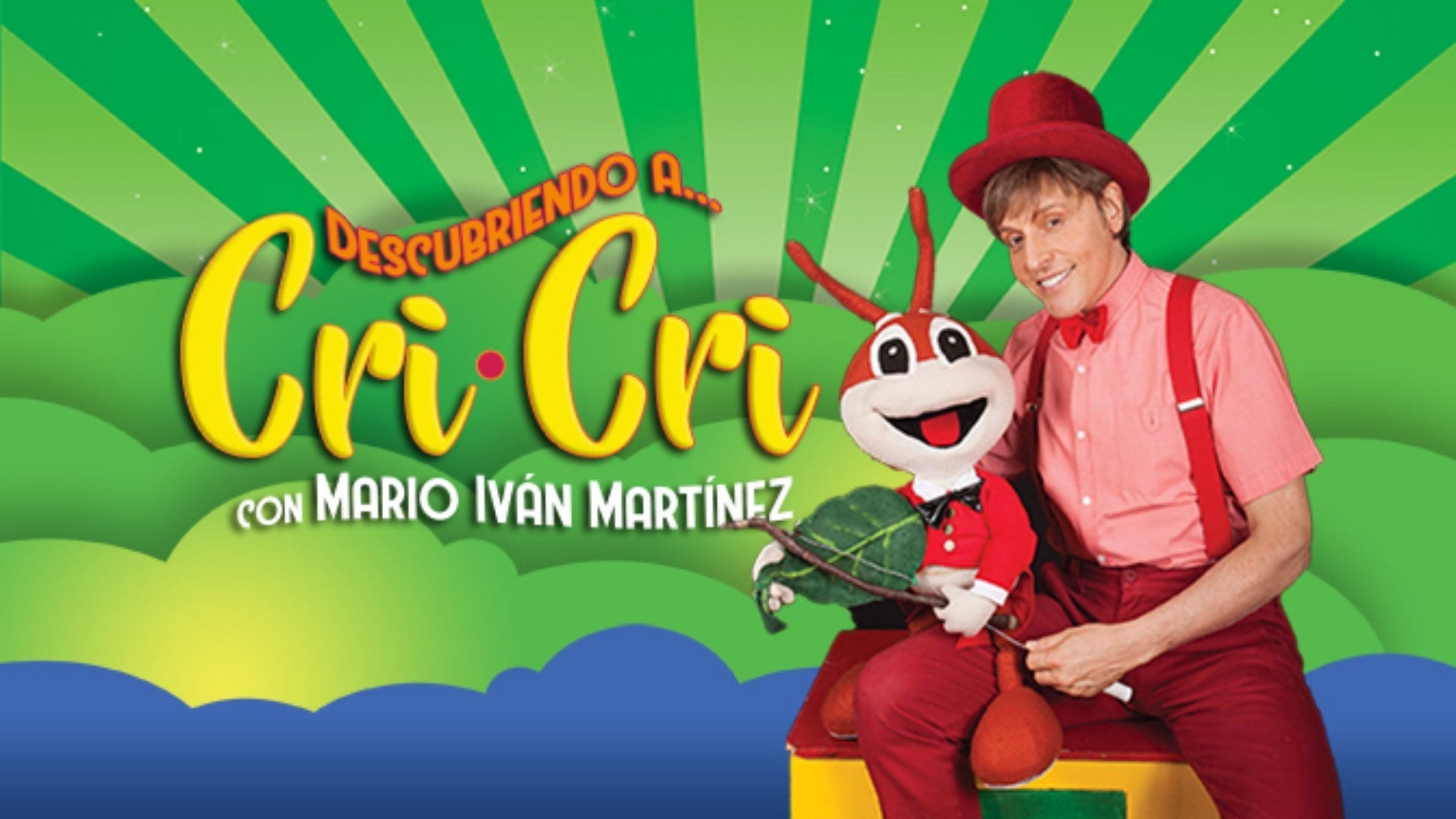
Mario Iván Martínez has been the licensed ambassador of Francisco Gabilondo Soler's Cri-Cri catalogue since 2007, and Descubriendo a Cri-Cri is the solo show he built from its least-played corners. It is still running Sundays at Mexico City's Teatro Hidalgo, with two dates on sale as of 22 November 2026.
A screen actor who went looking for a smaller audience
Mario Iván Martínez Morales was born in Mexico City on 17 February 1962, into a household already working in performance: his father, Mario Iván Martínez Ortega, was a radio journalist, his mother the actress Margarita Isabel. He was on stage at nine with the National Theatre Company of Mexico, and his professional career is dated from 1982. Training took him to the London Academy of Music and Dramatic Art, arranged through the British Council, and in Mexico to the directors Julio Castillo and Héctor Mendoza.
The screen and adult-stage work came first and is substantial. Como agua para chocolate took him the Ariel for best actor in 1992 and the ACE prize in New York in 1993; he was nominated for the Ariel again for Sucesos distantes in 1996 and La habitación azul in 2002. On stage he won the Mexican theatre critics' prize for best actor in a musical for El beso de la mujer araña in the 1996-97 season, best actor for De monstruos y prodigios in 2000-01, and the Premio Bravo in 2015 for La jaula de las locas. Telenovela credits run from Pueblo chico, infierno grande through Alborada, Amor real and Mañana es para siempre.
The turn towards children was accidental and dates to 1997, when the Secretaría de Educación Pública enrolled him in a reading scheme called ¿Quieres que te lo lea otra vez?, which put a single book into an actor's hands to be read anywhere from a library to the patio of a house. He told Milenio in July 2017 that he started adding props, recorded music and a Renaissance costume out of his own wardrobe, on the reasoning that the younger the child, the shorter the attention span. When the state programme was wound up — a serious mistake, in his view, for a country that needs reading promotion — he carried on alone. The company that grew out of it, Un Rato para Imaginar Producciones, dates its stage strand to 2002 on his own CV.
A phone call from Cri-Cri's son
Francisco Gabilondo Soler, 1907 to 1990, grew up in Orizaba, Veracruz and built the character of Cri-Cri, the singing cricket, on the XEW radio station from 1934. Martínez has made the point that the programme ran about twenty-five years and that the songs were strung together by a large body of spoken material — lucid, funny, reflective pieces written to introduce each number. That connective tissue, not the hit songs, is what interested him.
He assumed the catalogue was closed to him on rights grounds. Then Tiburcio Gabilondo Gallegos, the composer's son, telephoned to invite him into the 2007 centenary celebrations of his father's birth, built around a concert at the Palacio de Bellas Artes. Out of that came a working relationship with Gabsol, the company Gabilondo founded to hold the rights to his own work, and the position Martínez has held since: ambassador of the work from 2007, with a separate Gabsol recognition as a promoter of it in 2011. He described the ambassadorship in 2022 as the greatest privilege of his career, and has said he is a storyteller in large part because of how much the singing cricket made him daydream as a boy.
The show opened the same year at the Teatro Coliseo of the Poliforum Cultural Siqueiros, a house that no longer exists. Its remit from the start was the unfamiliar end of the catalogue — the songs and texts that the records and the 1963 film never made famous.
Volume XIV
Un rato para imaginar is a shelf of audiobooks as much as a stage repertory, self-edited and self-distributed; Martínez counted twenty-two volumes in 2017 and his CV listed twenty-three by November 2024. Descubriendo a Cri-Cri is volume XIV, twenty-three tracks alternating narration with song, produced musically by Paco Aveleyra with Grupo Cántaro under José Luis González, Sergei Gorbenko on violin and the vocal ensemble Voz en Punto directed by José Galván.
A second Cri-Cri homage followed and filled volumes XXI and XXII as a double album: Que dejen toditos los sueños abiertos, which exists as a stage piece too, performed with Jimena Parés and Pablito Rodríguez and in a symphonic version with the Orquesta de Minería at the Sala Nezahualcóyotl. It took the Agrupación de Periodistas Teatrales prize for best children's show in 2017. His children's work had already won the Mexican critics' award for best children's show in 2004 and again in 2006, the year he also took the Premio Nacional Alas de Plata.
The research has spilled into print. De niños, pianos y un grillito. El pequeño Gabilondo, written with Gabsol and illustrated by Juan Gedovius, was published by Alfaguara Infantil on 8 October 2024: seventy-two pages for readers of seven to ten, following a boy with a passion for learning and no patience for school from his grandmother's house and his piano to the XEW studio. It sits in a series of his on famous childhoods alongside volumes on Mozart, Leonardo da Vinci and Sor Juana Inés de la Cruz.
A Sunday fixture, with gaps
The show's home is the Teatro Hidalgo Ignacio Retes on Avenida Hidalgo in the historic centre of Mexico City, Sundays at 13:00, billed as an open-ended season rather than a limited run — the box office described it in April 2026 as having no fixed end. The 2026 record shows how it actually works: a single performance in Puebla at the Teatro Principal on Thursday 30 April at 7pm for Día del Niño, priced at 600 pesos in the stalls, 500 in the platea and 400 in the boxes; a Mexico City run that closed on 28 June, reopened for 5 and 12 July with the first of those two shifted and some ticket-holders moved to Saturday 18 July; October dates on the 11th and 18th; nothing on 8 November; then 15, 22 and 29 November.
As of 22 November 2026 the Ticketmaster artist page lists exactly two performances, both at the Teatro Hidalgo at 13:00 — that Sunday and the following one, 29 November — with tickets available for each and no sold-out or cancellation markers. The published face value is 440 pesos in the preferred zone and 550 in VIP, before service charges; discount resellers have advertised the same seats from 320 and from 250 pesos. Children from the age of two need a ticket. Nothing is scheduled beyond November, and requests for Guadalajara keep surfacing in the listing's comment thread.
How it is put together
Martínez writes, directs and performs it. The set is a room full of colour whose boxes open to release puppets and objects, which he handles himself while narrating; the puppets and props are credited to Gabriela Villalpando, the paper art and Cri-Cri's piano to Adriana Amaya, and the recorded soundtrack to Paco Aveleyra over incidental music by Grupo Cántaro. Audiences have reported a cricket, a negrita figure and an elephant among the puppets.
Two versions exist on his books. The solo one, with the recorded track, is logged at one hour ten with an interval; a live-music version adds Alberto Cruzprieto at the piano and the young musicians Miguel Ángel Villeda on cello and Ana Caridad Villeda on violin, and runs about one hour fifteen. Listings for the Teatro Hidalgo season give an hour and a half. The music includes the Cri-Cri theme, El baile de los muñecos, El ropero, Cucurumbé, Los pollitos jardineros, Los ratones bomberos, Los cochinitos dormilones and El ratón vaquero, with fragments of Chon Ki Fu, Di por qué, La muñeca fea and El barquito de nuez. The spoken pieces carry titles of their own — Un grillito convertido en señor, Mexicanismos y preocupaciones, Don Pimpirulando, El reino de las sombras, Muchachas antiguas, Consejos de don Periquín Plumero.
His working rule, stated in Puebla in April 2026, is that work made for children has to be made as though for adults, only better. He calls the whole enterprise his life project.
A divided room
The reception is genuinely split, and the split follows the show's design. Its Ticketmaster page carries a 5.0 rating from four reviews, one of them simply asking for more dates, and the Cartelera listing's eighty-plus comments include Jacqueline Padilla on 8 April 2026 calling it an excellent adaptation and saying she daydreamed through it like a child.
Against that, Iñigo Fernández wrote on 17 November 2025 that the song interpretations were fine but that there were too few of them, and that roughly thirty minutes went on Martínez himself and on promoting his books and recordings. Claudia Anaya, on 17 November 2026, arrived expecting dance numbers and a conventional children's story, found a single performer carrying the whole thing, and called it a fiasco. A talk-led hour built out of the catalogue's unfamiliar material will do that to a room that came for El chorrito.
Martínez has been blunt about the field he works in. He has described the dismissiveness aimed at colleagues who do children's theatre, argued that going on stage with contempt and a lack of concentration guarantees collapse within five minutes, and put the sector's weakness down to the absence of solid policy dignifying work made for children. Surviving, he says, has meant finding his own sponsors and building a returning audience.
The show, now
A current performance is a solo hour at the Teatro Hidalgo on a Sunday at 13:00 — there is no support act and no second performer, only Martínez, a recorded soundtrack and a set of boxes that open to release puppets and paper props. Listings for the Mexico City run give an hour and a half; his own production notes put the solo version at one hour ten with an interval, and a live-music variant with Alberto Cruzprieto on piano and two young string players at about one hour fifteen. The shape is alternating narration and song: Gabilondo Soler's own spoken pieces, among them Un grillito convertido en señor, Mexicanismos y preocupaciones and Consejos de don Periquín Plumero, each leading into a number, with El ropero, Cucurumbé, Los ratones bomberos, Los cochinitos dormilones and El ratón vaquero among those sung in full and Chon Ki Fu, La muñeca fea and El barquito de nuez appearing in fragments. Tickets are 440 pesos in the preferred zone and 550 VIP before fees, and children from two years up pay. As of 22 November 2026 only two dates are on sale, both at the Teatro Hidalgo at 13:00 — 22 and 29 November — after a year of stop-start runs that closed on 28 June, resumed for 5 and 12 July, played 11 and 18 October and skipped 8 November. Reaction divides sharply along the show's own grain: a 5.0 average from four Ticketmaster reviews and comments calling the adaptation excellent, set against a November 2025 complaint that too little of the hour is singing and about thirty minutes goes on Martínez himself and his books, and a November 2026 verdict of "un fiasco" from someone who had come expecting dance numbers and a familiar children's story. Requests for a Guadalajara run recur in the listing's comment thread.
Researched from carteleradeteatro.mx · carteleradeteatro.mx · diariopuntual.com · chilango.com · ticketmaster.com.mx · milenio.com · marioivanmartinez.com · marioivanmartinez.com