On tour
Every date the ticketer lists, worldwide · venue time
Listen
SoundCloud
The profile · researched 7 November 2026
The rhythm guitar's claim: Diego Baliardo, Canut Reyes and an argument over a name
Diego Baliardo played rhythm guitar on the 1987 record that sold flamenco rumba to the world. In 2026 he fronts Gipsy Kings by Diego Baliardo, one of several acts trading under that name, and has taken it from Porto to Brisbane to Rio.
Two families and a death in 1979
The group began in the south of France, around Arles and Montpellier, in 1979. Its raw material was two intermarried Gitano families: the Reyes clan and the Baliardos. The pivot was the death that year of José Reyes, a flamenco singer who had spent much of the 1970s performing alongside the guitarist Manitas de Plata. His sons — Nicolas, Canut, André, Patchaï and Pablo — carried the family trade forward, joined by their cousins Diego, Paco and Tonino Baliardo and by the French-Moroccan Chico Bouchikhi.
What they played was not orthodox flamenco. It was rumba gitana: the harmonic furniture of flamenco put over a dance pulse, sung in Spanish and in Gitano, with several nylon-strung guitars interlocking rather than one soloist holding the floor. Diego Baliardo's role in that arrangement was the rhythm part — the compás that the lead lines sit on top of. The personnel credits on the band's commercial breakthrough list him as Maurice "Diego" Baliardo, rhythm guitar and handclaps, which is a fair description of the job.
Canut Reyes, born François Reyes in Strasbourg on 9 June 1954, sang. He left the group with his brother Patchaï at one point in the early years and returned for the world tour that followed the 1989 album Mosaïque. He has also recorded on his own — Bolero in 1989, a nod to Ravel, and Gitano in 2012 — and paints.
The records that did the travelling
The first two albums went almost nowhere. Allegría arrived in 1982 and Luna de Fuego in 1983, and neither troubled the wider market. The change came with the self-titled album issued on 21 August 1987 and put out in the United States by Elektra the following year. It spent forty weeks on the Billboard 200, reached number two on the Australian albums chart, and was certified platinum in the US, double platinum in Canada and double platinum in Australia.
Two tracks from it did most of the work and still do. "Bamboléo" opens the album; "Djobi Djoba" sits at track eight. Between them they account for a large share of why a European act singing in Spanish and Gitano ended up on radio in countries with no flamenco tradition at all. Mosaïque followed in 1989 and Tierra Gitana in 1996. The group's total sales are usually given as more than sixty million albums, a figure the current promotional material repeats.
The last major prize went to a lineup Diego Baliardo was not part of. Savor Flamenco, released in 2013, won the Grammy for Best World Music Album in 2014, by which point the recording band had narrowed to Nicolas Reyes and Tonino Baliardo as its permanent members. That distinction matters when reading the billing on a 2026 poster: the catalogue and the awards belong to a name with a complicated ownership history, not to any one of the men currently touring it.
Whose name is it
The group fractured in stages. Pablo Reyes left in 1988 because of hearing trouble. Chico Bouchikhi went in 1991 after a financial falling-out and started his own project. By the 2010s several configurations of Reyes brothers and cousins were touring versions of the repertoire, and the question of who could call themselves the Gipsy Kings went to court.
The decisive judgment came from the Paris Court of Appeal on 19 January 2021, case number 18/07991, following a first-instance ruling in 2018. Nicolas Reyes and Tonino Baliardo sued four former members, Bouchikhi among them, who had been recording and performing as Gipsy Kings et Chico. The court held that where a group name is co-owned by its members, the right to use it falls to those who can show they have carried the artistic project forward. Reyes and Baliardo qualified on two grounds: they had written most of the songs, and they had been continuously present since the beginning. The four defendants lost the use of the name and were sanctioned for unfair competition.
Enforcement has continued outside France. In 2024 Reyes and Baliardo moved against concerts in Casablanca and Marrakech on 26 and 27 July billed as Gipsy Kings by Patchaï Reyes. Diego Baliardo and Canut Reyes were not parties to the 2021 Paris case, and their project continues to tour internationally under the Gipsy Kings name with the founder's own name appended — the same construction used by André Reyes, who also tours as Gipsy Kings by André Reyes. Audiences buying tickets in 2026 are therefore choosing between several acts with genuine claims to the history and no single agreed custodian of it.
2026: Porto to Rio, with a Brazilian detour
The year was built around a tour branded "A Tu Vera", named after a song in the catalogue rather than any new release, and sold on the claim of thirty-five years of international hits — promotional arithmetic that sits a few years short of the 1987 album's actual age. Portuguese press announced it on 6 January 2026 for two dates: Coliseu Porto Ageas on 1 May and the Coliseu dos Recreios in Lisbon on 10 May, with tickets from €25 to €50.
Australia came in October, promoted by Abstract Touring: the State Theatre in Sydney on 15 October with an 8pm start, Thirroul on the 16th, Adelaide on the 17th, the Fortitude Music Hall in Brisbane on the 19th and the Palais Theatre in St Kilda on the 20th. Singapore's Capitol Theatre followed on 28 October at 7.30pm.
The South American run is the current business. Suhai Music Hall in São Paulo on 28 November, doors at 7pm and stage at 9pm in a room holding up to 3,407, with tickets having gone on general sale on 4 August; Qualistage in Rio de Janeiro on 29 November; and, per Brazilian coverage published on 1 November, further dates in Porto Alegre and Belo Horizonte plus Brasília's Ulysses Centro de Convenções on 5 December. The year closes in France, at L'Espace de Forges in Forges-les-Eaux on 13 December.
The Brazilian shows carry a genuine novelty. Sidney Magal, marking sixty years as a performer, appears as special guest, playing his own material — "Sandra Rosa Madalena", "Me Chama Que Eu Vou" — before the two acts share the stage for a joint finish. It is an unusual pairing of rumba gitana and Brazilian popular song, and it is specific to this run.
On stage now
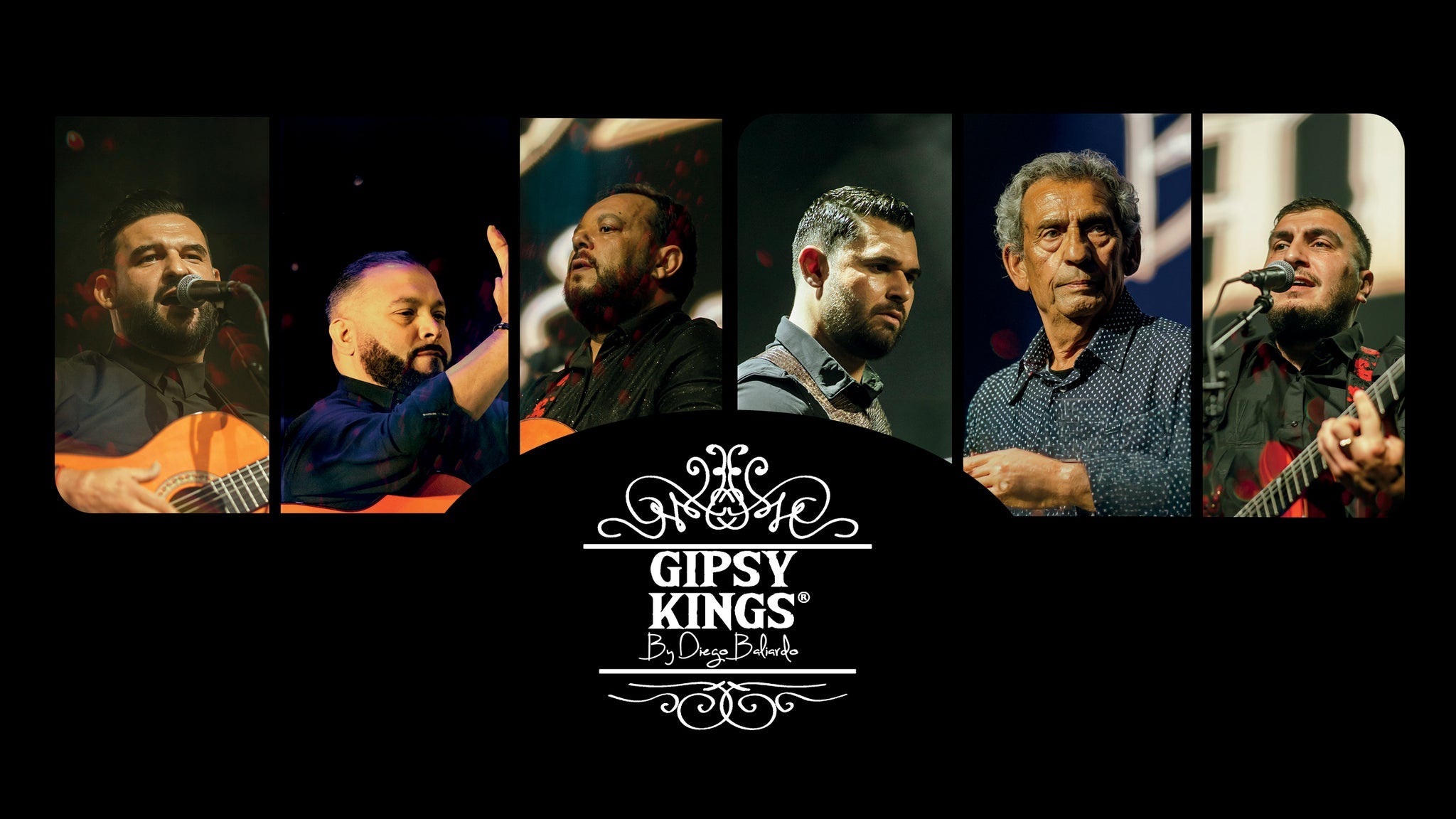
The pitch is straightforward and the group does not dress it up: this is the only touring configuration that puts two of the original members, Diego Baliardo and Canut Reyes, on a stage together, surrounded by younger players drawn from the same families and the same tradition. No orchestra, no theatrical production, no concept — guitars, percussion, voices and the compás.
The repertoire is the hits, played close to their recorded shapes: "Bamboléo", "Djobi Djoba", "Volare", "Bem Bem Maria", "Un Amor", the group's reading of "Hotel California", and "A Tu Vera" as the tour's nominal centrepiece. Reports from the Australian dates describe a continuous set of just under two hours with no interval, the band working openly to get a seated theatre audience standing, and the younger guitarists given room. The recurring note in ticket-buyer feedback from that run is the generational one — the originals present, the next cohort visibly taking the weight.
The show, now
A show in 2026 runs just under two hours in a single continuous set with no interval, according to reports from the October Australian dates, and is staged plainly: a row of nylon-strung guitars, percussion and voices, no production concept. Diego Baliardo takes the rhythm part he has always played, Canut Reyes sings, and a younger group of players from the same families fills out the sound and takes solos. The set is the catalogue — "Bamboléo", "Djobi Djoba", "Volare", "Bem Bem Maria", "Un Amor", the band's version of "Hotel California" and "A Tu Vera", which gives the tour its name — played close to the recordings, with the players working the room directly to pull a seated theatre audience up. Typical rooms this year have been mid-sized theatres and halls: the 8pm start at Sydney's State Theatre on 15 October, the Fortitude Music Hall in Brisbane on the 19th, the Capitol Theatre in Singapore at 7.30pm on 28 October. There is no standing support act on most dates, but the Brazilian run in late November and December is different: Sidney Magal, marking sixty years on stage, performs his own songs and then joins the group for a combined finale, a one-off pairing of rumba gitana with Brazilian popular music. Ticket-buyer feedback from the Australian shows returns repeatedly to two things: the pace, which does not let up, and the sight of the founding members playing alongside the next generation of the family.
Researched from en.wikipedia.org · en.wikipedia.org · en.wikipedia.org · gipsykingsbydiegobaliardo.com · solvoxia-avocats.com · visitlisboa.com · artesonora.pt · songkick.com
Pictures
The ticketer's photographs