
On tour
Every date the ticketer lists, worldwide · venue time
Listen
Top tracks on Spotify · SoundCloud
The profile · researched 16 October 2026
The Lute, Plugged In: Jozef Van Wissem's Long Argument With Early Music
A Dutch composer who left the punk circuit for a Renaissance instrument, won a Cannes score award with Jim Jarmusch, and spends autumn 2026 touring a new record and a live score for a 1920 silent horror film.
Punk bands, then a lute teacher in Manhattan
Jozef van Wissem was born in Maastricht on 22 November 1962 and came up through the Dutch punk scene of the 1980s, playing in bands including Mort Subite and Desert Corbusier. He has described an encounter with the Slovenian industrial group Laibach, during a tour of Yugoslavia, as a formative one. By the early 1990s he had tired of contemporary guitar rock altogether; he has said that after seeing Nirvana play he decided the moment had arrived to switch instruments entirely.
He moved to New York in 1993 and spent the decade studying the lute there with Patrick O'Brien, one of the instrument's more serious American teachers. That training is the reason the work never sounds like a rock player holding an antique: the Renaissance and Baroque repertoire, and the counterpoint technique underneath it, became the raw material he has been taking apart ever since.
Playing it backwards: the method and the early records
His professional discography opens in 2000 with Retrograde: A Classical Deconstruction on Persephone Records, and the title names the method. Retrograde motion — a line restated back to front, borrowed from old counterpoint — gives his pieces their palindromic shape and their habit of arriving where they began. Early releases went out on small independents including BVHaast, Incunabulum and The Spring Press before he signed to Important Records, which issued It Is All That Is Made in 2009 and Ex Patris in 2010.
The output since has been heavy. By mid-2026 he put the count at close to fifty albums, made on eight custom-built lutes, with the writing done during an annual working stretch in Warsaw, which he finds more productive than working at home in the Netherlands. The newer records keep the early-music fingering and add drones, electronics and field recordings; Incunabulum Records has become his main home.
Fifteen years with Jim Jarmusch
The collaboration with Jim Jarmusch began in 2011 with The Joy That Never Ends and continued through Concerning the Entrance into Eternity in 2012 and The Mystery of Heaven the same year, the latter carrying a guest vocal from Tilda Swinton. In 2013 van Wissem took the Cannes Soundtrack Award for his score to Jarmusch's vampire film Only Lovers Left Alive. Away from film he also wrote the music for the video game The Sims Medieval.
The duo's records have grown sparer. American Landscapes, released in 2023, pared the sound down to cycling lute figures and pealing feedback. The Day The Angels Cried followed in 2025 on Incunabulum, and reviewing it for Magnet on 6 June 2025, Bill Meyer heard e-bowed guitars stacked until they resembled bagpipes, with multi-tracked lutes left slightly out of sync with each other. He judged the writing more succinct than its predecessor's — the eight-minute To Those Who Mourn moves at a funeral pace, the title track sets a mortality-haunted vocal over chiming guitar — and read the economy as intent, two musicians who "really want to make some points before the curtain falls".
Scores for screens, and the records between them
Film and television work runs alongside the albums rather than instead of them: a score for Nosferatu: The Call of the Deathbird in 2022, music for the HBO series Irma Vep the same year, and the feature Un Prince in 2024. Silent cinema has become a specialism, with commissioned scores for Nosferatu, The Fall of the House of Usher and Luis Buñuel's L'Âge d'Or performed live.
His solo work continued through that period with The Night Dwells in the Day, issued by Incunabulum on 19 January 2024 and described at the time as his twenty-second solo album. Reviewing it for Silent Radio, Andrew Neal placed the record "in the hinterland between old and new", noting a debt to the slow weight of Earth and Sunn O))) sitting beside delicately plucked lute and electronic pulse. The Call of the Deathbird, written during the pandemic, is one of the rare tracks to use van Wissem's own voice. Neal found the narrow palette a strength, adding to the record's mesmeric quality.
This Is My Blood, May 2026
The current record, This Is My Blood, came out in May 2026 on Incunabulum as INC 043, on CD, digital and red vinyl. Seven tracks, recorded in Warsaw, are framed at either end by slide-lute improvisations originally made for Maquina, a psychedelic road film shot in the Colorado desert by Joaquim Pujol — the press text calls them scorched mirages, and they set the tone for a record built on grief and loss rather than on song structures. Repetition is held long enough to turn into ritual. The one vocal piece, Remission, draws on Christian mysticism, and the title is meant to carry absolution, the clinical sense of the word and a private recovery at once.
Reviewing it for Paris-Move, Patrick Dallongeville rated the album very good and called van Wissem a musical oddity whose unconventional handling of the instrument works through cinematic delta-blues accents and enigmatic atmospheres, comparing the state it induces to walking through Chartres Cathedral. The record is the one being toured through 2026 and into 2027.
The amplified lute and Dr Caligari
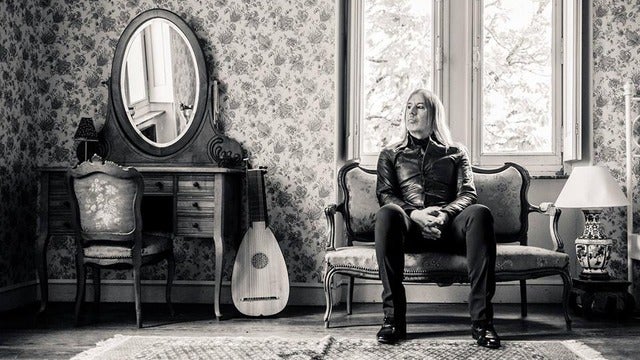
The instruments themselves are the argument. Van Wissem plays a 24-string lute fitted with a pickup and works it with a bottleneck slide; one of his theorbos, a 14-course instrument, has built-in microphones and a folding neck. He is blunt about how that lands with early-music audiences: "When I do this at a show, the first people who leave are the classical people. They can't stand it." His counter-argument is historical — the lute spent 250 years out of use, but before that it was in taverns and brothels as much as at court, so the genteel associations are a later invention. Of the instrument itself he has said it is "like a part of my body", and that its complexity is what keeps him at it, because there is always something new in it.
The largest recent commission is a new score for Robert Wiene's Das Cabinet des Dr. Caligari from 1920. It had its world premiere on 27 September 2025 in the Theaterzaal at De Vooruit in Ghent, presented jointly by Film Fest Gent and VIERNULVIER as part of the VIDEODROOM soundtrack festival, against the 67-minute silent print. The score opens with subdued solo lute and builds into layered drone on electric guitar, sound collage and spoken word. It has since travelled as a touring piece in its own right, including a performance at LUX in Nijmegen on 12 February 2026 programmed by Doornroosje, doors at 19:30 and music from 20:15.
The show, now
Two formats are in circulation this autumn and they are not interchangeable. The solo show carries the new material from This Is My Blood — cinematic slide-lute pieces evoking deserted contemporary landscapes, played alone on amplified lute with pedals, pitched at volume rather than at chamber level, and built from cycling figures that are repeated until they settle. The other is the full 67-minute live accompaniment to Das Cabinet des Dr. Caligari, which starts on quiet unaccompanied lute and ends in layered drone, electric guitar, sound collage and spoken word; it is programmed as a screening rather than a gig, which is why the routing mixes clubs with cinemas and churches — Kino Rotterdam, Kino Cameo in Winterthur, Kino Muranów in Warsaw, the Chiesa Luterana in Trieste. Support is usually a single local opener or none at all. Songkick logs more than 350 past shows, with New York (24), London (23), Warsaw (13), Paris (13) and Berlin (11) his most-played cities; recent stops include Bologna on 26 July 2026, Rome on 8 October and Arci Bellezza in Milan on 16 October 2026. Two dates are currently on sale: Rust in Copenhagen on 25 October 2026 and Klub Zaścianek in Kraków on 8 November 2026. Audiences split along predictable lines — the slide work and the pickup are what early-music listeners walk out on and what experimental crowds come for.
Researched from en.wikipedia.org · jozefvanwissem.bandcamp.com · soundohm.com · paris-move.com · magnetmagazine.com · silentradio.co.uk · guitarplayer.com · britbrief.co.uk