
Arts & Theatre · Theatre · Musical
Matilda the Musical (Touring)
No dates on sale right now · on Ticketmaster
Not on sale
We check the ticketer every hour
The profile · researched 6 September 2026
RSC’s Matilda the Musical takes its classroom back on the road
Fifteen years after its West End transfer, the Royal Shakespeare Company’s Matilda the Musical is in the middle of a second large‑scale UK and Ireland tour, with 2026 dates rolling through major receiving houses and local reviews charting how the show plays outside London.
From Stratford to the world: how Matilda became a touring staple
Matilda the Musical began at the Royal Shakespeare Company’s Courtyard Theatre in Stratford‑upon‑Avon, where it gave its first public performance on 9 November 2010. That initial Christmas run proved decisive: a purpose‑built family show with a brand‑new score by Tim Minchin and a book by Dennis Kelly that felt written to sit in a major repertory’s seasonal slot, but robust enough to travel.
Within a year the production moved to London, transferring to the Cambridge Theatre; after preview adjustments, the West End opening landed on 24 November 2011 and the show has remained the building’s resident musical ever since. The RSC’s own account frames those early weeks as a pivot from seasonal hit to long‑runner.
Awards attention followed. At the 2012 Laurence Olivier Awards, Matilda won seven trophies – then a record haul for a musical – before heading to New York, where it opened at the Shubert Theatre on 11 April 2013 and later earned five Tony Awards, including Best Book of a Musical for Dennis Kelly. The Olivier tally has since been equalled but not surpassed; the Tony win fixed Kelly’s adaptation in the contemporary canon.
The show has proved unusually exportable for a piece that uses British school culture so specifically. After Broadway, the RSC and partners built North American and Australian touring companies (the latter collecting 13 Helpmann Awards), while London continued to run. The film adaptation premiered in October 2022, widening the property’s audience before its post‑pandemic stage life settled again.
The work that matters: Minchin’s score, recordings and the screen version
Tim Minchin’s writing – contrapuntal classroom patter, lullabies that turn on a moral, and playground anthems that read as self‑assertion – shaped Matilda’s identity on tour and in town. The Original Stratford/London cast recording arrived in September 2011, putting the show’s vocabulary (Naughty; School Song; When I Grow Up; Revolting Children) into circulation before the West End opening. A Broadway cast album followed in 2013.
Those titles remain the structure of a night out. Guides to the score consistently highlight School Song’s letter‑by‑letter gate‑climb and the swing sequence of When I Grow Up – stage pictures recreated in touring houses with the same design grammar. The 2022 film kept much of the song list, adding a new closing number for the screen; it premiered at the BFI London Film Festival on 5 October 2022 and hit Netflix in late December in the United States.
The second UK & Ireland tour: what’s on the road in 2025–27
The RSC announced a second UK and Ireland tour opening in October 2025, a follow‑up to the 2018–19 itinerary. The early leg ran Curve Leicester (6–25 October 2025), Bradford’s Alhambra (30 October–23 November 2025), Liverpool Empire (2 December 2025–4 January 2026), Theatre Royal Plymouth (13 January–7 February 2026), Sunderland Empire (11–28 February 2026), Edinburgh Playhouse (4–22 March 2026) and Palace Theatre Manchester (26 March–25 April 2026).
Further dates were confirmed in an RSC update on 13 March 2025: Southampton’s Mayflower (29 April–17 May 2026), Bristol Hippodrome (2–27 June 2026), Birmingham Hippodrome (1 July–2 August 2026), Norwich Theatre Royal (6 August–6 September 2026) and Milton Keynes Theatre (28 October–14 November 2026). These add to a schedule that now stretches deep into 2026 across major regional venues.
The tour sits alongside the ongoing West End run at the Cambridge Theatre, with the company marking 15 years in London during 2026. The producers note more than 100 cities played worldwide and over 13 million tickets sold across the property’s lifetime, figures that underline why a second national lap was commercially justifiable.
How the touring production looks and runs
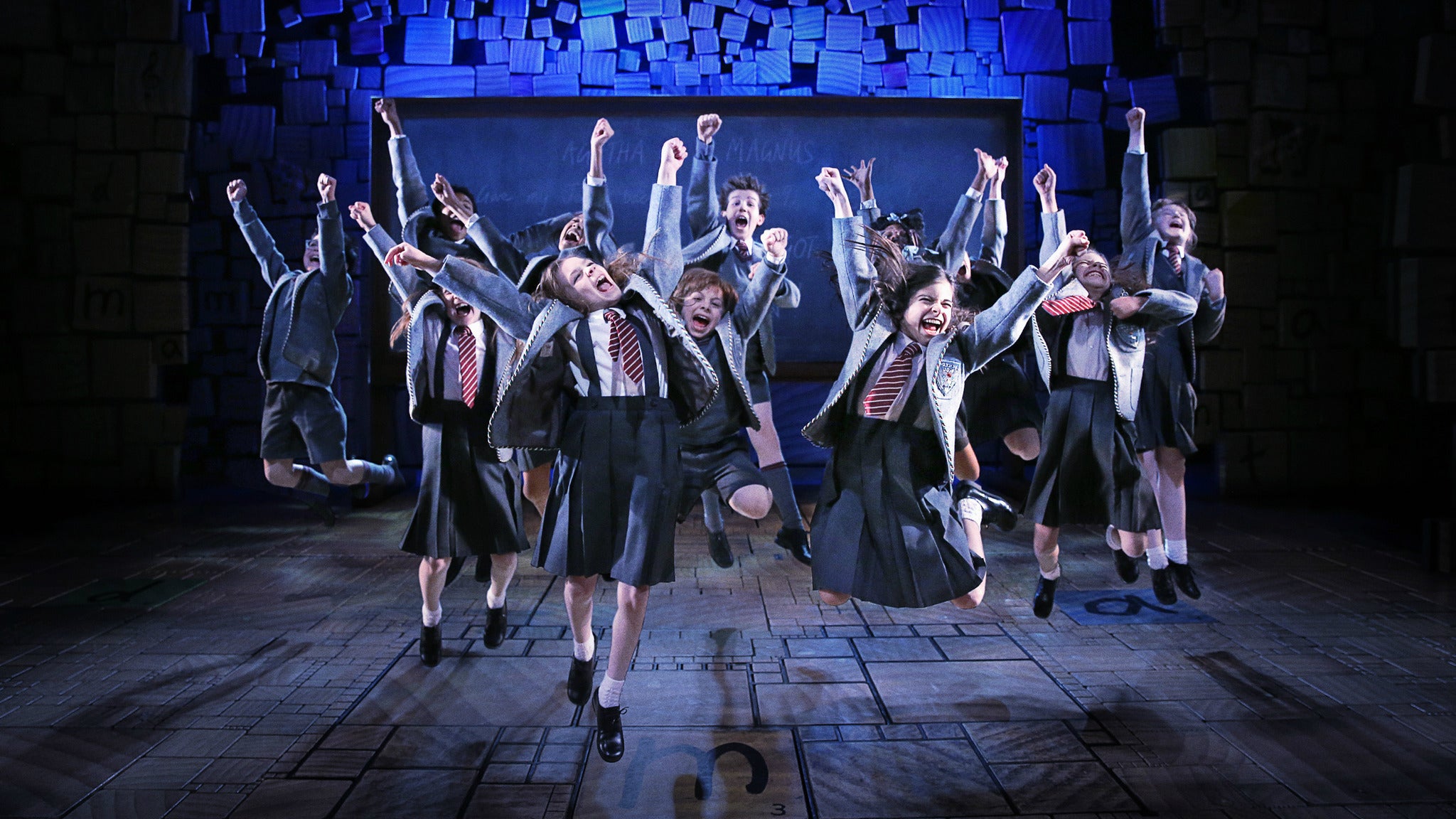
The tour preserves Matthew Warchus’s original staging and design language. Peter Darling’s choreography, Rob Howell’s set and costumes and Paul Kieve’s illusions travel intact: giant alphabet tiles stack into walls and desks; school gates become a climbing frame for School Song; seesaws and swings summon an entire playground for When I Grow Up; and props work at scale without feeling cumbersome in receiving houses. The production itself likes to share granular backstage facts – including the way the blackboard tracks miles over a year – details that give a sense of the show’s engineered precision.
Running time is consistently billed as approximately two hours 35 minutes including one interval, a rhythm that has proved friendly to early‑evening family starts on tour. Venue and promoter pages match the show’s own FAQs on this point. There’s no support act: it’s a conventional two‑act musical with a 20‑minute break.
Creative credits are central to Matilda’s portability: Kelly’s book finds theatrical equivalents for Dahl’s narrator, Minchin’s score carries narrative weight, and the design solves quick gear‑changes with mechanical, lighting and illusion support. That same blend has historically impressed awards juries (seven Oliviers in 2012; five Tonys in 2013 including Kelly’s Best Book), and remains the template on the road.
What recent reviews say on the 2026 legs
The 2026 spring leg across the North East and Scotland generated a flurry of local notices. In Sunderland (11–28 February 2026), British Theatre Guide reported the piece “gets off to a bang” and folded Matilda’s awards history into a primer for first‑timers; the note captures how the show now tours as a known quantity whose opening minutes act as re‑orientation for mixed‑age audiences.
At Edinburgh Playhouse (4–22 March 2026), outlets from The Edinburgh Reporter to BroadwayWorld filed upbeat write‑ups, with praise for delivery of the Minchin songbook – especially Naughty – and for the stage pictures that the show transports from London without dilution. One Edinburgh‑based reviewer also marked minor sound‑balance issues in ensemble lyrics during School Song, a frequent challenge in very large houses; otherwise, reaction stressed clarity of storytelling and scale.
Manchester (26 March–25 April 2026) played as an anniversary stop as the tour overlapped the show’s 15th West End year. While mainstream regional outlets treated the engagement as a returning hit rather than a novelty, the consistent through‑line across coverage is that the production’s mix of wordplay, physical comedy and a children’s ensemble drilled to pro level still lands with families – precisely the constituency national touring is built to reach.
Where Matilda sits now
By September 2026, Matilda is operating as a two‑track concern: the original West End production celebrating its 15th year in London, and a sizeable tour moving through England and beyond. The RSC’s public‑facing materials make a virtue of the show’s longevity and geographic range – more than 100 cities, 101 international awards – and the touring schedule continues through autumn 2026 with bookings announced months in advance. For an act of classroom rebellion devised in Stratford‑upon‑Avon in 2010, that’s an unusually sturdy long game.
The show, now
On the 2025–27 tour, Matilda plays as a straight two‑act evening or matinee of roughly 2 hours 35 minutes including a 20‑minute interval. There’s no support; the format mirrors the West End original, with the same creative blueprint and key set‑pieces. School Song remains the early showstopper, the cast scaling school gates as letters slot into place; When I Grow Up still deploys the swing set that seems to float out over the stalls; Naughty and Revolting Children book‑end a second act that accelerates through Miss Trunchbull’s comeuppance. The touring design carries Rob Howell’s alphabet‑tile environment and Paul Kieve’s illusions into large auditoriums, where local reviews in 2026 praised the scale and pace in Sunderland and Edinburgh, with one Edinburgh notice also noting some lyric intelligibility dips high up during School Song in the cavernous Playhouse – a reminder that this is a West End‑sized machine playing very big rooms. Running times and interval setup are consistent across venue, as per the production’s own FAQ and theatre listings.
Researched from rsc.org.uk · tour.matildathemusical.com · uk.matildathemusical.com · rsc.org.uk · tour.matildathemusical.com · uk.matildathemusical.com · cdn2.rsc.org.uk · timminchin.com
Pictures
Photographs from Wikimedia Commons, credited
 Philafrenzy · CC BY-SA 4.0
 Blethering Scot · CC BY-SA 3.0

