On tour
Every date the ticketer lists, worldwide · venue time
Listen
SoundCloud
The profile · researched 30 September 2026
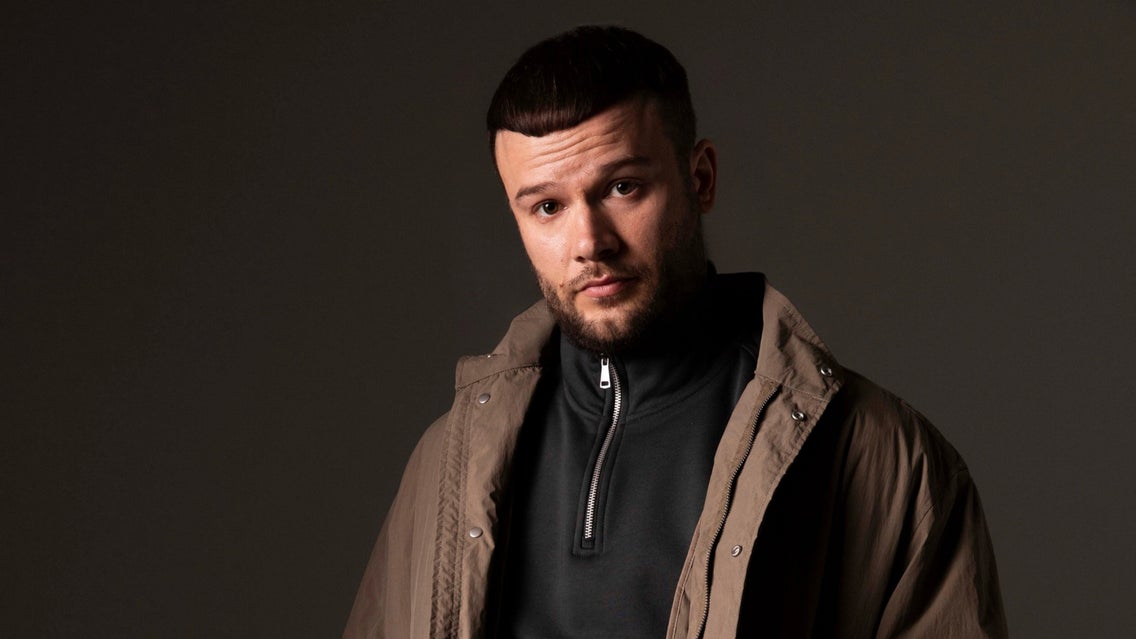
Max Korzh: the stadium act with 60,000 fans and nowhere left to play at home
A Belarusian rapper who left the country in October 2024 under threat of prosecution, Korzh now fills 40,000- and 50,000-seat stadiums across Europe with a diaspora audience — and keeps running into authorities who would rather he did not.
Luninyets, a borrowed $300 and a viral upload
Maksim Anatolyevich Korzh was born on 23 November 1988 in Luninyets, a small town in what was then the Byelorussian SSR. His parents were entrepreneurs who put him into music school early. At sixteen he formed Lun Clan with friends, a Belarusian-language rap group that released a single album in 2007 and folded in 2010.
The solo career began with a gamble rather than a plan. Korzh was studying at Belarusian State University and dropped out in his third year, borrowed $300 from his mother, and recorded "Nebo pomozhet nam" with the electronic production team Magic Sound. He then went off to do military service. By the time he came back the track had spread across VKontakte without him, and he spent the following stretch pushing it to Minsk DJs to get it into club rotation.
The debut album Zhivotniy mir followed in 2012, sixteen tracks and his first music video, and he signed to the Russian label Respect Production. What he had landed on was a hybrid rather than orthodox rap: rap and hip-hop sitting against pop and rock structures, built for crowds singing back rather than for close listening.
Six albums and an early arena record
The commercial arc moved quickly. In 2013 he became the first Belarusian musician to sell out Minsk-Arena, drawing 13,000, and was nominated for Breakthrough Artist at the Muz-TV Awards. In 2014 he took Best Album at Muz-TV for Zhit' V Kaif and released a third record, Domashniy. In 2015 came three further Muz-TV nominations, including Best Hip-Hop Artist and Best Live Show — the last of those a fair reading of where his real strength lay.
The fourth album arrived split in two, Maliy povzroslel Pt. 1 and Pt. 2 across 2016 and 2017. He sold out Minsk-Arena a second time on 8 December 2017, toured the United States for the first time in 2018, and released Психи попадают в топ in 2021. He won a VK Music Award in December 2022. The catalogue now stands at six studio albums, and his most recent single, "Что ты несёшь", opened both of his big stadium sets this year.
The songs that survive into the current live show span the whole run, from "Nebo pomozhet nam" through "Stilevo", "Sozhzheny", "Wake Up", "Optimist", "Balkony" and "Gde tvoya lyubov' Amsterdam". Very little of the early material has been retired.
The politics, and the cost of them
During the 2020 protests in Belarus, Korzh posted on Instagram urging demonstrators to stop for their own safety, and was reported to have been near the Okrestina detention centre himself. In 2022 he released the anti-war track "Svoj dom" and publicly condemned Russia's invasion of Ukraine. The consequences were immediate and commercial: organisers cancelled his Russian tour, and he then cancelled Belarus and Ukraine himself, saying he could not perform while people were being killed. At a Riga show in September 2023 he had the audience chant "No to war".
In October 2024 he left Belarus altogether. State security had summoned him over displaying the white-red-white opposition flag at concerts abroad and over his earlier anti-war statements. Officials said no criminal case had been opened, but warned that further association with people the state designates as "extremist" could trigger prosecution.
That history is inseparable from who turns up. His audience is now largely Belarusian, Ukrainian and Russian-speaking diaspora, and the shows have become gathering points for people who cannot easily gather anywhere else.
2025: Warsaw, and what it triggered
On 9 August 2025 Korzh played Warsaw's National Stadium to 60,000 people. The tickets had gone in five days. The date was the fifth anniversary of the Belarusian presidential election that set off the 2020 protests.
The night turned into a Polish political incident. Fans broke from the stands onto the pitch in numbers security could not hold. Police detained more than a hundred people on charges ranging from drug possession and pyrotechnics to assaulting security staff and unauthorised entry. Separately, footage showed the red-and-black flag of the Ukrainian Insurgent Army in the crowd — a symbol tied in Poland to the Volhynia massacres of ethnic Poles, which Poland classifies as genocide. Interior minister Marcin Kierwiński announced investigations into the display of totalitarian symbols, and the stadium operator issued its own condemnation.
The fallout travelled. Korzh had a show booked at Almaty's Central Stadium for 6 September 2025, nine months in preparation since November 2024, with 35,000 tickets sold and more than 17,000 foreign fans expected. In late August the permit was pulled, officially over the state of the pitch and the need to protect it for FC Kairat's Champions League fixtures, though his team said protective covering had been planned and three weeks was enough for recovery. All tickets were refunded. "We did everything possible to make this concert happen," he said. "But the authorities firmly decided not to take responsibility for it." Asked why, his own summary was blunter: they had swung very hard in Warsaw.
Where things stand now
The 2026 run has been built almost entirely around single stadium dates in cities with large post-Soviet populations. He played Arena Națională in Bucharest on 23 May 2026, Beşiktaş Tüpraş Stadium in Istanbul on 6 June to a sold-out crowd of up to 50,000, and his Düsseldorf debut at the Merkur Spiel-Arena on 26 June, billed as his only German stadium show of the summer.
Istanbul repeated the Warsaw pattern in a lower key. Fans began arriving on 1 June, filling İstiklal Avenue and the Eminönü ferry terminal, chanting and setting off flares; on the day of the show, thousands walked in an unsanctioned march from Galataport along the Bosphorus to the stadium at around two in the afternoon. Turkish police put extra officers out but mostly redirected rather than dispersed the crowds, and no mass arrests were reported. Residents complained online about several days of disruption.
One date is currently on sale: Deutsche Bank Park in Frankfurt on 10 October 2026, with tickets released in late August. His official site also lists Novosibirsk, Yekaterinburg and Saint Petersburg as venues without dates attached — no scheduled shows, and nothing announced.
The show itself
These are long nights by any measure. Bucharest ran to forty songs: a twenty-seven-song main block, then an acoustic section of seven or eight numbers including "Stan'", "Nebo pomozhet nam" and "Taet dym", then back to full arrangements to finish on "Isklyuchenie". Istanbul ran roughly three and a half hours. Doors open two to three hours before the music, and the crowd is generally in place long before the start.
There is no conventional support act on the bill. The structure does the work instead — a sustained opening run, the acoustic drop in the middle, and a closing stretch built on the oldest and most familiar material. Stage production is stadium-scale, with pyrotechnics and a full lighting rig, but the defining element is the crowd rather than the design: flares, flags and mass singing that has twice now drawn police attention in its own right.
The show, now
A Korzh stadium show in 2026 runs long and front-loads almost nothing. Bucharest's Arena Națională on 23 May delivered forty songs: twenty-seven in the main block, an acoustic mid-section of seven or eight — "Stan'", "Nebo pomozhet nam" and "Taet dym" among them — and then a return to full arrangements closing on "Isklyuchenie". Istanbul's Beşiktaş Tüpraş Stadium on 6 June lasted about three and a half hours in front of a sold-out crowd of up to 50,000, drawing across the whole catalogue from 2012 onwards: "Sozhzheny", "Stilevo", "Optimist", "Wake Up", "Control" and "Teplo". Doors open early — 4pm for a 6pm start in Bucharest — and the stands fill well ahead of time; the Düsseldorf show on 26 June ran from roughly 7.30pm to 11pm. No conventional support act is billed, and the shape of the night is the structure itself rather than a warm-up. Production is stadium-scale, with pyrotechnics and a full lighting rig, but the crowd is the event: flares, flags, chanting that starts in the streets days before the gig, and in Warsaw in August 2025 a mass movement from the stands onto the pitch that overwhelmed security and led to more than a hundred detentions. Istanbul residents complained about several days of disruption before the show; Turkish police handled an unsanctioned pre-gig march of thousands by redirecting it rather than breaking it up.
Researched from en.wikipedia.org · notesfrompoland.com · en.tengrinews.kz · en.belsat.eu · setlist.fm · setlist.fm · turkiyetoday.com · maxkorzh.live
Pictures
The ticketer's photographs