
On tour
Every date the ticketer lists, worldwide · venue time
The profile · researched 30 September 2026
Fourteen dancers, three nights, and a question asked at the 1916 centenary
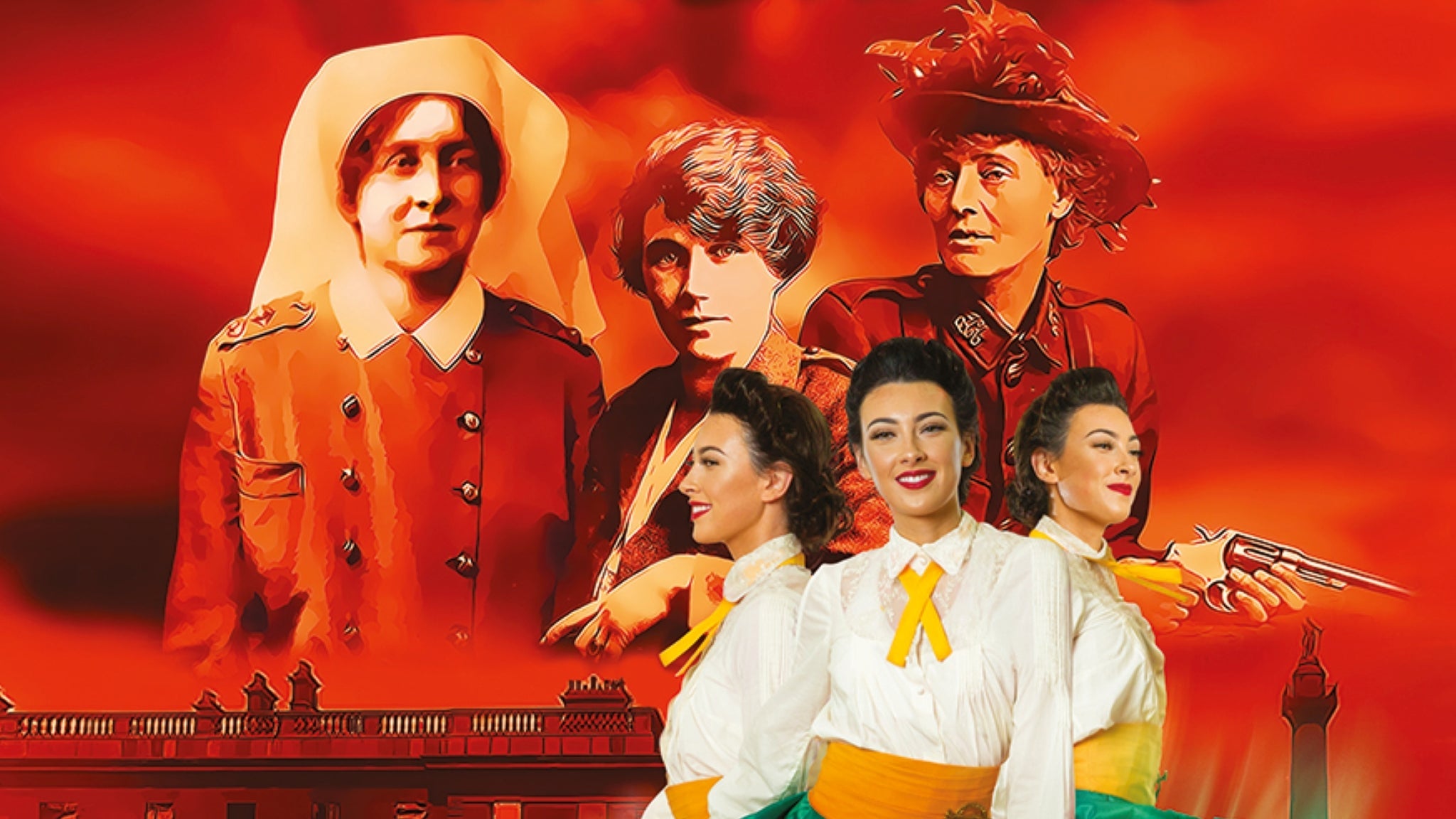
Mná na hÉireann is Carol Leavy Joyce's Irish dance theatre account of the women of 1912–1918, built over roughly a decade from a 2019 workshop in Dundalk into a three-night run at Dublin's Ambassador Theatre from 14 October 2026.
The question behind it
The production starts from something that happened in an audience rather than a rehearsal room. Carol Leavy Joyce attended the Easter commemorations of 2016 and came away asking where the women had been in what was marked. Interviews published in September 2026 put it plainly: the more research was done, the more the stories accumulated. What followed was archival work, workshops and fundraising spread across roughly a decade, with the Covid years cutting a hole in the middle of it.
The period covered is narrow and deliberately so: 1912 to 1918, the years in which women organised through Cumann na mBan, the Irishwomen's Council, and Inghinidhe na hÉireann, the Daughters of Ireland. The named figures are Countess Markievicz, the first woman elected to the British House of Commons; Nurse Elizabeth O'Farrell, who carried Pádraig Pearse's surrender to Brigadier-General William Lowe in April 1916; Dr Kathleen Lynn; Winifred Carney; Julia Grenan; and Grace Gifford. O'Farrell is a particular focus. The framing the company uses is not a chronology of events but the relationships between the women — friendships, loyalty, loss and what came after.
Who is making it
Leavy Joyce holds three World titles, three All Ireland titles and nine Ulster titles, and spent eight years with Riverdance as Irish Dance Director and Assistant Director. The choreographic credits outside that include Broadway's The Pirate Queen in 2007 and productions staged in Japan and Norway, plus The Rising Step, co-created and choreographed in 2008. There is an academic strand too: an MA in Ethnochoreology from the University of Limerick in 2011, and part-time lecturing in musical theatre at Dundalk Institute of Technology.
The co-choreographer is Michael Patrick Gallagher, a two-time World Champion and five-time All Ireland Champion who joined Riverdance in 1996 and stayed with the show for more than seven years, later appearing on Dancing with the Stars and now running a dance school in Phoenix, Arizona. Gallagher also took a Limerick ethnochoreology MA, in 2014, as did movement director Ella Clarke in 2019 — three of the core creatives came through the same postgraduate route, which shows in how the traditional steps are handled as material rather than as a fixed repertoire.
Dundalk, September 2019
The work first met an audience as a workshop production at An Táin Arts Centre in Dundalk, running from 4 to 8 September 2019 with an 8pm curtain and tickets at €25 and €20. It was billed then as a celebration of the women of the revolution, and the listing named a creative team that has largely held: choreography by Leavy Joyce and Gallagher, a newly composed score by Áine McGeeney, movement direction by Ella Clarke, lighting by Sebastian Pizarro, set by Jason Byrne and costumes by Eileen Johnston.
That run is where the spoken material was worked out. Dramaturg Declan Gorman adapted the texts during the 2019 workshop process alongside Clarke and McGeeney, and the structure tested there — dance carrying the narrative, with music, poetry and narration between — is the structure the 2026 staging inherits. Gorman's own background is in theatre rather than dance: nearly four decades as actor, writer, director and teacher, co-founder of Co-Motion, artistic director of Upstate in Drogheda from 1997 to 2010, and co-writer and director of a 2022 production staged at Kilmainham Gaol and Smock Alley drawn from a republican writer's prison notebooks.
What 2026 adds
The Dublin production keeps the choreography and score and rebuilds everything around them. Video set design comes from COSMOAV, a French audiovisual company founded in 2003 in Ivry-sur-Seine whose usual work is video mapping, monumental projection and immersive environments — an unusual hire for an Irish dance show and the clearest signal that the staging is projection-led rather than built from flats. Lighting is by Sonya Fossett, costumes by Thérèse McKeone, whose credits include Oklahoma at the Bord Gáis Energy Theatre, two seasons of RTÉ's Dancing with the Stars and an Irish Times Theatre Award nomination for The Nose. Anthony Davis handles sound design, playback arrangement and programming.
Narration is delivered by Carla O'Brien, a former World Champion Irish dancer and Riverdance lead who now presents RTÉ's Crimecall, and the narration text is drawn from the poetry of Eavan Boland. Using Boland — a poet whose subject was repeatedly the women left out of the national story — is the production arguing its own case through its choice of writer.
McGeeney's score is the other continuity. A founding member of the band Goitse, with five albums, a BA in Irish music and dance and an MA in Irish music performance, McGeeney has played lead fiddle with Lord of the Dance, was named Female Vocalist of 2016 by Irish American News, and had already written commissioned suites for the 1916 centenary and, in 2018, for the First World War centenary. Clarke brings a different training again: a 1993 graduate of the Perm State Choreographic Institute in Russia, movement director on Irish Times Theatre Award-winning work for the Gate and Loose Canon, nominated for best movement direction at the 2020/21 Irish Times Irish Theatre Awards, on the faculty of the TU Dublin Conservatoire of Drama since 2001, and a doctoral researcher at Trinity College Dublin from 2021 to 2025.
The company on stage
The Dublin cast runs to fourteen principal performers plus two dance captains, drawn from dance schools across the island. Siobhán Phelan plays Countess Markievicz, Enya Higgins plays Elizabeth O'Farrell, Zoe Talbot plays Winifred Carney and Jade Ryan plays Grace Gifford, with an ensemble assembled from both competitive Irish dance and musical theatre.
Ryan's route in is typical of the casting. From Castletroy and now living in Newport, Co. Tipperary, dancing for the Flynn O'Kane Academy in Nenagh, Ryan placed fourth at the World Irish Dance Championships and took a team first in Chicago in 2026, graduated from college and is starting out professionally with this production. Competitive Irish dance produces a large pool of technically finished performers each year and very few narrative roles for them; giving those dancers named historical characters to play, with acting demands attached, is the harder ask the show is making of its cast.
Where it stands now
As of the end of September 2026 the announced run is three performances and nothing else: Wednesday 14 to Friday 16 October 2026 at the Ambassador Theatre on Upper O'Connell Street, Dublin 1, at 7.30pm, with tickets at €39 including booking fees through Ticketmaster. No further tour dates have been published, which makes this a short Dublin season rather than a touring show, and a test of whether the full staging can support a longer life.
Irish press picked it up steadily through September: a Journal of Music listing on 1 September, a feature in the Irish News on 9 September carrying the line that these women deserve to be seen, heard and remembered, and a piece in IMAGE on 24 September. There are no critical notices yet, because the 2026 production has not opened — the 2019 Dundalk run was a workshop staging, and the Ambassador nights are the first public performances of the finished version. The company's own framing leans on a line from Mary Robinson quoted on the show's website, about wanting women who have felt themselves outside history written back into it.
The show, now
The current staging runs about one hour 45 minutes plus an interval, starting at 7.30pm, and it is a single theatre bill with no support act. The form is traditional Irish dance set against contemporary movement and non-traditional staging, cut with Áine McGeeney's original score, song, poetry and narration — the narration spoken by Carla O'Brien in words drawn from Eavan Boland. Fourteen principals and two dance captains carry it, with Siobhán Phelan as Countess Markievicz, Enya Higgins as Nurse Elizabeth O'Farrell, Zoe Talbot as Winifred Carney and Jade Ryan as Grace Gifford, so the dancing is attached to named characters rather than to abstract ensemble numbers. Visually it rests on projection: the French company COSMOAV, which normally works in video mapping and large-scale architectural projection, designed the video set, with lighting by Sonya Fossett, costumes by Thérèse McKeone and sound design and playback programming by Anthony Davis. The structure moves through the years 1912 to 1918 by way of the women's relationships — organising, the Rising, its aftermath — rather than as a narrated timeline. There are no audience or critical verdicts to report yet: the only prior public performances were the 2019 workshop run in Dundalk, and the full production does not open at the Ambassador until 14 October 2026.
Researched from journalofmusic.com · journalofmusic.com · irishnews.com · image.ie · dublin.ie · mnanaheireanntheshow.ie · mnanaheireanntheshow.ie · ilovelimerick.ie