
On tour
Every date the ticketer lists, worldwide · venue time
Listen
Top tracks on Spotify · SoundCloud
The profile · researched 26 October 2026
From a Montevideo school hall to Las Ventas: inside No Te Va Gustar's longest year on the road
No Te Va Gustar have spent three decades turning Uruguayan rock, candombe and a brass section into stadium music across Latin America. In 2026 they are touring Florece en el caos, their twelfth studio album, on the biggest European run they have ever attempted.
A band named by accident in Malvín
No Te Va Gustar began on 26 June 1994, when a group of teenagers from Liceo 10 in the Montevideo neighbourhood of Malvín played a school band festival. The first line-up was a straightforward rock trio: Emiliano Brancciari on guitar and voice, Mateo Moreno on bass and Pablo Abdala on drums. The name came out of a conversation rather than a plan — asked what they were calling themselves, one of them answered "no te va gustar", meaning "you won't like it", and it stuck.
Between 1996 and 1997 the group widened out, adding percussion and a horn section and pulling reggae, candombe, ska, salsa and murga into what had been a guitar band. That mix is still the core of the sound: rock songs with trumpet, trombone and saxophone lines doing the work a second guitar would do elsewhere. Recognition arrived in 1998 with wins at the Third Song Festival of Montevideo and a competition run by the city council's youth commission.
Brancciari was born in Buenos Aires to an Argentine father and a Uruguayan mother and raised largely by the women of his family in Montevideo, an upbringing he has linked directly to his songwriting. He is the only founder still in the line-up.
Records, gold discs and a long churn of members
The debut, Solo de noche, was recorded in July 1999 and released independently that December, produced by Juan Campodónico. Este fuerte viento que sopla, cut in Santiago de Chile in 2002, went gold within six months and settled the band's position in Uruguayan rock. Aunque cueste ver el sol followed in 2004, launched with a concert for 10,000 people and a tour of more than 40 European cities — the first sign that the audience extended well beyond the Río de la Plata.
The line-up then turned over almost entirely. Moreno and Abdala left after Todo es tan inflamable in 2006; Diego Bartaburu came in on drums and Guzmán Silveira on bass. Pablo Coniberti joined on guitar in 2009. El camino más largo arrived on 22 October 2008 and Por lo menos hoy in 2010, the latter presented to 60,000 people in Montevideo on 19 March 2011 and bringing the band their first two Latin Grammy nominations, for Best Rock Album and for the song "Chau".
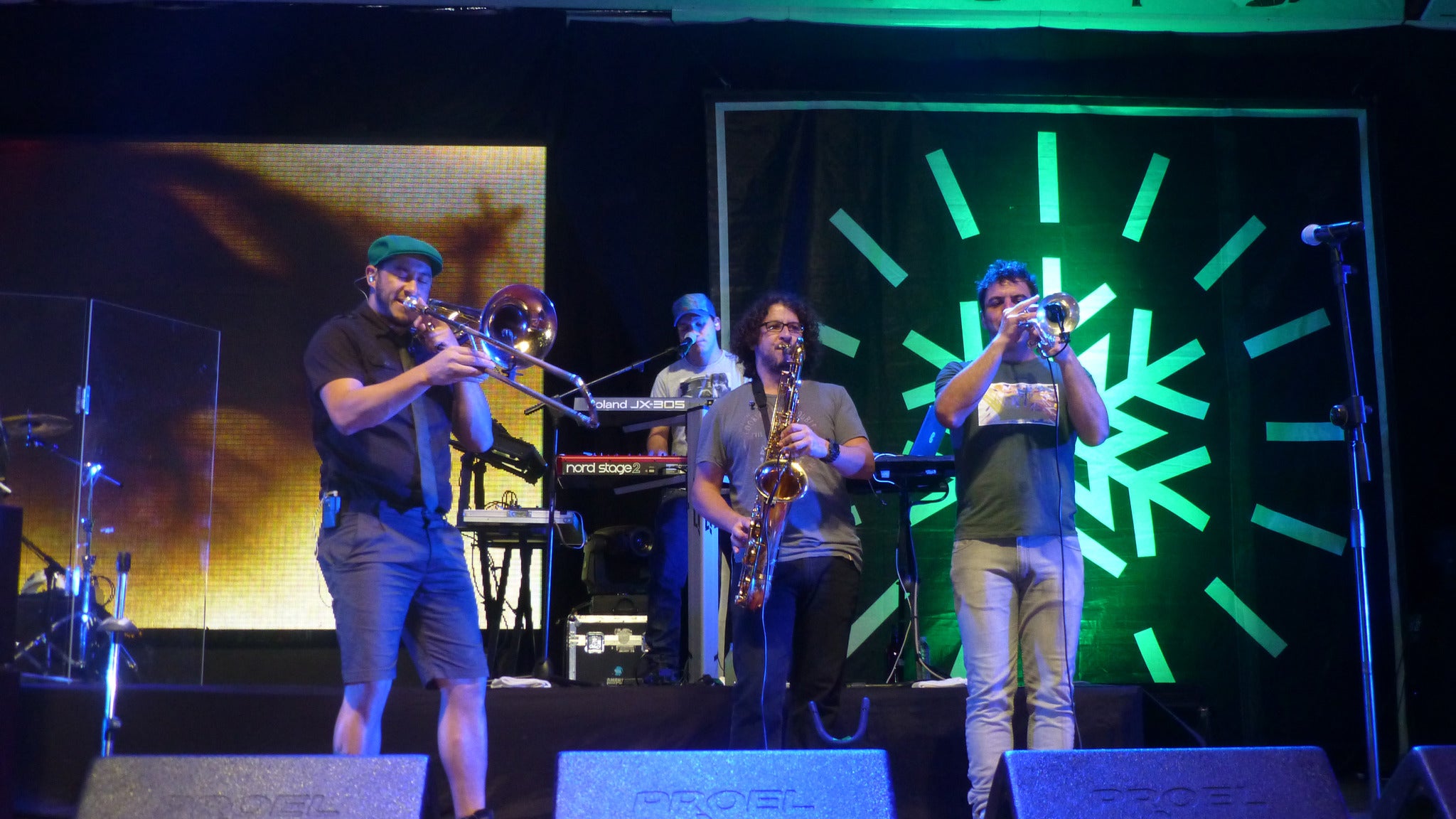
Founding percussionist Gonzalo Castex, the last link besides Brancciari to the school-hall version of the band, left in 2020. The current eight-piece is Brancciari, Martín Gil on trumpet, Denis Ramos on trombone, Mauricio Ortiz on saxophone, Bartaburu, Silveira, Coniberti and Francisco Nasser on keyboards.
A death, then the biggest records of their career
On 14 July 2012 keyboard player Marcel Curuchet died after a motorcycle accident on the New Jersey Turnpike. He was 28. El calor del pleno invierno, released that October, became the band's first album to reach number one in both Uruguay and Argentina, certified gold and platinum within three days, and produced further Latin Grammy nominations, including one for "A las nueve". Nasser took the keyboard chair in 2012.
El tiempo otra vez avanza, released on 9 October 2014, was produced by Joe Blaney and brought in Hugo Fattoruso and Charly García as guests, pushing further into folkloric Argentine material, funk and murga. Suenan las alarmas followed on 2 June 2017 through Bizarro Records, produced by Héctor Castillo. For the band's 25th anniversary they recorded Otras canciones over two nights in December 2018 at the Sala Hugo Balzo, reworking the catalogue acoustically with Julieta Venegas, Jorge Drexler, Draco Rosa and Flor de Toloache.
Luz, the tenth album, came out on 7 May 2021 after sessions in José Ignacio the previous October. Its singles marked the band's first real streaming-chart presence: "No te imaginás", released on 8 January 2021, was their first entry on the Billboard Argentina Hot 100, and "Venganza", released that March with Nicki Nicole, took on gender violence from the victim's point of view.
Thirty years, eighteen countries, and a studio rebuilt
The Gira 30 Años dominated 2024 and 2025. It opened in Atlántida, Uruguay, in front of 50,000 people, took in Vive Latino in Mexico City, sold-out Movistar Arena dates in Buenos Aires and Bogotá, and a crowd of 30,000 on Montevideo's Rambla. By the end it had covered 18 countries — Argentina, Uruguay, Chile, Peru, Brazil, Mexico, Paraguay, Ecuador, Colombia, the United States, Spain, Ireland, the United Kingdom, Denmark and the Netherlands among them — and more than 70 cities. It finished on 8 November 2025 at the Estadio UNO in La Plata, a city Brancciari has described as feeling like home.
Speaking to Infobae in October 2025, Brancciari explained why the band has never moved its base to Buenos Aires despite the logistics: every member has children, and in Uruguay, as he put it, the rockstar figure does not exist — they do their own errands and pay their own bills. He also described how long it took to get comfortable fronting the group, playing side-on and looking at the floor until the others pushed him to centre stage at Cosquín in 2009.
In May 2025 the band moved into Parque Rodó and rebuilt their own studio, a refitted Elefante Blanco, specifically to make the next record there.
Florece en el caos
The twelfth studio album, Florece en el caos, was released on 8 January 2026: ten songs recorded in Montevideo with producer Nico Cotton and engineer Carlos Imperatori. The title points at both the state of the world and the band's own internal churn, with chaos treated as a source of momentum rather than only a problem.
The record is harder and more direct than Luz without losing the melodic shape the band is known for. It opens with the political "Halcones y payasos" and closes with "Cartas por jugar"; "La noche de ayer" got an official video. The advance singles were "En llamas" and "Todo mal", the latter featuring Andrés Ciro Martínez of Los Piojos and Ciro y Los Persas — a pairing of two of the most recognisable voices in rioplatense rock, built on a harmonica intro and clearly aimed at stadiums.
Announcing the Mexican leg in February 2026, Brancciari said the point of the record was to avoid becoming "a tribute band to what we were", and described the songs as the group's way of taking shelter.
The 2026 route
The album was launched live at the Estadio de Ferro in Caballito, Buenos Aires, in April 2026 before more than 30,000 people: 40 songs across roughly three hours, with images of the disappeared projected during the politically weighted material and references to Argentina's dictatorship and the 1999 Floresta killings. Brancciari's nephew Gonzalo appeared on a newly written song.
Six Mexican dates ran from 21 August in Zapopan through Querétaro, Puebla, San Pedro Garza García and León to the Pepsi Center WTC in Mexico City on 29 August — the band's 35th show of a year scheduled to run to around 70.
The European leg, the longest the band has mounted, ran through October: Milan, Paris, London's O2 Shepherd's Bush Empire, Dublin's Button Factory, Copenhagen and Berlin, then eight Spanish dates taking in Bilbao, Santiago de Compostela, Málaga, Mallorca and Valencia. As of late October the run still has Zaragoza's Oasis Club Teatro on 27 October, two nights at Razzmatazz in Barcelona on 29 and 30 October, and Madrid's Live Las Ventas on 1 November. After that come Argentine dates on 20, 21 and 22 November, Uruguayan shows in Salto on 4 December and Colonia on 5 December, and the Velódromo Municipal in Montevideo on 12 December. Cosquín Rock on 6 and 7 February 2027, the Arena Mar del Plata on 3 April and Festival Alaire in Lima on 5 June are already booked.
The show, now
A current No Te Va Gustar show runs long and loud: 40 songs over about three hours at the Estadio de Ferro in Buenos Aires in April 2026 in front of more than 30,000 people, and 32 songs over roughly two and a half hours at the Pepsi Center WTC in Mexico City on 29 August, from 8.42pm to just after 11pm. The opening is fixed — "Halcones y payasos", the new album's hardest track, straight into "No te imaginás" and "A las nueve" — and new material such as "En mil pedazos", "Paranoia" and "No somos nosotros" is threaded through the back catalogue rather than played in a block. There is a seated acoustic stretch in the middle ("Memorias del olvido", "Cartas por jugar", "De nada sirve"), and a closing run that reliably sets off a pogo during "Fuera de control" before "No era cierto" ends the night with the crowd jumping and holding on to each other. The eight-piece line-up puts trumpet, trombone and saxophone at the front of the arrangements; stadium shows add projections, including images of Argentina's disappeared during the political songs, while the European leg plays mid-sized halls such as Razzmatazz and the O2 Shepherd's Bush Empire with the same set and less production. Brancciari works the local angle hard — he dedicated "Una vida más" in Mexico City to Uruguayan musician Rubén Rada, who had died on 26 August, and dropped a solo snippet of Café Tacvba's "Esa noche", which the room recognised instantly. Reviewers of the 2026 shows have consistently praised the sound and lighting and the band's refusal, in Brancciari's own phrase, to become a tribute act to their old records.
Researched from en.wikipedia.org · infobae.com · fmrockandpop.com · lacarnemagazine.com · infobae.com · laganzua.net · songkick.com · cooltivarte.com
Pictures
Photographs from Wikimedia Commons, credited
 Mezzutt · CC BY-SA 4.0
 Leandro Kibisz (Loco085) · CC BY-SA 2.5
 Bicentenario Uruguay · CC BY-SA 2.0
 Bicentenario Uruguay · CC BY-SA 2.0


