Arts & Theatre · Cultural · Cultural
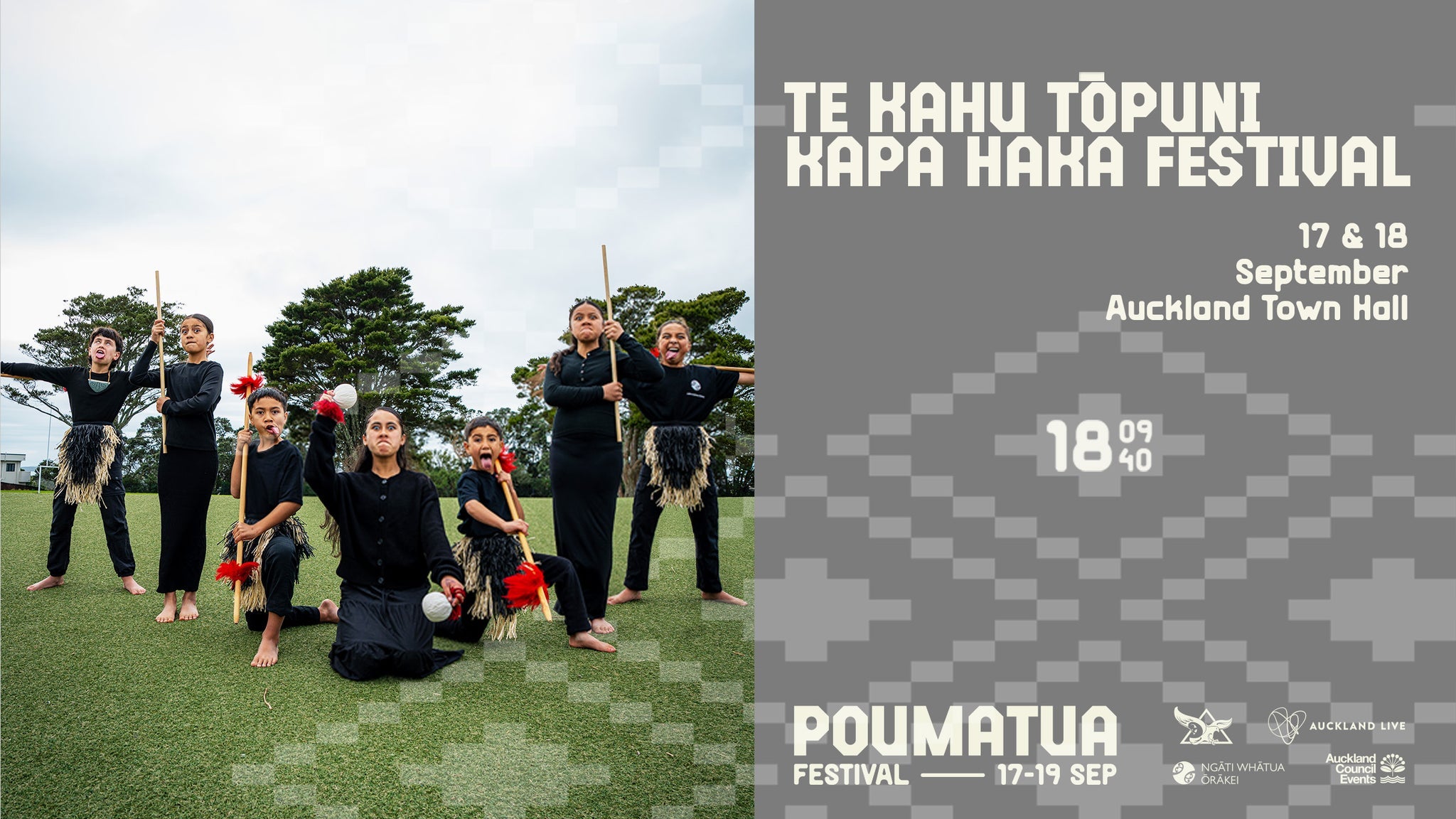
Te Kahu Tōpuni Kapa Haka Festival
No dates on sale right now · on Ticketmaster
Not on sale
We check the ticketer every hour
The profile · researched 8 September 2026
Twenty-one schools, four sessions and a Town Hall full of poi: Auckland's first Te Kahu Tōpuni
Te Kahu Tōpuni Kapa Haka Festival is the opening act of Poumatua, a new three-day Māori cultural festival in central Auckland. Over 17 and 18 September 2026 it puts primary school children on the Great Hall stage before four of the most decorated groups in kapa haka history close the weekend.
A festival that does not exist yet
Te Kahu Tōpuni is new. It has no back catalogue of previous editions, no archive of reviews and no roll of past winners, because it is non-competitive by design and because its first performance is still ten days away. What exists is a programme, a set of school names, a ticket price and the people who have put it together. This profile is built from those.
The festival was announced on 18 August 2026 in a press release from Tumutumuwhenua Cultural Trust, carried by Scoop the same day and picked up by Waatea News two days later. The trust is presenting the wider Poumatua Festival in partnership with Auckland Live, the council-owned operator of the Town Hall and Aotea Centre, with support from Ngāti Whātua Ōrākei and Auckland Council Events. General tickets went on sale at 9am on 19 August.
Poumatua as a whole runs from Thursday 17 to Saturday 19 September across three sites in the city centre: Auckland Town Hall, Aotea Square and Q Theatre. Te Kahu Tōpuni occupies the first two of those days in the Great Hall and is the part of the programme aimed squarely at children and their families.
Where it comes from
The festival grows out of a specific relationship between Ngāti Whātua Ōrākei and the city built on its land. At the centre of the Poumatua programme sits Tuku Whenua, a formal ceremony on the morning of Friday 18 September commemorating the allocation of land by the Ngāti Whātua rangatira Apihai Te Kawau that allowed Auckland to be established. The iwi's own festival page frames the 2026 ceremony as marking 186 years since that tuku whenua, and describes it as a gathering for Ngāti Whātua Ōrākei whānau.
Marama Royal, chair of Ngāti Whātua Ōrākei Trust, put the purpose plainly in the launch release: Poumatua, she said, is about he taonga tuku iho, remembering those who came before, celebrating who the people are today and creating something for those who will follow. Waatea News noted that the iwi now represents more than 8,000 registered whānau, and that the September festival follows on from the Matariki Herenga Waka event the iwi hosted in July 2026.
Huia Pihema of Tumutumuwhenua Cultural Trust described the intent as generational: a programme that brings tamariki taking the stage together with some of the most celebrated kapa haka rōpū in the country. Daniel Clarke, director of Auckland Live, said the organisation was proud to support the first Poumatua and to provide a platform for those stories, adding that seeing its venues and public spaces fill with tamariki, whānau and senior groups would be special.
The school programme
Te Kahu Tōpuni runs as four separate sessions, two each day. On Thursday 17 September the morning session runs from 9.30am to 12.05pm and the afternoon from 12.30pm to 3pm; Friday 18 September follows the same pattern. Each session is a rolling showcase of primary and intermediate school groups performing waiata, haka, poi and mōteatea, with items telling stories connected to Tāmaki Makaurau. Auckland Live lists the event as suitable for all ages and prices every seat at ten dollars.
The published line-up names twenty-one schools across the four sessions, with Meadowbank School appearing in both afternoon slots. Thursday morning brings St Francis Catholic School, Clendon Park School, Grey Lynn School, Point View School, Rutherford Primary School and Hobsonville Point Primary School. Thursday afternoon has Meadowbank, Te Rehu Westmere Primary School, Te Kira Tiwāwha ki Ohinerau, Halsey Drive School and Te Kura Kaupapa Māori o Ngā Maungarongo.
Friday morning is the session with the closest ties to the host iwi: Ōrākei School and Te Kura o Ōrākei share the bill with Pasadena Intermediate, Greenhithe School, Tirimoana School and Marist College. Friday afternoon closes the school programme with Meadowbank again, Parnell District School, Te Ipu Kura o Mataaho, Te Papapa School and Rangeview Intermediate School. The spread runs from Clendon Park in the south to Hobsonville Point and Greenhithe in the north-west, and mixes mainstream schools with kura kaupapa Māori and Catholic schools.
The finale: four groups, fourteen national titles
Te Kahu Tōpuni hands over on Saturday 19 September to Tuku Iho, subtitled Golden Years of Kapa Haka, which starts at 9am in the same hall. This is the programme's headline act and the reason the weekend has drawn attention beyond the schools involved. Four groups with long histories at Te Matatini, the national kapa haka championship held every two years since 1972, appear on one stage: Waihīrere, Te Waka Huia, Ngāti Rangiwewehi and Te Rōpū Manutaki. Ngāti Whātua ki Tāmaki open the morning as tangata whenua, and Auckland Anglican Māori Club appear as special guests.
The record of those four groups explains the billing. Waihīrere, from the Gisborne region, won the very first national festival in 1972 and added titles in 1979, 1988, 1998 and 2002. Te Waka Huia, based in Auckland, won in 1986, 1992, 1994, 2009 and 2013. Ngāti Rangiwewehi of Rotorua took the title in 1983 and 1996. Te Rōpū Manutaki, also an Auckland group, has two national wins, the second of them in 1990. Between them that is fourteen championships across the festival's first four decades.
The iwi's festival page describes the Saturday programme as a morning acknowledging the composers, tutors, leaders and performers behind those groups rather than a competition. As of the 18 August launch, tickets for Tuku Iho were listed as coming soon, separately from the school sessions and the Q Theatre talks that went on sale on 19 August.
Around the Town Hall
Two further strands fill out the three days. Mākete Whātua turns Aotea Square, immediately beside the Town Hall, into a free marketplace on Thursday and Friday, with Māori makers, artists, fashion, gifts and food. Tuku Kōrero, billed as Tāmaki Talks, runs at 6pm on both evenings at Q Theatre on Queen Street. It pairs established leaders with younger speakers on identity, belonging and the future of Auckland, in a format the organisers say is modelled on TED Talks. Speakers had not been published at the time of writing.
Waatea News placed the festival in a wider Auckland moment, noting that its dates sit alongside the opening of the City Rail Link, the underground line whose central stations sit close to Aotea Square. The Town Hall itself has hosted plenty of kapa haka before, but the city's most recent brush with the art form at scale was Te Matatini in February 2023 at Eden Park, the first time Auckland had staged the national festival since 2002. Te Whānau-ā-Apanui won that year; the 2025 festival moved to New Plymouth, where Ngāti Whakaue took the title.
Where it stands now
As of early September 2026 the position is simple. The programme, session times, ticket price and school line-up are published on Auckland Live. The finale line-up is confirmed and its opening protocol is set, though its tickets were still pending at launch. Nobody has reviewed Te Kahu Tōpuni because nobody has seen it. Whether it becomes an annual fixture, and whether the Poumatua umbrella returns in 2027, has not been announced by the trust or the iwi.
What can be said is that the event is unusually cheap for the venue, is structured so that a family can see one school session in a morning and be out by lunchtime, and is anchored to a ceremony with a date attached to it. Those are the facts on the table before the first child walks onto the Great Hall stage on 17 September.
The show, now
A Te Kahu Tōpuni session lasts about two and a half hours: 9.30am to 12.05pm or 12.30pm to 3pm on 17 and 18 September 2026 in the Great Hall of Auckland Town Hall. Five or six school groups take the stage in turn, each performing a bracket of waiata, haka, poi and mōteatea built around stories of Tāmaki Makaurau, and there is no judging or placings. Seats are ten dollars each and the event is listed as suitable for all ages. There are no support acts in the conventional sense; the festival's own finale on Saturday 19 September at 9am is a separate ticket, opened by Ngāti Whātua ki Tāmaki and featuring Waihīrere, Te Waka Huia, Ngāti Rangiwewehi and Te Rōpū Manutaki, with Auckland Anglican Māori Club as guests. Because this is the first edition, no audience reviews or press notices of the show exist yet.
Researched from scoop.co.nz · aucklandlive.co.nz · ngatiwhatuaorakei.com · waateanews.com · waateanews.com · kumaravine.com · aucklandunlimited.com · en.wikipedia.org
Pictures
The ticketer's photographs