On tour
Every date the ticketer lists, worldwide · venue time
The profile · researched 13 September 2026
The karaoke night that learned to book the Fillmore
Jason Mowatt turned a joke about Future records into a touring concert franchise in which the crowd is the act. A decade on, Trap Karaoke is running a twelve-date autumn 2026 routing through Fillmore-sized rooms and has mounted its first festival-scale outing in Chicago.
A joke about a Future record
Trap Karaoke started in the autumn of 2015, and it started as a bit. Mowatt was working at the social-broadcasting startup Thunderclap and had been turning over an idea for a browser plugin built around Future's music. Around the release of Dirty Sprite 2 he mentioned it to his friend John Wall, a fellow Future obsessive, who invited him along to a karaoke night with colleagues. Mowatt suggested the obvious upgrade — trap records rather than the standard songbook — and Wall handed him the name in the form of a question: "You mean, like a Trap Karaoke?"
That it became a business rather than a running joke has a lot to do with what Mowatt was already doing. He had worked on Trillectro, the Washington, D.C. festival, so his instinct was not to book a karaoke bar with a laminated binder but to build a full concert environment — proper staging, proper lighting, proper production — and then hand the microphone to whoever bought a ticket. Speaking to Black Enterprise in April 2016, he described the operation as self-sustaining, running on ticket sales, partnerships and sponsorship, and already eyeing secondary markets rather than the obvious coastal cities.
The framing he keeps returning to is civic rather than commercial. "I say that we're not party promoters, we're community organizers," he told Blavity. The other line he uses gets at the same thing from the opposite direction: Trap Karaoke, he says, is like going to church, except that instead of singing "Amazing Grace" the congregation is singing "Back That Azz Up". The stated aim is a room where people participate in the music rather than watch other people do it.
The work is the format
There is no discography here to weigh up, no special, no season. What has to hold up is the design of the room, and the design is more considered than the premise suggests. Performers are pulled from the floor rather than booked. A host works the crowd between turns. A DJ sits behind the selections and — critically — controls the fades, dropping a track down or out when whoever is holding the microphone runs out of lyrics, which is what stops the format from collapsing into three minutes of public embarrassment.
KQED watched an early version of this at close range. On 9 April 2016 the event took place in a West Oakland backyard, at a space called #RegularsOnly: a small wooden stage under a tent, vegetable beds along the edge, roughly 300 people in the rain. The promoter LowKey hosted and Leon "Dnas" Sykes DJed. LowKey set the terms plainly — if a performer is wack, the room can boo them off — and the crowd took him at his word without much needing to use the option. The songs that pulled hardest were not all trap: Lauryn Hill's "Ex-Factor", UGK's "International Player's Anthem", Too $hort's "Blow the Whistle" for the Bay Area contingent, Rihanna's "Work".
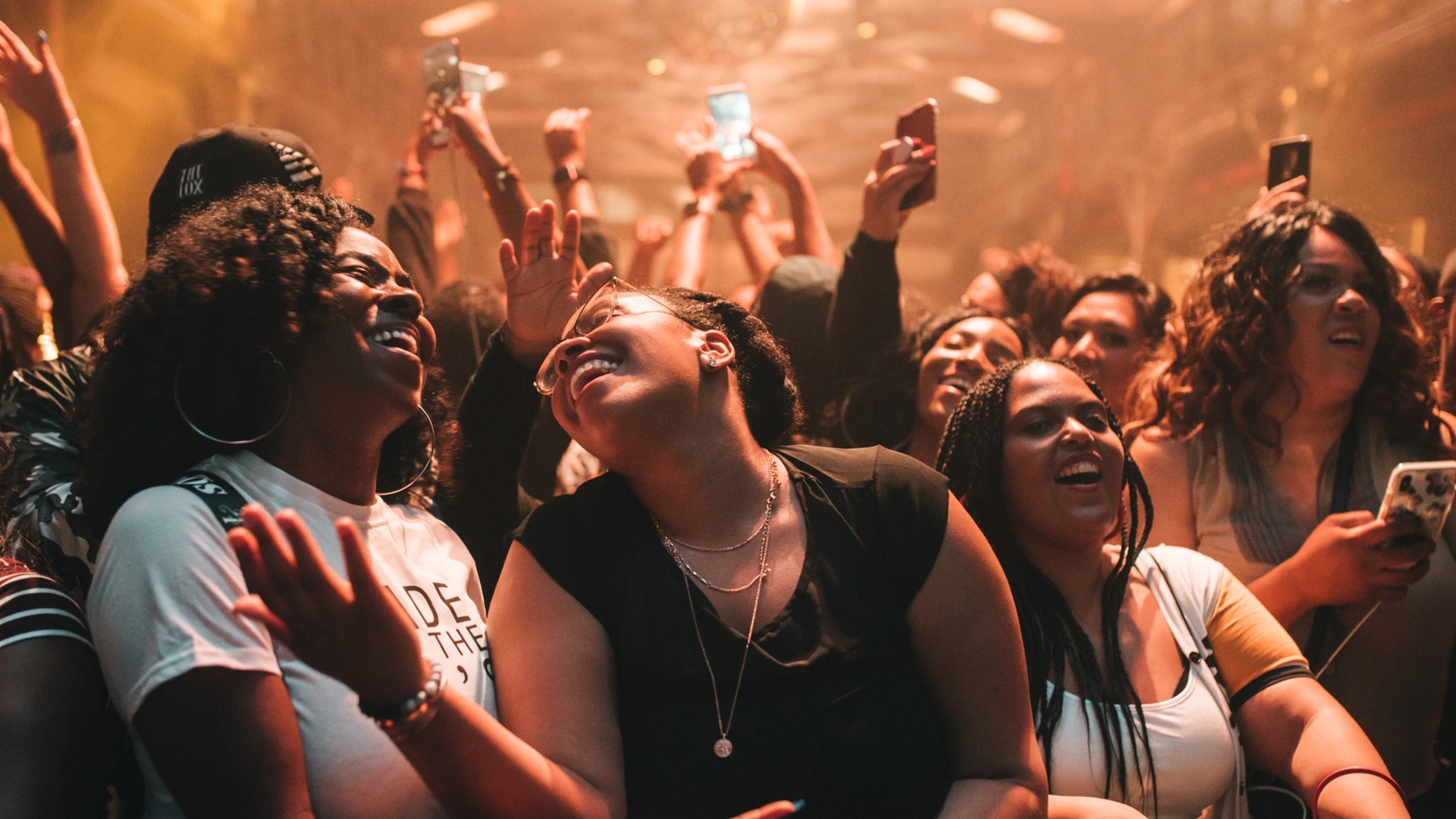
The detail that matters from that night is behavioural rather than musical. The crowd sang together first and only then began sending individuals up, which is the sequence the format is built to encourage. KQED described the result as joyfully chaotic — dancing enthusiastic enough to nearly bring down a heat lamp.
Scaling the room without breaking it
The move from a backyard to purpose-built venues is the part most participatory formats fail. Trap Karaoke made it by keeping the mechanics fixed and letting the room grow underneath them. A representative recent booking: The RITZ Ybor in Tampa on Friday 14 November 2025, a 21-plus, general admission standing-room show running from 7pm to midnight. The venue billed it as an interactive hip-hop karaoke touring experience and left the description at that, because by then the name did the explaining.
The other addition is the drop-in. The official site's gallery of past guests runs to Muni Long, Sisqo, Chance the Rapper, Ne-Yo and T.I., and Blavity noted LeBron James and T.I. among those who have turned up in the crowd. The guests are unannounced and structurally optional, which is the right way round: the show does not need one, so a night without a famous face is not a night that failed.
The musical remit widened along the way. Trap gave the thing its name, but Mowatt has been explicit that Afrobeats belongs in the room, and the guest list — Sisqo, Ne-Yo, Muni Long — points at how much R&B the format now absorbs.
Where it stands now
As of September 2026 the official site lists twelve upcoming dates, a routing that leans hard on the South and dips into the Midwest: Raleigh on 12 September, Richmond on the 18th, Baltimore on the 19th, New Orleans on the 25th and Houston on the 26th; then Jacksonville on 3 October, Miami on the 9th, Orlando on the 10th, Atlanta on the 16th, Memphis on the 17th and Milwaukee on the 24th; then Tampa on 6 November. Live Nation's listings fill in the rooms — The Fillmore New Orleans, the Bayou Music Center, The Fillmore Miami Beach at the Jackie Gleason Theatre, the Coca-Cola Roxy in Atlanta, Satellite Music Hall in Memphis. These are 1,500-to-3,500-capacity venues taking a booking with no headliner on the marquee.
The bigger development of the year sits just before that run. On 29 August 2026 the brand went to festival scale in Chicago with CuzFest, a partnership event built around the idea of strangers arriving as cousins, with Trap Karaoke: Chicago programmed inside it — described by the organisers as a night of singing, dancing, games and challenges. It is the clearest signal yet that the operation intends to be more than a touring night: the audience vocabulary, the cousins framing, has been spun out into an event of its own.
Ten years from a backyard, the thing has proved a fairly unusual point — that a concert can sell out on the strength of who is in the audience rather than who is on the poster.
The risk that keeps it honest
What separates this from a bar night is that failure is live and public, and the production does not pretend otherwise. LowKey's boo-them-off instruction was not a gag; it is the contract that makes a good turn mean something. The DJ's fade is the safety net underneath it, and the two together are why the format survives contact with a thousand-capacity room where the acoustics and the sightlines make every stumble visible.
The trade-off is that no two nights are comparable. A show built entirely from whoever puts their hand up will vary more than any headline tour, and the brand's pitch is that this variance is the product rather than a defect in it.
The show, now
A Trap Karaoke night now runs in a mid-sized concert venue rather than a bar, and the venue listings give the shape of it: the Tampa date at The RITZ Ybor on 14 November 2025 was a 21-plus, general admission standing-room show scheduled from 7pm to midnight, with the same pattern across the 2026 routing through The Fillmore New Orleans, the Bayou Music Center in Houston, The Fillmore Miami Beach and the Coca-Cola Roxy in Atlanta. There is no support act in the conventional sense. A host works the floor and picks who goes up; a DJ runs the selections and fades a track down when whoever has the microphone loses the lyrics, which is the single mechanism that keeps the format from stalling. The setlist is therefore unwritten — it is whatever the room wants badly enough to sing, which in practice spans trap, older hip-hop, R&B and Afrobeats rather than just the music the name promises. Surprise guests drop in without announcement, and past ones have included Muni Long, Sisqo, Chance the Rapper, Ne-Yo and T.I., with LeBron James among those who have simply watched. KQED's account of an early Oakland show captured the dynamic that still defines it: the crowd sings as one body first, then individuals start taking the stage, and the result tips into something joyfully chaotic — at that show, enthusiastic enough to nearly bring a heat lamp down.
Researched from blavity.com · blackenterprise.com · kqed.org · trapkaraoke.com · trapkaraoke.com · trapkaraoke.com · livenation.com · theritzybor.com
Pictures
The ticketer's photographs