From the top of a Bocagrande tower the walled city reads as a single lit object: a low golden hull moored against the dark, the Clock Tower at its prow, the Caribbean going violet behind it. That picture is why Cartagena's bar scene has spent the last few years climbing, first onto colonial roof terraces barely two storeys up, then onto hotel decks, and finally into the glass towers across the bay, where a bar on the fifty-first floor is the number everyone now measures themselves against. Once you have been up a few of them, the best view in this city turns out not to be the highest one.
What the climb actually changed
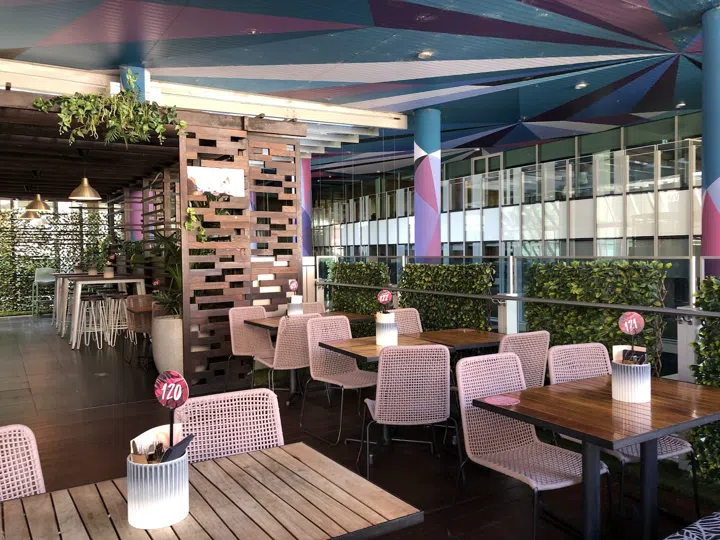
Cartagena has a hard ceiling in the one place you most want to be above. Inside the walls, building heights are tightly controlled. This is a protected historic centre, and nobody is adding a ninth floor to a seventeenth-century merchant's house. So the rooftops in the Centro Histórico sit where the old roofline sits: two, three, occasionally four storeys up, close enough to hear a horse cart on the stone below and to watch a woman on the corner stack her mangoes into a pyramid.
Bocagrande, the thin spit of hotels and apartment towers across the bay, has no such ceiling. That is where the altitude race is being run, and where the fifty-first-floor benchmark came from. Height and view do not scale together. Above roughly the twentieth floor, Cartagena stops being a city and becomes a map of itself: pretty, abstract, silent, and oddly far from the thing you crossed an ocean to stand in. The sweet spot is lower than the marketing suggests, six to a dozen storeys, high enough to clear the roofline, low enough that the cathedral dome still has weight and you can read the walls as masonry rather than as a line.
So the useful way to choose is not by floor count but by which of three things you want: the whole geography in one turn, a specific landmark squarely in frame, or a dinner that happens to be served in the sky. The six places below cover all three, and they differ from one another more than most rooftop clusters do.
The rooftop that explains the whole city
Alyzia Rooftop & Dining by Movich Hotels (walled city) is the one I send people to first, and specifically on their first evening, because it does something none of the others manage: one slow turn on the terrace gives you the old town's tiled roofs and belfries, the bay, and the Bocagrande towers standing up out of the water like a borrowed skyline. Everything else in Cartagena makes more sense afterwards. You stop asking where the sea is.
It was the plain Movich rooftop for years and still appears that way in older write-ups. It now trades as Alyzia Rooftop & Dining, so book under the new name. Non-guests are welcome, and the front desk sells a day pass if you want the pool rather than just the bar, worth knowing in March, when the stone city holds heat like a bread oven. The pool closes at 8pm; the bar carries on to 11pm.
The catch is space. The terrace is tight, and tight terraces at sunset in Cartagena mean one thing: reserve. A couple can sometimes slip in on a weekday. Four or more arriving at 5.45pm without a booking will be standing by the lift, drink in hand, watching other people have the view. Prices sit at the mid-to-upper end of the walled city, which is to say you are paying for the roof, as you are everywhere here.
Two terraces inside the walls
Townhouse Rooftop (walled city) is the young, photogenic end of the rivalry, and its real distinction is the hours. It opens at 8am, which turns a rooftop from a one-hour sunset errand into a place you can use properly: coffee and eggs above the street at nine, when the light is clean and the lanes are still being swept, then back up at midnight for the last one. That breakfast slot is the most underrated rooftop hour in the city, and it costs nothing to sit in.

Access for non-guests requires a reservation, and on weekends the terms are explicit: parties of two to ten, with a deposit of USD 10 per person. That is a fair, legible system and I would rather have it than a vague door policy. But ten is a hard ceiling. If you are twelve, you are not getting on this roof as one group, whatever you are told on arrival, so plan around it rather than hoping. Pricing is mid-range, the friendliest on this list after Mirador.
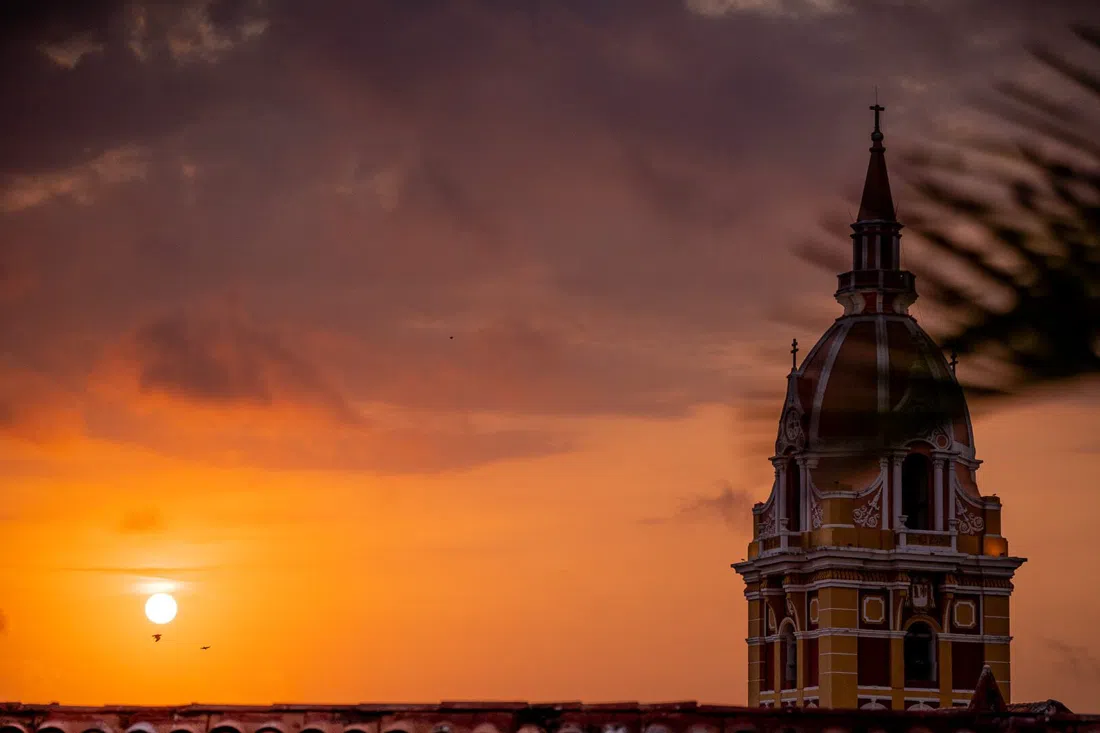
Mirador Culture Bar (walled city, within sight of the Clock Tower) is the one that owns a landmark. Every rooftop here claims a view; this is the only one that puts the Torre del Reloj squarely in frame, the yellow gate every arriving visitor walks through, seen from above as the hinge between the old city and Getsemaní. It is now Mirador Culture Bar, not the Mirador Gastro Bar still printed in guides written three years ago, so search the current name or you will be told it has closed.
It is also the late one: the rooftop runs from noon to 3am. It openly courts groups and private celebrations, takes event bookings by WhatsApp and through its reservations page, and has the Claustrum club downstairs to absorb a party that outgrows a terrace at 1am. Prices are reasonable by walled-city standards. All of which tells you who it suits: a birthday, a stag-ish night, eight people who intend to keep going. It is not where you take someone on a quiet second date.
When the dinner should outrank the view
Mar y Zielo (walled city, in Casa La Escribana) is the cooking-first entry, and the only one here where I would judge the kitchen before the panorama. Caribbean seafood run through Peruvian technique, served as the cathedral goes gold. Cocina de autor pricing, and worth it if you are eating properly rather than grazing between cocktails. The house is a multi-level old mansion; the rooftop terrace itself is small, which is both its charm and its logistical problem.
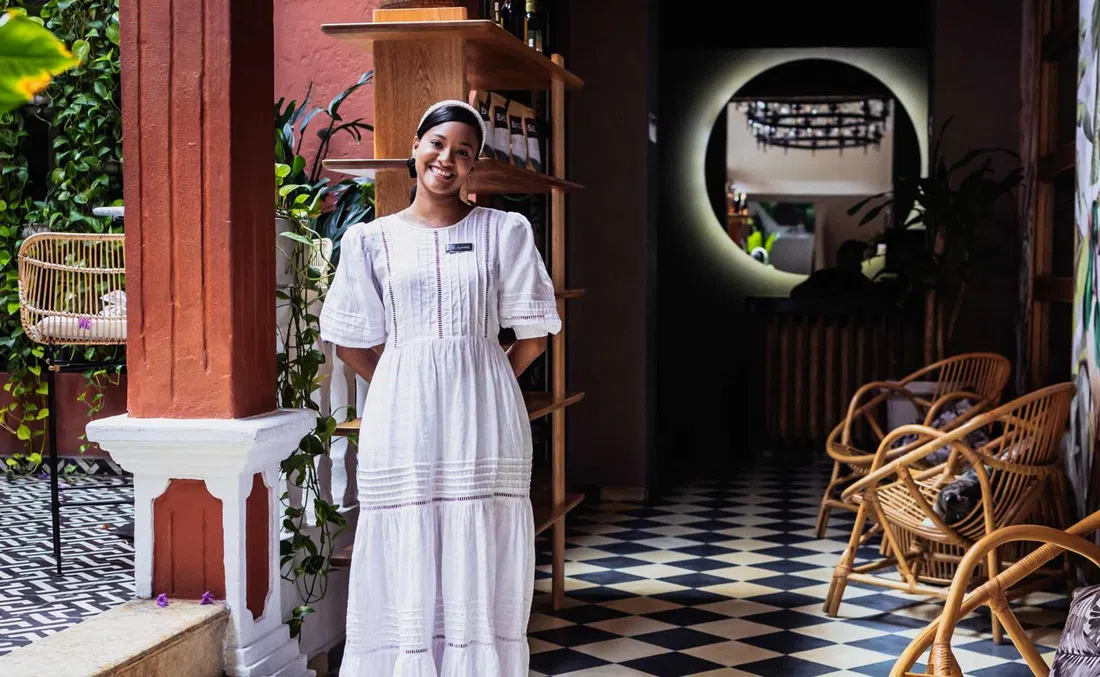
Book the terrace specifically, by name, and book early. A table at Mar y Zielo is not the same as a table on the roof of Mar y Zielo, and sunset slots up there are the first thing to go. Groups get seated downstairs, which is a perfectly good dinner but an entirely different evening. Treat this as a two-to-four proposition and go for the food.
Buena Vida Marisquería y Rooftop (walled city) solves the problem every other place on this list has, which is capacity. Three floors give it real room, and it is comfortably the easiest walled-city rooftop for a group that wants to sit down and eat rather than stand holding a glass. The seafood is very good, there is live saxophone and there are DJ sets, and the mood is loose without tipping into a club.

One hard constraint: the rooftop runs 2pm to 10:30pm. That makes it a late-afternoon and sunset venue, not a late one. Arrive at six, eat through the colour change, and accept that you will be going somewhere else at half ten. Reserve for the top floor explicitly; the lower floors are busy and the staff will seat you there by default if the booking does not say otherwise.
Bocagrande from a lower, warmer altitude
7 Cielos Rooftop Gastrobar (Bocagrande) is the useful counterweight to the tower bars on its own peninsula. It faces the bay, it sits low enough to feel like a room rather than an observation deck, and it is far easier to get a table at than anything with a fifty-first floor. The trade is obvious and I think it favours you: less altitude, more evening. Warm light, conversation at normal volume, the water close enough to matter.
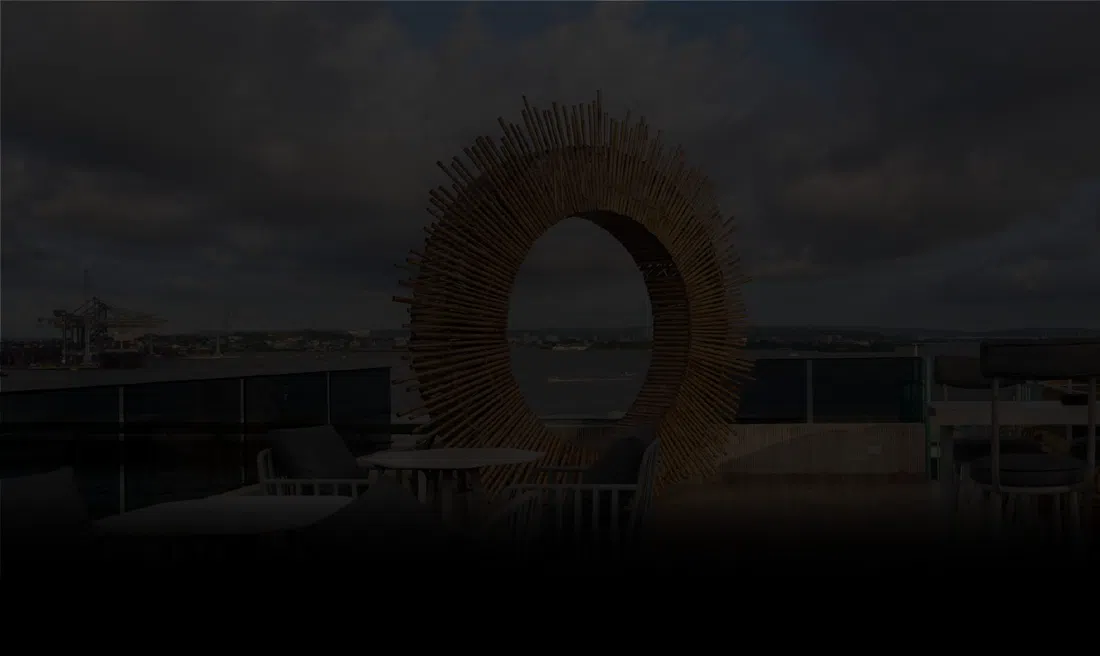
Hours are 5pm to midnight, extending to 1am on Friday and Saturday. It takes private events and groups, and books through OpenTable or WhatsApp, which makes it one of the two straightforward group bookings on this list alongside Buena Vida. Pricing is mid-to-upper. If you are staying in Bocagrande, and plenty of people are, because that is where the beach hotels sit, this is your local, and it saves you a taxi each way at the exact hour every taxi in the city is busy.
Who gets in and who gets turned away
Cartagena's rooftops are a reservation culture now, and pretending otherwise is how good evenings go wrong. Four of the six take or require bookings for the sunset hour; the two that will most likely absorb a walk-in are Mirador, by volume, and 7 Cielos, by virtue of being across the bay. Alyzia, Townhouse, Mar y Zielo's terrace and Buena Vida's top floor should all be booked in advance, and the smaller the terrace the earlier you need to do it.
Group size is the real filter. Townhouse caps at ten with a per-person deposit. Alyzia and Mar y Zielo have small terraces and will quietly route a large party elsewhere. Buena Vida and 7 Cielos are built for groups, and Mirador wants them. If you are more than ten people, start with those three and work backwards rather than arriving at a tight terrace to negotiate.
When you book anywhere here, ask whether a deposit or minimum spend applies to your group. Townhouse publishes its terms, others settle it over WhatsApp, and it is a two-message conversation that prevents an argument later. Dress is not formal at any of them, but linen and closed shoes have never been refused anywhere in this city, and arriving straight off the sand in swimwear is the one look these roofs quietly dislike.
One evening, built properly
If you only have a single night for this, do it in two stops rather than three. Go up at Alyzia for the geography lesson while there is still light on the walls, then walk ten minutes through the lanes (the old city is small, and the walk between any two of these addresses inside the walls is the best part of the night) and eat at Mar y Zielo or Buena Vida depending on whether you are two people or eight. If the evening still has legs at half ten, Mirador is the only one of the six that will still be serving at two in the morning.
If you have two nights, give the second one to Bocagrande: 7 Cielos at six, with the walled city lit up across the water looking exactly like the galleon everyone compares it to. Seeing the old town from outside, after a day inside it, is the closest this city comes to a magic trick. For where to base yourself between the two, the Cartagena hotel search is the practical starting point. Staying inside the walls buys you walkable rooftops; staying in Bocagrande buys you the beach and a taxi habit.
Practical notes before you go up
Everything inside the walls is a walk, and after dark the Centro is pleasant and busy. Bocagrande is roughly ten to fifteen minutes by taxi from the Clock Tower outside rush hour, longer at 6pm. Taxis here are commonly unmetered, so agree the fare before you get in, or use a ride app so the number is fixed in advance. Coming home at 2am from Mirador, get the venue to call you a car rather than flagging one on a side street.
Prices are in Colombian pesos, and all six of these venues take cards. Carry pesos anyway, in small notes, for taxis, the fruit seller and the tip. Bills often arrive with a voluntary 10 percent service line. You are asked, and you can decline, though for table service on a roof it is normal to leave it. Change dollars to pesos properly rather than paying in dollars at a bad house rate.
Being near the equator, Cartagena's sunset barely moves: roughly 5.40pm in December, closer to 6.30pm around midsummer. Arrive 45 to 60 minutes before it, which is also when the terraces fill. September to November brings short heavy rain that usually clears within the hour. Rooftops here have covered sections, but a downpour will shut a terrace temporarily, so have a second address in mind. December to February is dry and genuinely windy; a breezy roof in January is the most comfortable seat in the city.
On budget, Mirador and Townhouse are the mid-priced pair and the easiest on a long trip. Alyzia, 7 Cielos, Buena Vida and Mar y Zielo run mid-to-upper, with Mar y Zielo the most expensive by some distance because it is a serious restaurant rather than a bar with a kitchen. A sensible plan is one upper-end dinner and two mid-priced drink stops, not three expensive roofs in a row; the views do not get three times better. For context on the rest of the city, including what sits below all these terraces, the Cartagena guide covers the ground.
The towers will keep going up, somebody will open higher than fifty-one floors, and it will be photographed relentlessly. But the view that stays with people is the one from three storeys up, at the moment the street lamps come on below and the stone goes the colour of a peach, close enough that you can still hear the city you are looking at.
Questions
Do I need a reservation for Cartagena's rooftop bars?
For the sunset hour, yes, at most of them. Townhouse Rooftop requires a reservation for non-guests and takes a USD 10 per person deposit on weekends. Alyzia, the rooftop terrace at Mar y Zielo and the top floor at Buena Vida are all small, so book ahead. Mirador Culture Bar and 7 Cielos are the two most likely to take a walk-in.
Which Cartagena rooftop bars actually work for a group?
Buena Vida Marisquería y Rooftop has three floors and is the easiest walled-city rooftop for a group that wants to eat; reserve the top floor specifically. Mirador Culture Bar takes groups and private celebrations, and has the Claustrum club downstairs for late nights. 7 Cielos in Bocagrande books private events through OpenTable or WhatsApp. Townhouse caps groups at ten people, and the terraces at Alyzia and Mar y Zielo are too small for a large party.
Can non-guests use the rooftop pool at Alyzia?
Yes. The front desk sells a day pass for the pool, and the rooftop is open to non-guests. The pool closes at 8pm while the bar runs until 11pm, so an afternoon swim followed by sunset drinks is the obvious way to use it. The terrace is tight, so book if you are more than two.
What time is sunset in Cartagena, and when should I arrive?
Sunset sits close to 6pm all year, about 5.40pm in December and nearer 6.30pm around midsummer. Arrive 45 to 60 minutes earlier, for the light and because that is when the terraces fill. Buena Vida's rooftop closes at 10.30pm, so it is a sunset venue rather than a late one.
Is it better to drink in the walled city or in Bocagrande?
The walled city puts you on low terraces close to the roofline, with landmarks like the Clock Tower in frame and everything in walking distance. Bocagrande trades that for height and the view back across the bay, where the old town reads as one lit object. 7 Cielos is the sensible Bocagrande choice because it sits lower, feels warmer and is far easier to get a table at than the tower bars.
First published on cartagenaguides.com, the Cartagena guide.