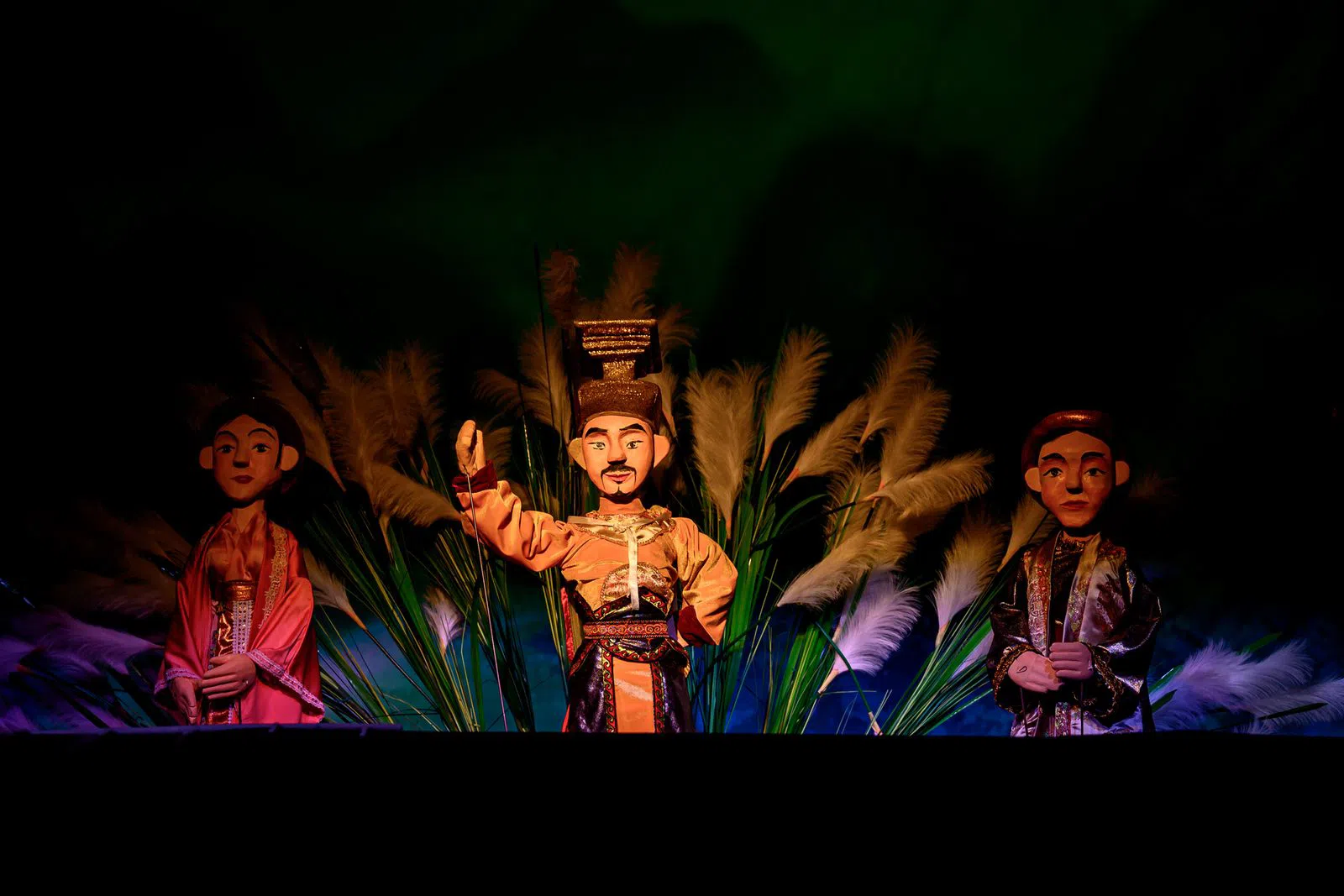
A dragon comes up out of a metre of green water, close enough to spit sparks at the front row, then drops back in a sheet of spray. Behind the bamboo screen, people are standing in that water up to their hips, working three-metre rods whose ends they cannot see. Múa rối nước was invented in flooded rice fields, and in Hanoi you can still watch it in one, or in a theatre by the lake that runs seven shows a day, every day of the year.
What the water is hiding
Water puppetry has no stage floor. The stage is a pool, waist to chest deep, and the performers stand in it behind a split-bamboo screen hung under the roof of a thủy đình, the small water pavilion copied from the ones built out in village ponds. Every puppet is driven from below and behind, on long bamboo rods and cords that run under the surface. What you see is a lacquered wooden figure moving with nothing visibly attached to it: a duck paddling off, a boy climbing onto a buffalo, a fish that turns into a dragon and lifts its whole body clear of the water.
The water hides the mechanism, carries puppets that can run to several kilos, and turns every entrance and exit into a splash. That is why the form never moved onto dry land, and why it stayed in the Red River Delta: when the fields around Hanoi go under in summer, a flooded paddy or a village pond is the one flat, communal surface a village has, and the audience stands on the bank.
The repertoire is village work rather than court work. Fishermen argue over a catch, a girl herds ducks until a fox takes one, farmers plough, children race buffalo, the golden turtle hands back the sword in the lake you can walk around before the show. Holding it together is chú Tễu, the bare-bellied clown who introduces each scene and gets mocked for his trouble, plus the band at the side of the pool: chèo singers, đàn nhị fiddles, a moon lute, drum and wooden clapper, doing all the voices. Nobody addresses the audience in English and it does not matter. The vignettes are two to four minutes long, they are named on the programme sheet, and a six-year-old follows them without help.
The lakeside theatre that never goes dark
Thang Long Water Puppet Theatre (Nhà hát Múa rối Thăng Long), on the eastern side of Hoàn Kiếm lake in the Old Quarter, is the anchor and, for most visitors, the only realistic option. It is the only theatre in Asia that stages water puppetry 365 days a year: seven shows a day Monday to Saturday, eight on Sunday, fifty minutes each, roughly seventeen vignettes, no interval. Seats run 100,000 to 200,000 VND (about US$4 to 8) by tier, and there is a 20,000 VND surcharge if you intend to photograph or film. Pay it at the desk, in cash, before you sit down; the ushers do check.
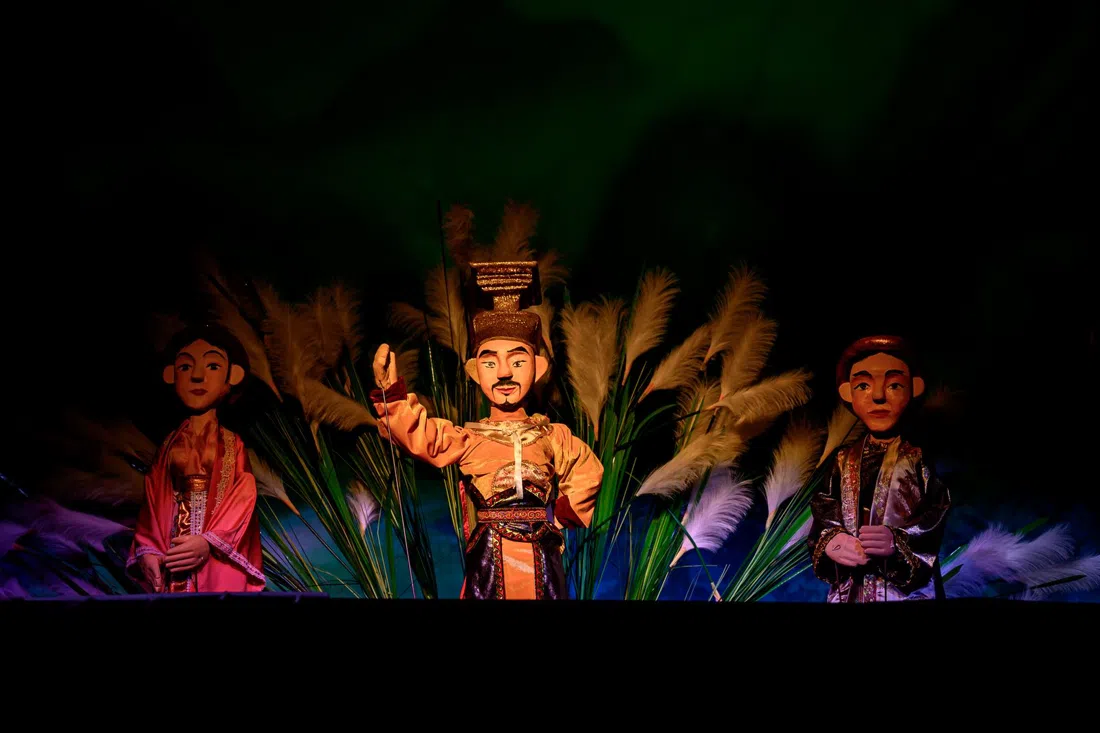
The theatre was built for groups and it is run like it. Tour operators block-book the 18:30 and 20:00 slots, and the house charters whole private performances for a single coach party, so the evening timetable is effectively wholesale. For a Saturday evening or a Sunday afternoon, buy two to three days ahead. Midweek, outside those two evening slots, you can usually walk up an hour before and get a seat.
If you have any flexibility, take an early-afternoon slot. The room is the most heavily touristed fifty minutes in Hanoi, and at 18:30 that shows: late arrivals climbing over rows, phones held up for the full show, a flat wall of flash at the dragon finale. At 15:00 on a Tuesday the same company plays to half a house and you can hear the rods knock against the pool wall. The seat tiers are essentially rows, so pay the top tier and sit centre: the pool is wide and low, and from the far side seats you lose whatever is working the back corners.
The puppeteers are unaffected by any of this. They spend whole shifts in water, and the control on the solo figures (the fish, the fox, Tễu's head turns) holds up whoever is sitting in front of it.
When the lakeside theatre is full
Lotus Water Puppet (Múa rối nước Bông Sen), a short walk around the same lake in Hoàn Kiếm, is the obvious fallback, and on price per seat it is the better buy: 80,000 VND standard, 100,000 VND for the VIP rows, which is US$3 to 4 either way. Shows run at 16:00, 17:15 and 18:30 depending on the day, with the Thursday and Sunday timetables the fullest.
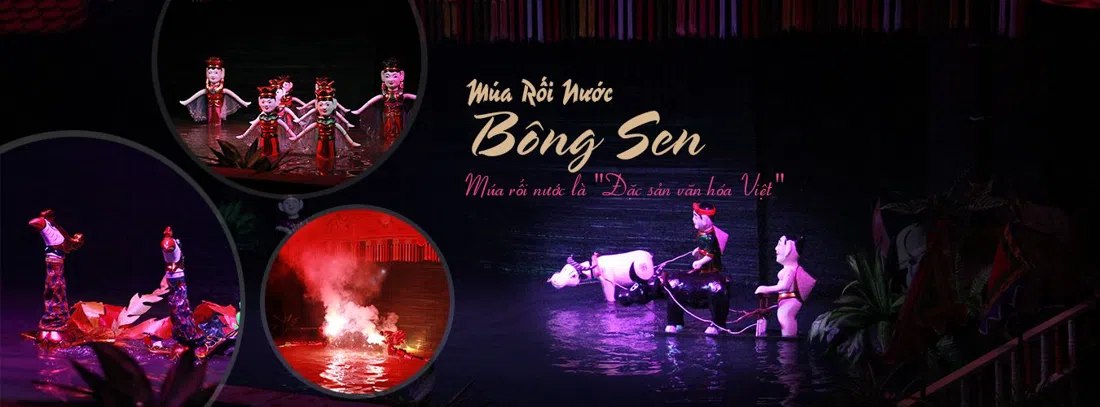
The room is smaller than Thang Long's, which cuts both ways. You sit closer to the water, you hear the puppeteers' cues through the screen, and it feels less like a scheduled product. You also get less of a stage picture in the big group scenes, and there is no spare capacity, so a party of more than about ten should book direct with the theatre rather than through an online ticket agent.
The weak point is the door. Lotus sells heavily through online resellers with hotel ticket delivery, and collection at the venue is slow: reviews repeatedly report a queue and a confused desk at five minutes to curtain. Arrive twenty minutes early with your booking reference on screen, not in a folder of emails, and the problem disappears.
The national company out on Trường Chinh
Vietnam National Puppetry Theatre (Nhà hát Múa rối Việt Nam) sits out on Trường Chinh in Thanh Xuân, fifteen to thirty minutes by taxi from the lake depending on traffic. This is the national company, the deepest bench of artists in the country, and it has an open-air water stage, which no central venue can offer. The traditional water puppet programme is 150,000 VND; package rates exist by contract.
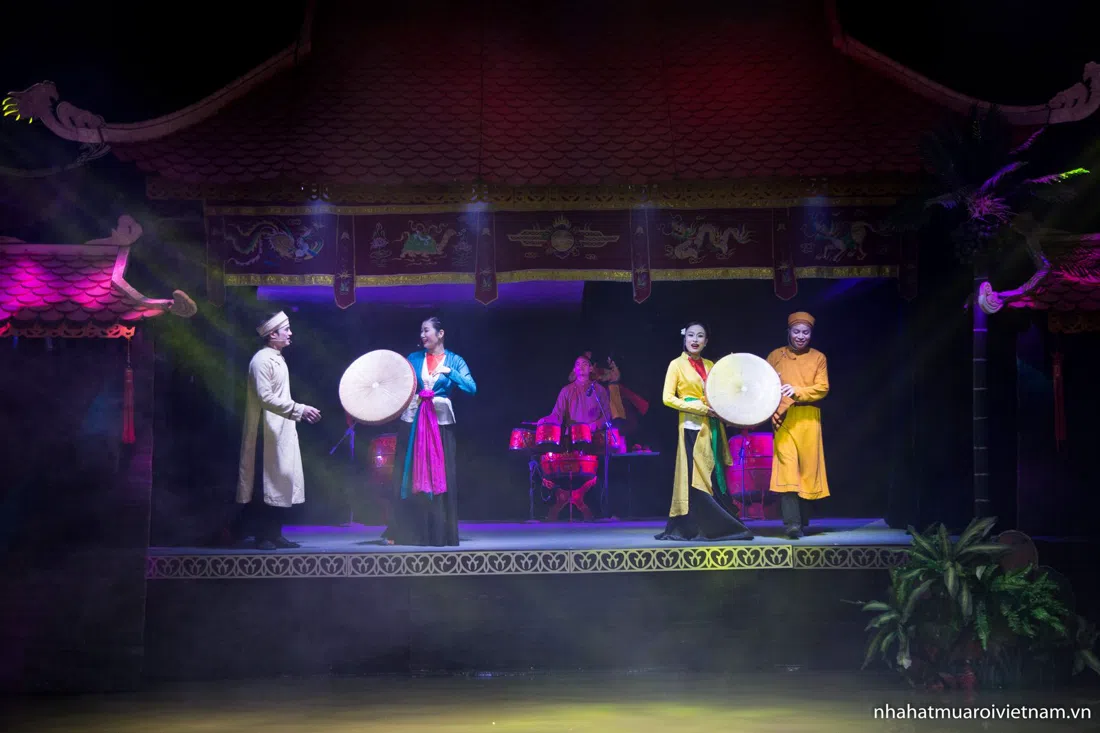
The catch is structural. Most of the repertoire (Âm vang đồng quê, Cảm xúc Long Thành, Thế giới Thần tiên) is sold theo hợp đồng, meaning as a block booking to schools, companies and tour operators. The public schedule is thin outside holidays and the thirty-day Mùa hội Múa rối Trường Chinh season. A single traveller who turns up on a random Wednesday afternoon may find nothing scheduled at all, and nobody will have warned them.
So treat this one as a phone call, not a walk-in. For a group of twenty or more, or a school, it is the strongest programme available to you and the staff are set up for exactly that conversation. For two people, ring or email before you commit to the taxi, and ask specifically whether the water programme is on the public schedule that week.
A real flooded field after dark
Tinh Hoa Bắc Bộ (Quintessence of Tonkin) at Baara Land, out west of the city in Quốc Oai, is not a puppet theatre and should not be booked as one. It is an outdoor night spectacle staged on a genuinely flooded field, with farmers standing in the water, and it runs Wednesday, Saturday and Sunday only, 19:30 to 20:45.
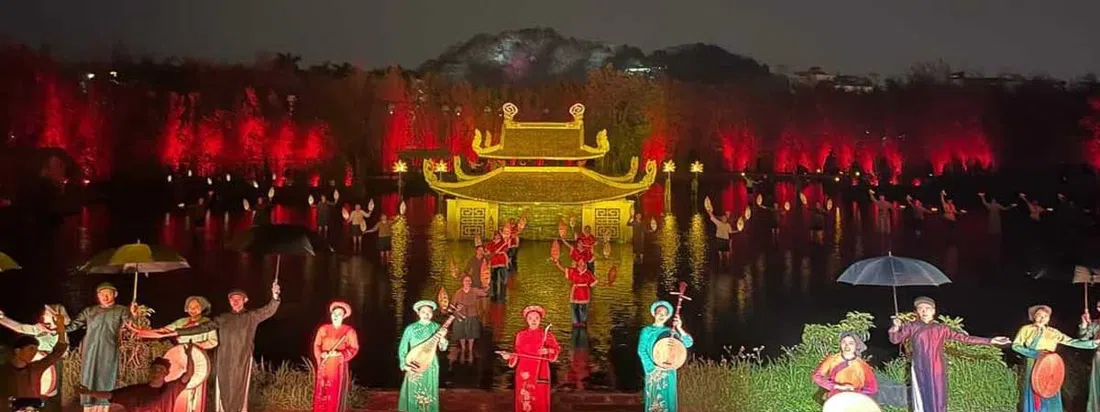
It earns its place here because it is the only thing within reach of Hanoi that shows you water puppetry's actual habitat. Watch a lit paddy at night, with the water surface as the stage and people working waist-deep in it, and the fifty minutes you spent in the Hoàn Kiếm theatre make sense as a village technology moved indoors. Go here second, not first.
Tickets are 450,000 to 1,200,000 VND per person across three seating tiers, with Wednesday the cheapest night, and at present four adult tickets come with a Northern-style set dinner included. It was purpose-built for coach groups: wide tiers, long access paths, big arrival flows. Dress for mosquitoes, long sleeves and repellent, because you are sitting beside standing water for 75 minutes. And pre-book your car in both directions; a field in Quốc Oai at 20:45 is not a place to start looking for a ride.
The puppets back inside the royal city
Imperial Citadel of Thăng Long (Hoàng thành Thăng Long), the UNESCO site in Ba Đình, runs a free water puppet programme at lunar new year, staged inside a recreation of a Later Lê court Tết. In 2026 it played across the Tết period with shows at 9:30, 10:30, 11:30, 15:00 and 16:00 on the second to sixth days of the lunar new year. The performances cost nothing; you pay only citadel admission, currently around 30,000 to 100,000 VND under the revised tariff, with under-15s free.
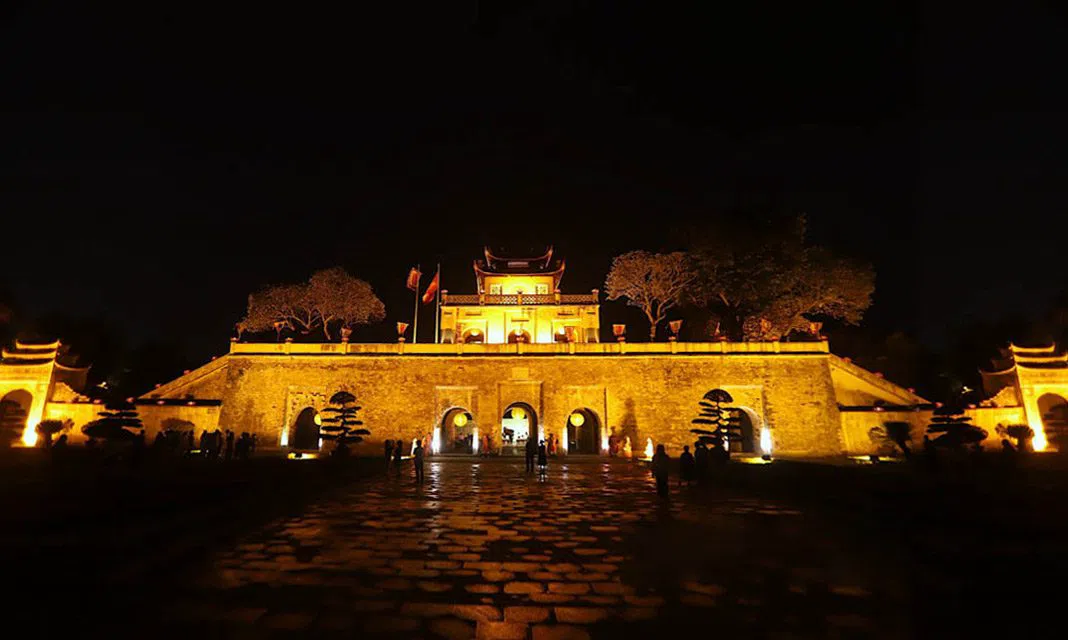
Historically it is the most interesting staging of the five, because the court took this form from the villages rather than inventing it, and the citadel is where that transfer happened. Practically, it is a seasonal programme and nothing more. Do not build a trip around it. If you are in Hanoi over Tết, check the heritage centre's published calendar: the dates and times shift each year with the lunar calendar, and the programme is confirmed late.
Which one to book
First visit, two people, one free evening: Thang Long, early afternoon or the 17:00-ish slot rather than 18:30. Sold out, or watching the budget: Lotus, twenty minutes early at the door. A coach party, a school or a corporate group of thirty-plus: charter Thang Long, or contract the national company out on Trường Chinh, which is a better programme if your dates are flexible. Second visit, or you care about where the form comes from: the flooded-field spectacle on a Wednesday, when it is cheapest. In Hanoi over Tết: the citadel, for free.
With young children, the fifty-minute no-interval format at either lake theatre works well, and the 16:00 and 17:15 starts work better still. The field show ends at 20:45 an hour from the centre, which does not.
Getting there, paying and timing
Both lake theatres are walkable from anywhere in the Old Quarter or around Hoàn Kiếm. From Friday evening until Sunday night the streets ringing the lake are closed to traffic, so a taxi or ride-hailing car will drop you a couple of blocks out: add ten minutes on a weekend. For Quốc Oai, budget around an hour each way and 500,000 to 800,000 VND for a return car with the driver waiting. There is no useful public alternative at that hour.
Bring Vietnamese đồng in small notes. The 20,000 VND camera surcharge, door extras and most ticket-desk transactions are cash, and the desks are not interested in splitting a 500,000 VND note at the last minute. ATMs are dense around Hoàn Kiếm and scarce out at Baara Land.
On timing: two to three days ahead for a weekend evening at Thang Long; twenty minutes early at the Lotus door; a phone call before anything at the national theatre. The only periods when the whole city's programme widens are Tết and the Mùa hội Múa rối Trường Chinh season.
Two people in top-tier lakeside seats with the camera fee costs about 420,000 VND. The same couple at Lotus: 200,000 VND. The same couple at the flooded-field show on a Wednesday, lowest tier, plus the car: roughly 1,400,000 to 1,700,000 VND all in, dinner included.
Staying in Hoàn Kiếm puts three of these five stages inside a fifteen-minute walk, which is the single biggest convenience you can buy here. Compare rooms and districts on the Hanoi hotel search, and see the Hanoi guide for what to do with the rest of the day before a 17:00 curtain.
Questions
How much does a water puppet show in Hanoi cost?
The lakeside theatre charges 100,000 to 200,000 VND depending on seat tier, plus 20,000 VND to use a camera. Lotus Water Puppet is 80,000 VND standard, 100,000 VND VIP. The Vietnam National Puppetry Theatre's traditional programme is 150,000 VND. The outdoor flooded-field show at Baara Land costs much more, 450,000 to 1,200,000 VND per person, and Wednesday is its cheapest night.
How far ahead do I need to book?
For Saturday evening or Sunday afternoon at Thang Long Water Puppet Theatre, buy two to three days ahead, because tour operators block-book the 18:30 and 20:00 slots. Midweek early-afternoon shows are usually available an hour before. For the national theatre on Trường Chinh, phone or email first: most of its repertoire is sold as block bookings, and some weeks nothing appears on the public schedule at all.
Is there a language barrier?
No. The chèo musicians sing and speak all the parts in Vietnamese, but the vignettes are two to four minutes long, visual, and listed by name on the programme sheet. Nothing in the plot depends on following the words.
Does it work for young children?
Yes, and it is one of the few evening options in Hanoi that does. Shows at either lake theatre run fifty minutes with no interval, and the 16:00 and 17:15 starts suit small children best. Skip the outdoor field show with under-eights: it finishes at 20:45, an hour's drive from the centre.
What is the difference between the theatre shows and the outdoor spectacle at Baara Land?
The theatre shows are water puppetry: lacquered puppets worked on submerged rods from behind a bamboo screen, in an indoor pool. Tinh Hoa Bắc Bộ is not a puppet show. It is a large outdoor night spectacle on a real flooded rice field, with live performers in the water. It explains where the art form came from, so it works best as a second visit rather than a substitute.
First published on hanoigetaways.com, the Hanoi guide.